

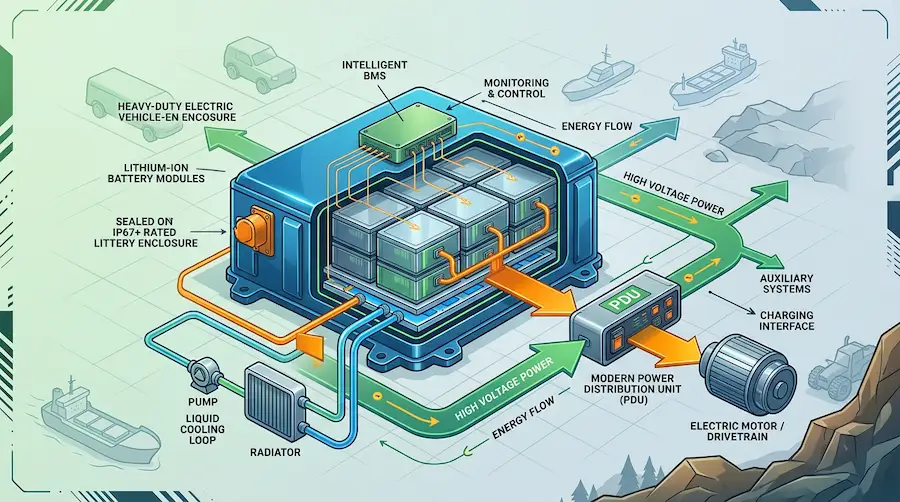
If you are an engineer working on commercial electrification, you already know that slapping a passenger car battery into a commercial truck is a recipe for disaster. Heavy-duty platforms require entirely different thermal, mechanical, and electrical architectures. In this guide, I will break down exactly what a heavy-duty EV battery system is and how to successfully integrate one into your next platform.
A heavy-duty EV battery system is a highly ruggedized, large-scale energy storage unit designed specifically for commercial vehicles, marine vessels, and off-highway equipment. It integrates raw lithium-ion modules with specialized IP67+ enclosures, precision liquid cold plates, intelligent battery management systems (BMS), and high-voltage power distribution units (PDUs) to deliver reliable power in extreme operating environments.
If you are struggling with the massive engineering headache of turning raw battery modules into a plug-and-play energy system, you are in the right place. Let’s dive into the technical anatomy of these systems and explore how to bridge the gap between cell chemistry and a customized vehicle.
What is an electric heavy-duty truck?
An electric heavy-duty truck is a commercial vehicle—typically Class 7 or Class 8—powered entirely by an electric drivetrain rather than a traditional internal combustion engine (ICE).
These are not your average daily commuters.
We are talking about massive machines designed to haul 80,000 pounds of cargo across vast distances, or rugged vocational trucks operating in demanding environments like construction sites and ports. Because of their immense size and the heavy continuous loads they carry, these trucks demand incredibly robust and energy-dense power sources to meet their intense operating profiles.
What are the purposes of the heavy-duty EV battery system?
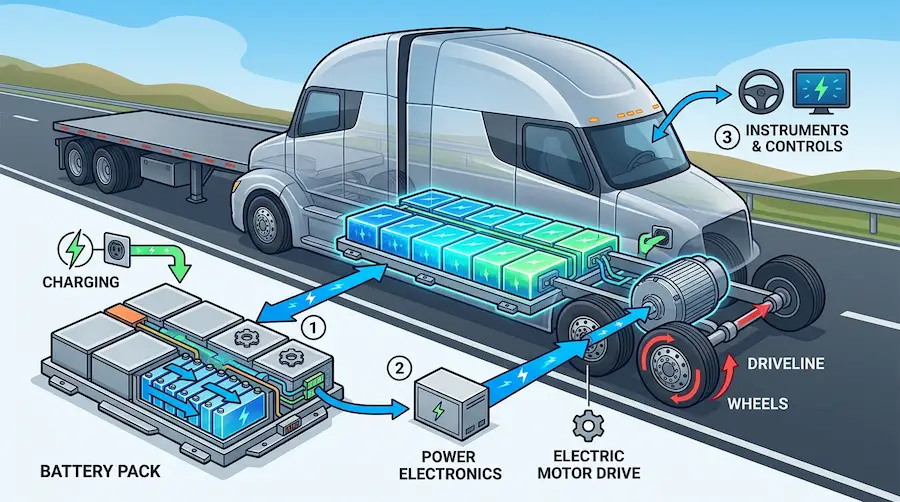
The primary purpose of a heavy-duty EV battery system is to provide safe, sustained, and massive energy output for commercial applications.
But it goes much deeper than just holding a charge.
These systems are engineered around the real requirements of the vehicle, vessel, or machine. Their purposes include:
Delivering High Continuous Power: Heavy-duty applications experience harsh duty cycles. The battery system must sustain high discharge rates without triggering thermal degradation.
Ensuring Extreme Durability: Heavy trucks have exceptionally high demands for battery pack durability. The system must survive relentless vibration, mechanical shock, and extreme weather.
Enabling Safe High-Voltage Integration: Commercial systems operate at high voltages (often 800V or more). The system’s purpose is to manage this safely via advanced PDUs and contactors.
Meeting Compliance and Homologation: A proper system guarantees that your vehicle meets rigorous global standards, such as UN38.3 and ECE R100.3.
How does the heavy-duty EV battery system work?
At its core, a heavy-duty EV battery system functions as a highly coordinated ecosystem. It is not just a box of batteries; it is a smart network of mechanical, thermal, electrical, and control elements.
Here is how the magic happens:
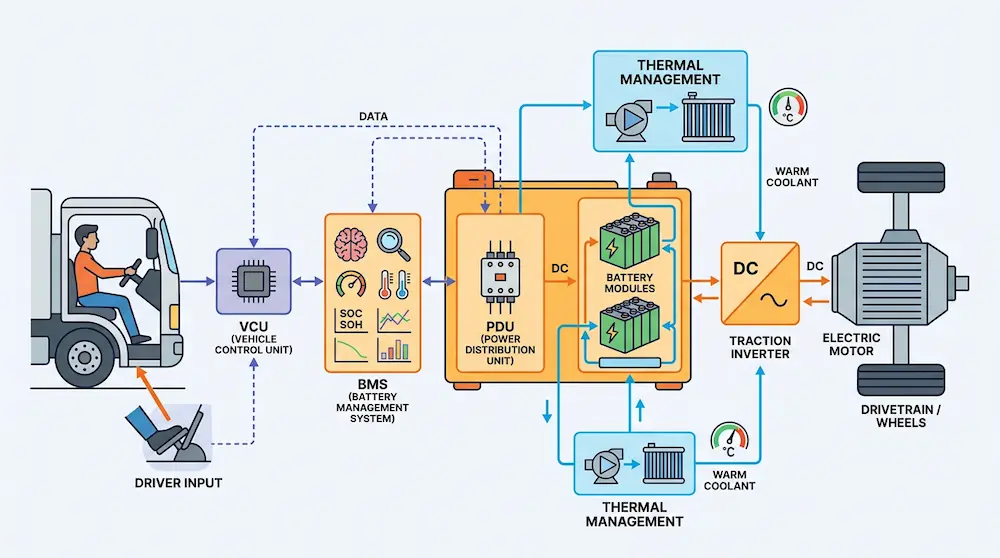
First, the Vehicle Control Unit (VCU) sends a torque request when the driver presses the accelerator.
The VCU communicates directly with the Battery Management System (BMS). The BMS is the brain of the operation. It constantly evaluates the state of charge (SOC), state of health (SOH), and the real-time temperature of the lithium-ion cells.
If the conditions are safe, the BMS signals the high-voltage contactors inside the Power Distribution Unit (PDU) to close. This allows direct current (DC) to flow from the battery modules to the traction inverter, which converts it to alternating current (AC) to drive the electric motor.
Simultaneously, the thermal management system springs into action. Discharging massive amounts of energy generates severe heat. The system actively pumps coolant through a liquid cold plate to absorb this thermal load, ensuring the lithium-ion cells remain within their optimal temperature window. This coordinated workflow prevents thermal runaway and maximizes the lifespan of your chemistry.
What does the heavy-duty EV battery system consist of?
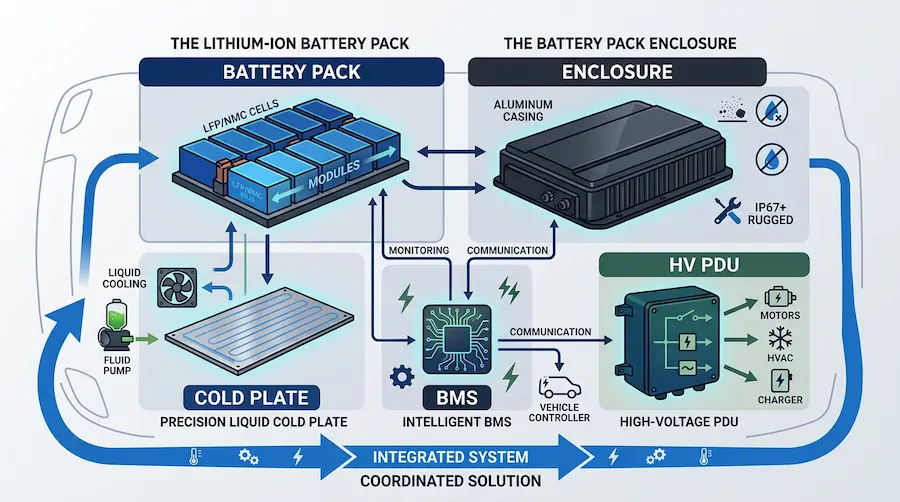
Battery projects often fail at the integration stage because mechanical, thermal, electrical, and control systems are not developed as one coordinated solution.
To build a reliable platform, your system must seamlessly integrate several critical components:
1. The Lithium-Ion Battery Pack (Cells & Modules)
This is the chemical heart of the system. Depending on your range and power needs, you might utilize LFP (Lithium Iron Phosphate) for maximum cycle life and safety, or NMC (Nickel Manganese Cobalt) for higher energy density. Our clients often leverage our “Bring Your Own Cells/Modules” model, negotiating directly with top cell manufacturers to secure raw modules at zero middleman markup.
2. The Battery Pack Enclosure
You cannot put standard plastic casing on a mining truck and expect it to survive. Heavy-duty applications require rugged IP67+ aluminum enclosures. These enclosures are often CNC-machined to ensure perfect sealing against dust, water, and debris, while also providing structural rigidity to protect against crashes and mechanical impacts.
3. Precision Liquid Cold Plate
Air cooling simply does not cut it for commercial EVs. Heavy-duty platforms require precision liquid cold plates. These are highly engineered metallic plates with internal micro-channels. A water-glycol mixture is pumped through these channels, absorbing heat directly from the bottom or sides of the battery modules. This keeps the temperature delta between cells minimal, which is critical for long-term battery health.
4. Intelligent BMS (Battery Management System)
An intelligent BMS architecture does more than just balance voltages . It handles advanced thermal runaway prediction, contactor control, high-voltage interlock loop (HVIL) monitoring, and seamless CAN bus communication with the vehicle’s VCU.
5. High-Voltage PDU
The High-Voltage Power Distribution Unit (PDU) acts as the electrical switchboard. It houses the main contactors, pre-charge circuits, and fuses, ensuring that high-voltage power is distributed safely to the motors, HVAC systems, and on-board chargers.
What are the benefits of the heavy-duty EV battery system?
When engineered correctly, the benefits of electrifying heavy-duty fleets are game-changing.
Massive Reductions in TCO: Electric drivetrains have significantly fewer moving parts than diesel engines. Over a 10-year lifespan, the savings on diesel fuel and mechanical maintenance (like oil changes and transmission rebuilds) drastically lower the Total Cost of Ownership.
Instantaneous Torque: Heavy-duty trucks require immense torque to get an 80,000-pound load moving from a standstill. An electric motor delivers 100% of its peak torque at zero RPM, drastically improving drivability and gradeability.
Zero Tailpipe Emissions: With tightening global emissions regulations, a robust battery system ensures your fleet remains compliant while hitting corporate sustainability goals.
Deployment-Ready Reliability: By partnering with an engineering-driven integrator, you can bring battery-powered platforms into operation with greater confidence and much shorter development cycles .
What are the disadvantages of the heavy-duty EV battery system?
I will be totally transparent with you—electrifying heavy-duty platforms is not easy. It comes with significant hurdles.
The Customization Gap: This is the biggest hidden trap. Tier-1 cell manufacturers are built for massive standard volume, and they often reject deep customization for off-highway, marine, or specialized commercial fleets. They sell you raw modules but leave you with a massive engineering headache. How do you cool them? How do you make them talk to your vehicle?
Weight Penalty: Lithium-ion battery packs are incredibly heavy. In a commercial truck, every pound of battery is a pound subtracted from your payload capacity.
Upfront Costs: The initial capital expenditure (CAPEX) for heavy-duty battery systems is high.
Charging Infrastructure: Megawatt-level fast charging is required to keep heavy trucks moving without long downtimes, and this infrastructure is still in its infancy globally.
Pro tip: If you want to overcome the customization gap, it might be a good choice to find an engineering-first integrator who can transform procured raw modules into a rugged, fully certified, plug-and-play energy system 8.
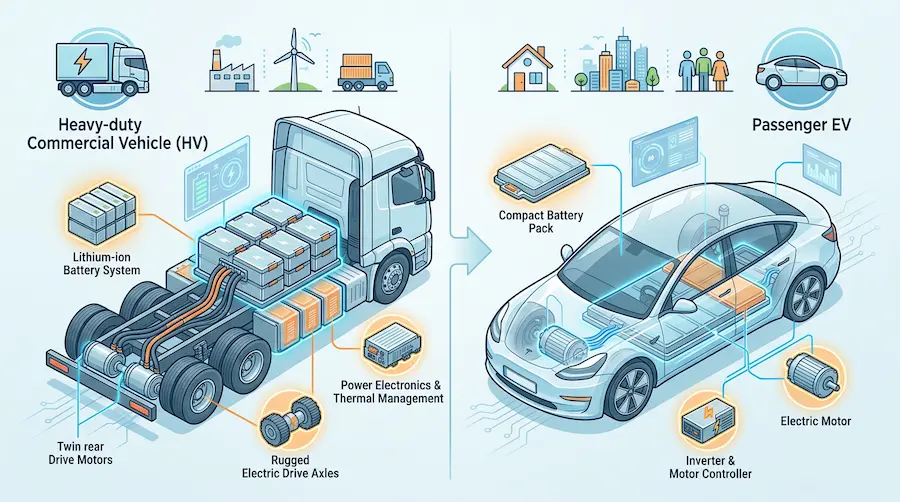
What are the differences between Electric Heavy-duty Truck and Passenger EV?
It is tempting to think of an electric heavy-duty truck as just a scaled-up Tesla.
Do not make that mistake. The engineering requirements are vastly different.
Durability and Lifecycle
EV passenger car manufacturers require high-precision battery pack systems, but they are dealing with predictable, light-duty cycles. Furthermore, European and emerging market passenger brands often outsource certain components simply to reduce costs.
Heavy trucks, on the other hand, have intense demands for battery pack durability, specialized liquid cooling, and complex high-voltage integration. A passenger car might run for an hour a day; a heavy-duty truck might run 18 hours a day under extreme mechanical vibration.
Thermal Management
Passenger cars can sometimes get away with simpler cooling architectures. In commercial applications, sustained high-C continuous discharge rates require incredibly precise thermal simulations and advanced liquid cooling integration.
Supply Chain Realities
If you are building passenger cars in the millions, cell giants will design a pack for you. But if you are building specialized commercial fleets, off-highway vehicles, or marine vessels, cell manufacturers will not give you bespoke engineering. You need a turnkey integration partner that leverages a specialized supply chain to build application-driven engineering around your real platform constraints.
What are the applications for the heavy-duty EV battery system?
Our mission is to make battery system integration more practical, more reliable, and more deployment-ready for demanding real-world applications.
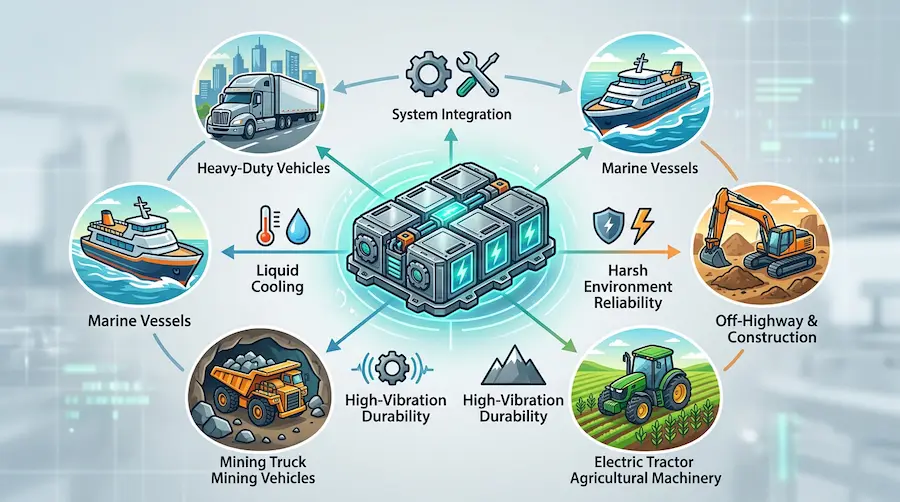
Here are the primary sectors actively deploying these rugged systems:
Heavy-Duty Vehicle Manufacturers
From Class 8 semi-trucks to specialized refuse collection vehicles, these OEMs need turnkey integration across mechanical, thermal, electrical, and control systems.
Marine Vessel Builders and Integrators
Electric boats and ferries have stringent requirements for waterproofing, liquid cooling, and system integration. The marine sector, particularly in Europe, is experiencing rapid growth, demanding highly reliable IP67+ systems.
Off-Highway and Construction Equipment OEMs
Excavators and wheel loaders operate in incredibly harsh, dusty, and high-vibration environments. They require customized battery packs engineered around tight packaging constraints and demanding operational profiles.
Electric Agricultural Machinery
The market for electric tractors and agricultural machinery is rapidly emerging. These platforms have a strong need for customized battery packs and liquid cooling systems designed for high-torque, slow-speed continuous operation.
Battery Electric Mining Vehicles
Mining vehicles demand the highest tier of engineering. They require highly reliable, heavy-duty battery systems that can handle extreme shock and, in some cases, must be explosion-proof.
Conclusion
Electrifying a heavy-duty platform is one of the toughest engineering challenges in the modern mobility space. Buying raw lithium-ion modules is the easy part. The real battle is enclosure engineering, thermal management, HV architecture, intelligent controls, and commissioning.
Projects typically fail when these elements are treated as isolated parts rather than one coordinated workflow.
If you are a Chief Engineer, or Program Manager staring down a complex electrification roadmap, you do not have to tackle the integration risk alone.
At Astraion Dynamics, we are the ultimate “Bring Your Own Cells / Modules” integration hub for heavy-duty, marine, and off-highway applications. We let you control the chemistry, while we master the engineering. From initial 3D design and thermal simulation to flawless UN38.3 / ECE R100.3 homologation and global logistics, we bridge the gap between raw cell chemistry and your customized vehicle.
Ready to shorten your development cycle and bring your battery-powered platform into operation with total confidence?
Contact our engineering team today, and let’s define your system architecture.
