

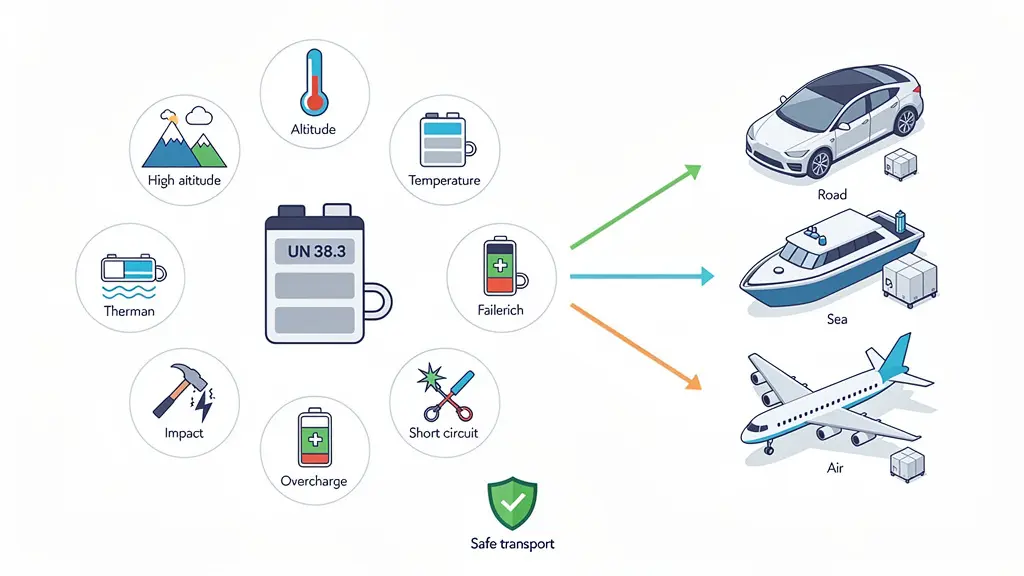
Are you getting ready to ship your new EV or marine battery pack across the globe, but worried about it getting held up at customs? You’re in the right place. In this guide, I’ll walk you through exactly what UN38.3 testing is, what it takes to pass, and why it’s absolutely critical for getting your electric vehicle platform off the ground.
UN 38.3 is an internationally recognized safety standard created by the United Nations for the safe transportation of lithium-ion and lithium-metal batteries. It consists of eight rigorous testing procedures (T1 through T8) that simulate extreme environmental, mechanical, and electrical conditions. These tests ensure that battery packs can withstand high altitude, thermal shocks, vibration, and short circuits without posing a fire or explosion risk during air, sea, rail, or road transit.
Keep reading. Getting a heavy-duty battery pack certified isn’t just a regulatory box to check; it’s a massive engineering challenge. Below, I’ll break down exactly what you need to know to navigate these requirements, avoid costly delays, and get your deployment-ready power systems to market faster.
What is the UN 38.3 test for lithium batteries?
Here’s the deal: lithium-ion batteries pack a massive punch. Thanks to their high energy density, they are the heartbeat of everything from electric passenger cars to heavy-duty mining trucks . But that same energy density makes them incredibly dangerous if they are damaged, poorly assembled, or subjected to extreme stress.
Because of the potential fire hazard, international transport authorities classify lithium batteries as Class 9 dangerous goods.
To mitigate these risks, the United Nations established Section 38.3 of the UN Manual of Tests and Criteria . Simply put, the UN 38.3 test is a globally adopted protocol that subjects batteries to the absolute worst-case scenarios they might face during transportation. Whether you are shipping raw battery modules from a Tier-1 supplier or a fully integrated 800V liquid-cooled pack for an electric ferry, they must pass this standard to be legally transported.

What is the UN 38.3 battery test report?
When people ask for the “UN 38.3 test report,” they usually think it’s just one simple certificate.
It’s not.
If you are handing off a high-voltage EV battery pack to a freight forwarder, airline, or maritime shipping line, you actually need a specific triad of documents to clear customs and ensure safe handling. If any of these are missing, your shipment isn’t going anywhere.
Here is exactly what makes up the comprehensive UN 38.3 documentation package:
-
MATERIAL SAFETY DATA SHEET (MSDS)
The MSDS (also referred to globally as the Safety Data Sheet, or SDS) has nothing to do with the physical drop tests or vibration data. Instead, it is the ultimate cheat sheet for the chemical and material hazards inside your battery pack.
Because lithium-ion batteries contain highly reactive transition metal oxides and flammable liquid electrolytes, logistics providers and first responders need to know exactly what they are dealing with if a thermal runaway event occurs. The MSDS outlines the exact chemical composition of the cells, toxicological information, proper handling procedures, and explicit emergency firefighting measures.

-
UN38.3 Test Report
This is the heavy-duty, highly technical engineering document issued by the accredited testing laboratory.
The UN38.3 Test Report contains the raw, granular data from all eight tests (T1 through T8). It details the exact testing parameters, the calibration data of the laboratory equipment used, the specific mass and voltage of your tested packs, and the minute-by-minute behavioral data of the battery during extreme stress.

Because this document is often 30 to 50 pages long and contains sensitive intellectual property (IP) regarding your pack’s design and cell architecture, you generally keep this between your engineering team, the lab, and strict regulatory bodies.
-
UN38.3 Test Summary
If the Test Report is for your engineers, the Test Summary is the golden ticket for your supply chain.
Since January 1, 2020, international shipping regulations have mandated the use of the UN38.3 Test Summary. Carriers and customs officials don’t have the time (or the right) to comb through your proprietary engineering data. Instead, the Test Summary acts as a standardized, condensed executive document.
It strips away your trade secrets but clearly lists the manufacturer details, the lab information, a description of the battery (watt-hours, weight, lithium content), and a simple checklist confirming that the pack successfully passed all required T1-T8 tests. This is the exact document your procurement lead and logistics manager must have on file to book cargo your supply chain network.

What are the requirements for UN38.3?
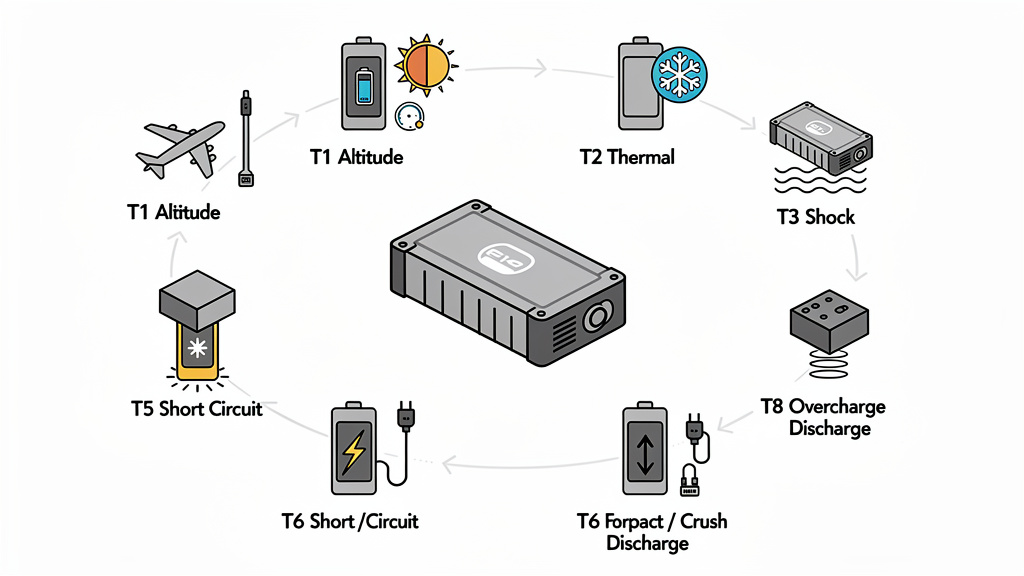
To get that certificate, your battery pack has to survive a brutal gauntlet. There are eight mandatory tests (T1 to T8), and they are not forgiving. Tests T1 through T5 are conducted sequentially on the exact same battery samples.
Here is what your battery pack will be subjected to:
T1: Altitude Simulation
This simulates the low atmospheric pressure of an unpressurized cargo hold in an aircraft . The pack is stored at 11.6 kPa (simulating 15,000 meters altitude) for over 6 hours. To pass, there can be no leaks, no venting, no ruptures, and certainly no fires.
T2: Thermal Test
If your EV battery pack has a flawed thermal management system, it will fail here. The pack is subjected to extreme temperature swings, going from +72°C down to -40°C for multiple cycles. This tests the integrity of your seals and internal components.
T3: Vibration
Transporting a massive marine battery pack on a truck or a ship involves constant vibration. This test simulates that reality using a sine sweep from 7Hz to 200Hz over 3 hours across three different axes.
T4: Shock
Imagine your battery pack being dropped or slamming against a loading dock. The shock test simulates this with a Half-Sine pulse (up to 50G for large packs) hitting the battery in six different directions.
T5: External Short Circuit
The lab will intentionally apply a short circuit across the battery terminals while the pack is heated to +55°C. The battery must handle this safely—meaning the case temperature can’t exceed +170°C, and it cannot rupture or catch fire within 6 hours . (This is where a high-quality High-Voltage Power Distribution Unit (PDU) and smart contactors save the day).
T6: Impact / Crush
This test is generally strictly for the primary and secondary cells rather than the whole massive pack. It simulates a heavy mass dropping onto the cell to ensure it doesn’t violently explode .
T7: Overcharge
For secondary (rechargeable) batteries like those used in EVs, the lab will push the charging current to twice the manufacturer’s recommended limit for 24 hours. Intelligent Battery Management Systems (BMS) are absolutely vital here to cut off the current and prevent thermal runaway.
T8: Forced Discharge
Also primarily for cells, this simulates a forced discharge condition to ensure the chemistry remains stable when drained beyond normal operating limits.
What’s the estimated lead-time for the UN 38.3 certification?
If you are scrambling to meet a launch deadline, pay close attention to this.
For standard consumer electronics batteries, labs often quote a fast-track processing time of 2–3 weeks.
However, if you are an engineering manager developing a heavy-duty 100kWh+ battery pack for an electric mining truck or an off-highway vehicle, you should bake more time into your schedule. Moving heavy freight to the testing facility, setting up the custom harnesses, and running through 10 thermal cycles (which take dozens of hours each) means you should realistically budget 3 to 4 weeks for the testing phase alone.
What’s the estimated testing service fee for the UN 38.3 certification?
Pricing is rarely a flat rate. The cost is highly dependent on your battery type, the number of distinct models you are testing, and the overall complexity of the laboratory setup.
For a small e-bike battery, testing might cost a few thousand dollars. But if you are an engineer developing massive, customized liquid-cooled packs for electric agricultural machinery, testing fees can easily range from US$750 to US$2,400 or more per model. Every time you change the fundamental architecture or cell chemistry, you have to pay for a new round of testing.
What is the validity period of UN38.3 certification?
Technically, there is no set expiration date for a UN 38.3 certificate.
Your certificate remains perfectly valid as long as the battery’s core design, cell chemistry, materials, and capacity remain completely unchanged.
But here is where things get tricky in the real world of global logistics. You might find that your freight forwarder or airline suddenly demands a document that is “less than 2 years old” or dated from the current year. Why?
Often, carriers want reassurance that regulatory classifications haven’t changed. Furthermore, if your batteries are passing through the People’s Republic of China, local authorities typically require annual verification that the battery still complies with the most recent amendment of the UN Manual.
Pro Tip: Have your integration partner or testing lab add a simple update column to your Test Summary sheet every year to keep customs officials happy.
How many battery packs do I need for the UN 38.3 certification?
You can’t just send one battery pack to the lab and call it a day.
Because tests T1 through T5 are conducted in sequence on the exact same samples, and T7 (Overcharge) requires separate samples, you must supply multiple units.
For large-scale EV or marine battery systems, testing labs typically require 2 to 4 complete, fully assembled battery packs, alongside a few dozen individual bare cells for the impact (T6) and forced discharge (T8) tests. This means you need to factor the cost of these prototype “sacrificial” packs into your R&D budget early on.
How to choose an agent to do the UN 38.3 Certification?
If you want to clear global customs without a hitch, you cannot use a sub-par testing facility.
When selecting an agent, look for laboratories that are fully ISO 17025 accredited. Accredited labs guarantee that the results will be globally accepted.
But here is an even better approach: don’t just hire a testing lab; hire an engineering integration partner who manages the certification for you.

At Astraion Dynamics, we are a turnkey integration partner for heavy-duty, marine, and off-highway battery systems. We don’t just build the pack; we take full responsibility for the homologation process. From initial 3D design to flawless UN38.3 and ECE R100.3 certification, we bridge the gap between raw cell chemistry and your customized vehicle. This significantly reduces your integration risk and shortens your development cycle.
How to pass the UN 38.3 Certification for EV Battery Packs?
Passing UN 38.3 isn’t about getting lucky. And it’s definitely not just about buying high-quality cells from a Tier-1 manufacturer.
Tier-1 suppliers are built for massive standard volumes. They will gladly sell you raw modules, but they leave you with a massive engineering headache. How do you cool them? How do you package them safely to survive a 50G shock?
Here is exactly how you engineer a heavy-duty pack to pass the rigorous UN 38.3 standards.
1. The Key: Cross-Disciplinary Coordination
Here is the hard truth. You can have the safest lithium-ion cells in the world, but if your mechanical team, electrical team, supply chain, and testing lab aren’t perfectly synced, you will fail.
Coordination is the absolute key to passing UN 38.3.
Why? Because UN 38.3 is a system-level test. Your Battery Management System (BMS) engineers need to know the exact thermal limits of the mechanical enclosure. Your mechanical engineers need to design around the high-voltage cable routing. And your compliance manager needs to coordinate with the ISO 17025 accredited lab months in advance to ensure the custom test harnesses and thermal chambers are prepared.
A siloed engineering approach almost always results in a failed T2 (Thermal) or T5 (External Short Circuit) test. Flawless coordination between chemistry, hardware, software, and testing facilities is what gets you to the finish line.

2. Ruggedized Enclosure Engineering
To survive the T3 (Vibration) and T4 (Shock) tests, your battery enclosure must be incredibly rigid.
We utilize CNC-machined, IP67+ rated aluminum enclosures designed specifically around your real-world platform constraints. This highly coordinated mechanical design ensures that whether the pack is dropped on a loading dock or vibrating inside a heavy-duty mining truck, the internal modules do not shift, arc, or rupture upon impact.
3. Precision Thermal Management
The T2 Thermal test will destroy batteries that can’t handle extreme temperature swings (from +72°C down to -40°C).
High-performance EVs and commercial electric vessels require integrated liquid cooling. By coordinating the mechanical enclosure design with precision liquid cold plates and advanced fluid dynamics, you ensure heat is dissipated evenly across the modules. This prevents the localized hot spots that trigger catastrophic thermal runaway.
4. Intelligent BMS and High-Voltage Integration
To pass the T5 (External Short Circuit) and T7 (Overcharge) tests, your electrical architecture must be foolproof.
Your BMS needs advanced algorithms to instantly cut the high-voltage contactors the millisecond an overcurrent or overvoltage event is detected. Combined with a robust, custom-engineered high-voltage Power Distribution Unit (PDU), this ensures the battery gracefully shuts down rather than catching fire.
Why is it necessary for the UN 38.3 Certification for EV Battery Packs?
It’s simple: without UN 38.3 testing and approval, your battery packs are legally grounded.
If you attempt to ship EV battery packs without this certification, you face severe consequences:
Shipment Rejections: Airlines and maritime freight forwarders will flat-out refuse to load your cargo .
Customs Seizures: Goods can be indefinitely held or confiscated at the port of entry.
Supply Chain Collapse: If you are a Purchasing Manager or Strategic Sourcing Lead, a stopped shipment means your production line grinds to a halt, costing your company millions.
Safety Hazards: Uncertified batteries are a massive liability. If a pack causes a fire incident during transit, the legal and reputational damage to your OEM brand could be fatal.
Getting certified gives you compliance confidence, smooth customs clearance, and total global market access.
Conclusion
The UN 38.3 test for lithium batteries is the ultimate gatekeeper for global electrification. From altitude simulation and thermal shocks to severe vibration and overcharging, these tests guarantee that your energy storage systems are robust enough for the real world.
But passing these tests requires far more than just buying good lithium cells. It requires meticulous enclosure engineering, advanced liquid thermal management, and intelligent high-voltage controls.
If you are leading an electrification startup, managing a fleet transition, or integrating systems for marine and off-highway applications, you don’t have to tackle this massive engineering and compliance headache alone. By partnering with a dedicated integration hub, you can control your chemistry while letting the experts master the engineering.
Ready to bring a reliable, UN 38.3-compliant energy solution to market faster? Make sure your integration strategy is as robust as the batteries you’re trying to ship.
