

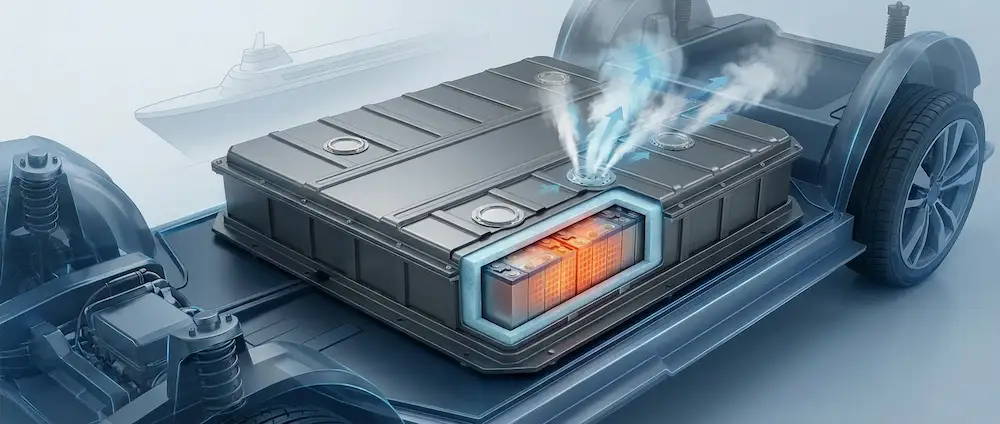
If you’re engineering a heavy-duty electric vehicle (EV), a marine vessel, or an industrial platform, thermal runaway is likely your biggest nightmare. In this guide, I’ll walk you through exactly what causes it, the warning signs, and the advanced engineering methods we use to prevent it. Let’s dive in.
Thermal runaway is an uncontrollable, self-heating state in a lithium-ion battery. It occurs when temperatures rise rapidly, triggering a chain reaction of chemical breakdowns within the cell. This releases flammable gases and immense heat, ultimately leading to fire or explosion.
Understanding the science behind thermal runaway is just the first step. To truly protect your battery systems, you need to know how to engineer around it. Here is everything you need to know.
What Is Thermal Runaway in Simple Words?
Imagine a snowball rolling down a steep, snow-covered mountain.
As it rolls, it gets bigger and faster. Soon, it’s an unstoppable avalanche.
That is exactly what thermal runaway is, but with heat instead of snow.
In a lithium-ion battery, a single cell gets too hot due to a short circuit, overcharging, or physical damage. This heat causes the internal chemical components to break down. When they break down, they release even more heat.
This extra heat speeds up the chemical reactions, which releases even more heat. It becomes a vicious, unstoppable positive feedback loop. Within seconds, the cell temperature can spike from a normal 25°C to over 600°C.
When one cell goes into thermal runaway, it usually transfers that massive heat to the neighboring cells. This is called thermal propagation. If you don’t have the right thermal barriers in place, your entire battery pack will catch fire.
What Are Signs of Thermal Runaway?
Thermal runaway doesn’t just happen instantly without warning. If you have the right sensors and battery management system (BMS) in place, you can spot the warning signs before disaster strikes.
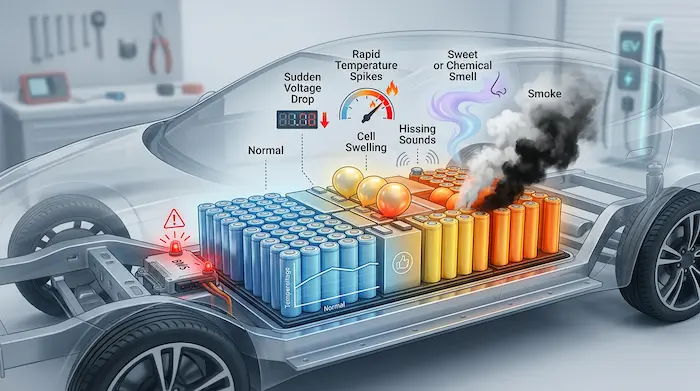
Here are the key indicators you should look out for:
Sudden Voltage Drop: Internal short circuits cause the cell voltage to plummet. A smart BMS will flag this anomaly immediately.
Rapid Temperature Spikes: If a cell’s temperature rises by more than 1°C per second, you are likely entering a runaway state.
Cell Swelling: As the internal electrolyte breaks down, it generates hydrocarbon gases. This causes pouch and prismatic cells to swell or “puff” up.
Hissing Sounds: Cylindrical and prismatic cells have safety vents. When the internal pressure gets too high, these vents burst open to release gas. This creates a distinct hissing or popping sound.
Sweet or Chemical Smell: The electrolyte in a lithium-ion battery has a distinct, sweet, and highly toxic chemical odor. If you smell this, the cell is venting.
Smoke: White or grey smoke means the electrolyte is vaporizing. Black smoke means carbon components are actively burning.
What Temperature Is Too Hot for a Lithium Battery?
This is a question I get all the time from vehicle integration engineers.
You need to differentiate between “too hot for optimal performance” and “too hot for safety.”
For standard lithium-ion chemistries like Nickel Manganese Cobalt (NMC), the ideal operating temperature is between 15°C and 35°C.
Once you push past 45°C, battery degradation accelerates. The cell will age faster, and its capacity will drop.
When temperatures hit 60°C to 70°C, you are in the danger zone. Most BMS architectures will trigger a critical thermal fault and disconnect the contactors to shut the system down.
At 90°C to 120°C, the solid electrolyte interphase (SEI) layer on the anode starts to break down. This is the first irreversible step toward thermal runaway. The battery is generating its own heat at this point.
Can LiFePO4 Batteries Have Thermal Runaway?
Yes, they can. But it is much, much harder to trigger.
Lithium Iron Phosphate (LiFePO4 or LFP) is widely considered the safest lithium-ion chemistry available on the market.
Why? Because the chemical bond between the iron, phosphorus, and oxygen in the cathode is incredibly strong.
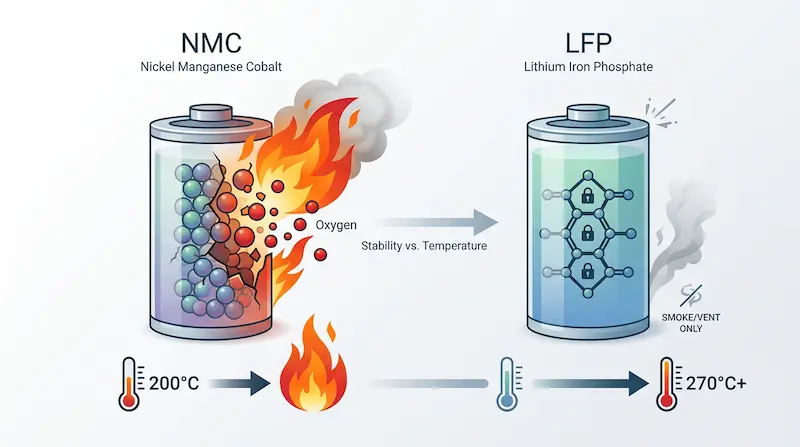
In an NMC battery, the cathode starts breaking down and releasing oxygen at around 200°C. That oxygen fuels the fire inside the sealed cell.
An LFP battery, on the other hand, doesn’t release oxygen until it reaches about 270°C to 300°C. Even when it does, the heat release rate is significantly lower.
An LFP cell in thermal runaway will typically smoke and vent violently, but it rarely produces the aggressive, self-sustaining flames that you see with NMC. This is why LFP is a massive favorite among off-highway and construction equipment OEMs.
At What Temperature Does a Lithium Battery Explode?
The exact “explosion” or violent venting temperature depends on the state of charge (SOC) and the specific cell chemistry.
A fully charged battery has far more reactive energy stored inside it than a depleted one.
For high-energy-density chemistries like NMC or NCA (Nickel Cobalt Aluminum):
130°C – 150°C: The plastic separator between the anode and cathode melts. This causes a massive internal short circuit.
150°C – 200°C: The cathode structure collapses and releases pure oxygen. Mixing this oxygen with the vaporized, flammable electrolyte creates an explosive mixture.
200°C+: The cell violently ruptures or explodes.
If your pack reaches this stage, you have failed at the integration level. Battery projects often fail at the integration stage—not because components are unavailable, but because mechanical, thermal, electrical, and control systems are not developed as one coordinated solution.
What Causes Thermal Runaway?
To stop a fire, you need to know how it starts. Thermal runaway triggers generally fall into four categories:
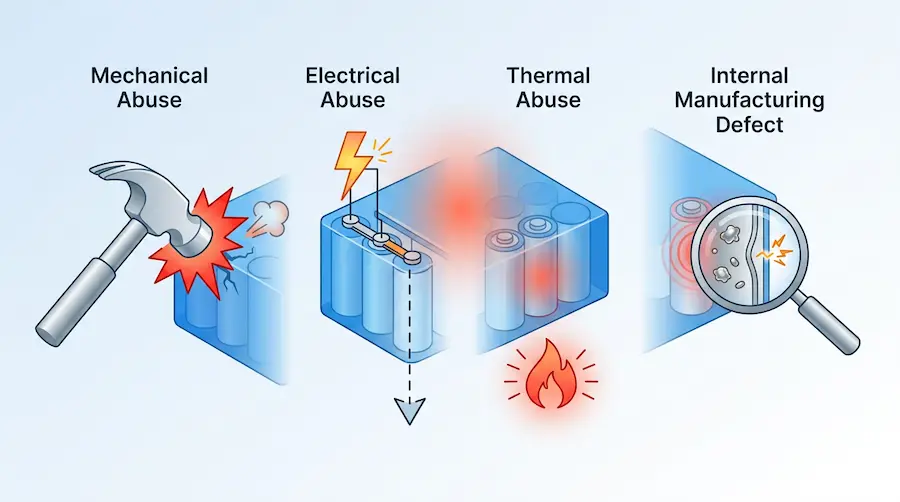
- Mechanical Abuse
This happens when the battery pack is crushed, punctured, or severely impacted. A high-speed vehicle crash or dropping a heavy tool on a bare module can physically tear the internal separator, causing an immediate short circuit.
- Electrical Abuse
Overcharging a cell past its maximum voltage limit causes lithium metal to plate onto the anode in sharp, needle-like structures called dendrites. These dendrites eventually pierce the separator and cause a short. Over-discharging can also dissolve the copper current collector, leading to shorts when the battery is recharged.
- Thermal Abuse
If the battery pack is exposed to external heat—like a vehicle engine fire or leaving the pack in a scorching environment without active cooling—the internal temperatures will cross the critical threshold.
- Internal Manufacturing Defects
Sometimes, the problem starts at the factory. Microscopic metal contaminants or poorly folded separators during cell manufacturing can cause latent internal short circuits that trigger months or years later.
This is why bridging the gap between raw cell chemistry and your customized vehicle is so critical. You can buy the best cells in the world, but if the integration is poor, you are exposed to extreme risk.
How to Avoid the Thermal Runaway of the Lithium Battery?
This is where the magic happens.
Tier-1 cell manufacturers are built for massive standard volume, often rejecting deep customization for off-highway, marine, or specialized commercial fleets. They sell you the raw modules, but they leave you with a massive engineering headache.
How do you cool them? How do you package them safely?
As an engineering-driven integration partner, here is exactly how we prevent thermal runaway at Astraion Dynamics.
Advanced Thermal Simulations
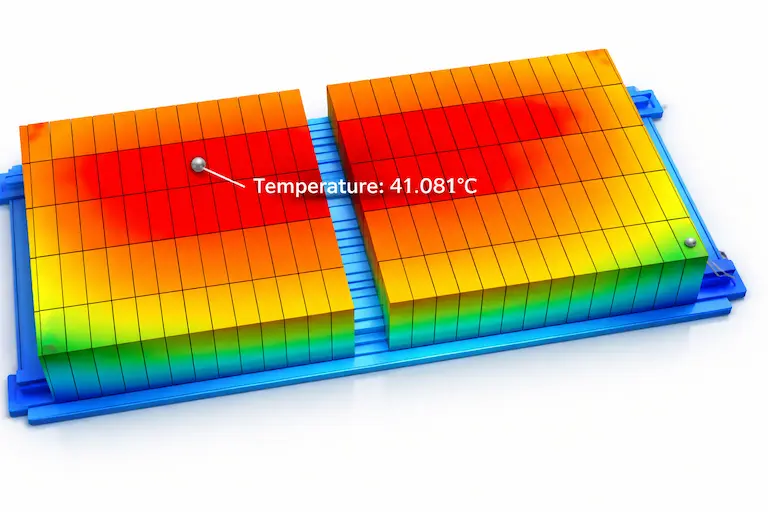
Before we cut a single piece of metal, we run extensive 3D Computational Fluid Dynamics (CFD) Simulations. We map exactly how heat will generate across the modules under peak load. We model the coolant pathways to ensure the temperature difference (delta T) between any two cells in the pack stays under 3°C. If you don’t simulate the thermal gradients, you are flying blind.
Strategic Material Selections
You cannot stop a single cell from failing 100% of the time. But you can stop it from spreading. Our Material Selections are critical. We use aerogel thermal barriers and specialized mica sheets between cell modules. These materials can withstand over 1000°C, acting as a firewall. We also use flame-retardant structural plastics (UL94 V-0 rated) to ensure the enclosure doesn’t contribute fuel to a fire.
Optimizing Coolant Flow Rate

Liquid cooling is non-negotiable for heavy-duty applications. But it’s not just about pumping water through a plate. You have to optimize the coolant flow rate. If the flow rate is too low, the fluid heats up before it reaches the end of the pack. If it’s too high, you create excessive pressure drops and drain power from the vehicle. We engineer the exact flow rate needed to pull maximum kilowatts of heat away from the cells during rapid charging.
Precision CNC Machining
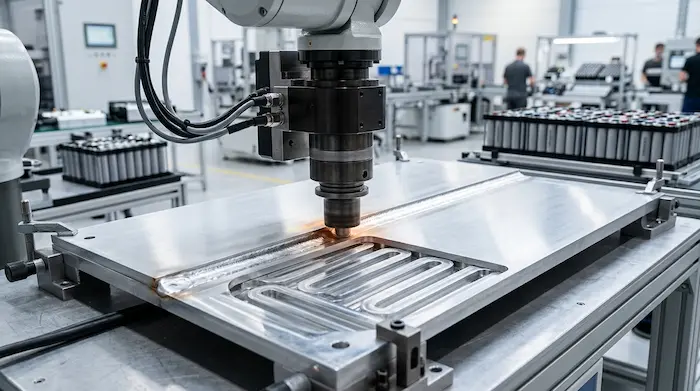
The gap between the bottom of your battery module and the liquid cold plate determines your cooling efficiency. To maximize heat transfer, you need an ultra-thin layer of Thermal Interface Material (TIM). But TIM only works if the surfaces are perfectly flat. We rely on high-precision CNC machining to create IP67+ aluminum enclosures and cold plates with near-perfect flatness tolerances. This guarantees flawless thermal contact.
Friction Welding for Cold Plates
Coolant leaks inside a high-voltage battery pack are a death sentence. To prevent this, we manufacture our liquid cold plates using Friction Stir Welding (FSW) or Friction Welding. Unlike traditional welding, which melts the metal and creates porous joints, FSW uses friction to soften and forge the metals together. This creates a monolithic, incredibly strong, and 100% leak-proof seal.
Rigorous End-of-Line Testing
You can’t just build a pack and hope it works. Manufacturing is executed by our strategic network of over 20 IATF-16949 certified partners, governed by resident QA engineers and 100% End-of-Line testing protocols.
Pressure Testing & Sealing Test: Before any modules go into an enclosure, the empty pack undergoes strict helium leak and air decay testing. This Pressure Testing and Sealing Test guarantees the IP67+ rating. If a pack can’t hold pressure, it will let moisture in, which can cause electrical shorts.
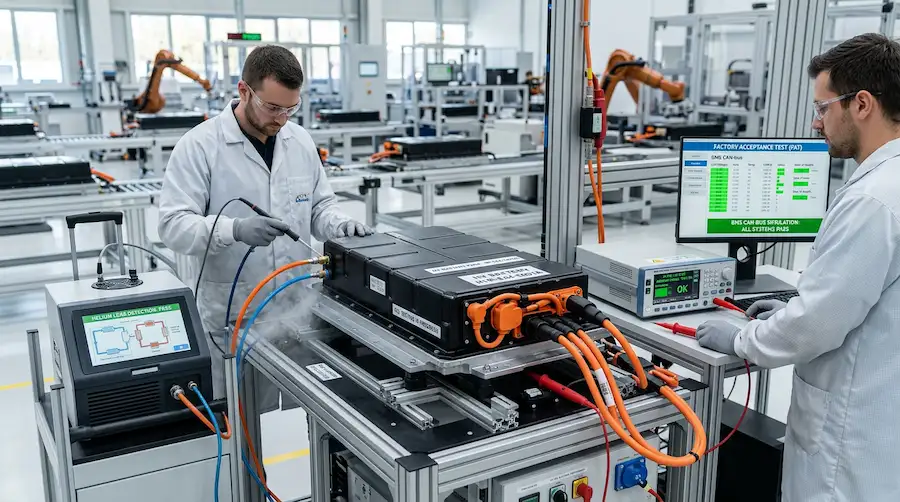
Thermal Shock Test: We subject the integrated systems to a brutal Thermal Shock Test. We rapidly cycle the pack from extreme freezing temperatures to scorching heat. This ensures that the expansion and contraction of different materials don’t crack the seals, break the welds, or compromise the thermal interface.
How Do You Stop Thermal Runaway in Batteries?
I’ll be blunt: once thermal runaway is in full swing, you can’t easily stop it.
You can’t just spray water on a lithium-ion fire and expect it to go out quickly. The chemical reaction is generating its own oxygen and heat.
Your goal isn’t to save the failing cell; your goal is to save the vehicle and the people inside it.
Here is how you manage and stop the propagation:
Directed Venting: When a cell vents explosive gas, you need to get that gas out of the pack immediately. We design enclosures with specialized pressure equalization valves and directed burst discs. This routes the 600°C gases away from the rest of the modules and safely outside the vehicle.
Active Immersion Cooling: In extreme performance applications, engineers are moving toward dielectric fluid immersion. Flooding the modules with non-conductive coolant can absorb massive amounts of heat instantly, quenching a runaway cell before it triggers the next one.
Massive Water Deluge: If a pack is fully ablaze, firefighters must use thousands of gallons of water. The goal is strictly to cool the surrounding intact cells below their critical temperature to break the thermal propagation chain.
Which Lithium Battery Is the Best Fit for the EV Battery Pack?
There is no single “best” battery. It entirely depends on your application, operating profile, and packaging constraints.
If you are a CEO or CTO of an early-stage electrification company, you need to match the chemistry to your business model.
For Passenger Cars & High-Performance EVs:
NMC (Nickel Manganese Cobalt) or NCA is the go-to. These chemistries offer incredible energy density. They give you the longest range in the smallest, lightest package. The trade-off is higher cost, lower cycle life, and a much stricter requirement for advanced thermal management. EV passenger car manufacturers require high-precision battery pack systems and liquid cooling integration to keep these safe.
For Heavy-Duty Trucks, Marine Veszels, & Off-Highway Equipment:
LFP (Lithium Iron Phosphate) is the absolute king here. Heavy trucks have high demands for battery pack durability, liquid cooling, and high-voltage integration. LFP is chemically stable, incredibly safe against thermal runaway, and can withstand thousands of daily charge cycles. They are bulkier and heavier, but in a mining truck or a marine vessel, safety and longevity far outweigh a slight weight penalty.
Electric boats and ferries have stringent requirements for waterproofing, liquid cooling, and system integration. For these applications, you want chemistry that won’t violently explode if things go wrong.
How to Choose the Lithium Battery?
Choosing the right battery chemistry, format (cylindrical, prismatic, pouch), and supplier is overwhelming.
But it shouldn’t be.
Our defining strength at Astraion Dynamics is our transparent “Bring Your Own Cells/Modules” partnership model.
You control the chemistry, we master the engineering.
You negotiate directly with top tier-1 cell manufacturers to secure raw modules at zero middleman markup. Then, you bring those raw cells to us.
We transform your procured raw modules into a rugged, fully certified, plug-and-play energy system, leveraging China’s vast specialized supply chain. We review the application, define the system architecture, and integrate the mechanical, thermal, electrical, and control elements.
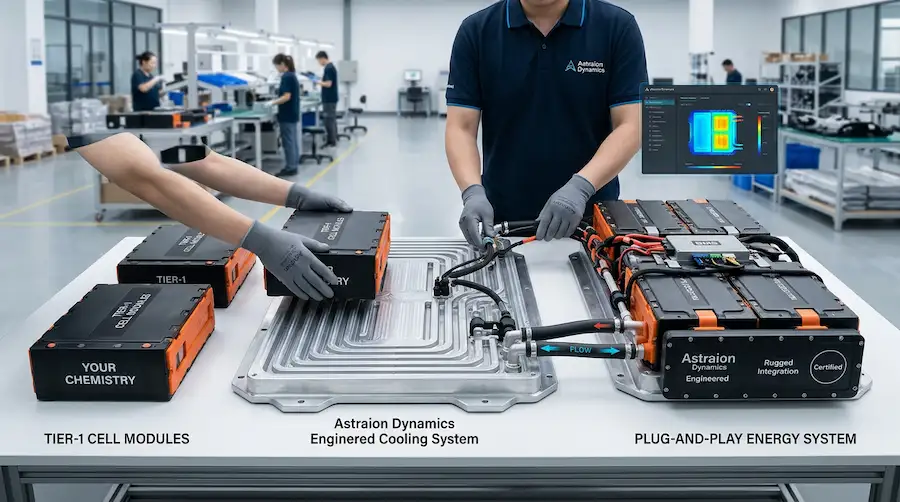
From initial 3D design and thermal simulation to flawless UN38.3 / ECE R100.3 homologation and global logistics, we bridge the gap.
Are you ready to build a reliable, safe, and deployment-ready battery system?
Whether you are an Engineering Manager, a Vehicle Integration Engineer, or a Purchasing Lead looking to outsource customized integration, we are here to help. Our role can range from focused subsystem support to full turnkey battery system delivery, depending on the project scope.
Stop risking your project’s success on fragmented suppliers. Let’s engineer a battery system that actually works in the real world. Contact Astraion Dynamics today to schedule a technical review of your platform constraints.
