

Let me guess. You’ve secured the perfect cell chemistry for your next electric vehicle platform, but now you are staring down the barrel of European homologation. I know the feeling. Bridging the gap between raw battery cells and a fully certified, road-legal energy system is one of the most brutal engineering challenges in the EV industry today.
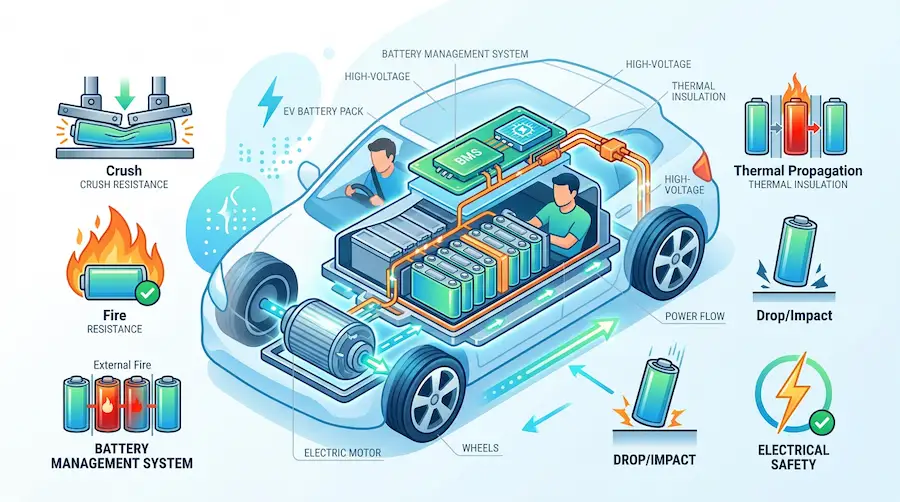
ECE R100.3 is a mandatory European safety regulation for rechargeable energy storage systems (REESS) used in electric vehicles. It mandates rigorous physical, electrical, and thermal tests—including crush, fire, and thermal propagation—to ensure lithium-ion battery packs are exceptionally safe for public roads.
Want to know exactly what it takes to get your battery pack through the lab and into production without burning through your R&D budget? Keep reading. I am going to break down everything you need to know about ECE R100.3 certification.
What is the ECE R100 regulation?
ECE R100 (specifically Revision 3) is a critical, legally binding European regulatory requirement for the approval of road electric vehicles.
At its core, it dictates all the safety tests that must be carried out on lithium-ion battery packs installed in 4-wheel electric vehicles (categories M and N). But it doesn’t just stop at passenger cars. The standards set by ECE R100 are so robust that they are increasingly used as the gold-standard baseline for heavy-duty trucks, off-highway equipment, and even electrical vessels.
The regulation is designed to establish globally harmonized safety standards, remove international trade barriers, and, most importantly, protect the public.
Why is it necessary for the ECE R100.3 Certification for EV Battery Packs?
If you want to sell an EV in the European Union, Japan, South Korea, and dozens of other participating countries, this certification isn’t optional. It’s mandatory.
But beyond the legal red tape, ECE R100.3 is necessary because electric vehicles introduce unique, high-stakes risks. We are talking about massive amounts of stored energy. If a battery system isn’t engineered correctly, you face catastrophic risks like thermal events following a crash, electrical faults from misuse, or critical failures due to component degradation.

Revision 3 (in force since 2022) is particularly focused on thermal propagation. If a single cell goes into thermal runaway, the regulation demands that the fire does not spread to the rest of the pack for at least 5 minutes, giving passengers enough time to evacuate.
Without this certification, your lithium-ion battery pack is essentially a liability. With it, you prove to authorities, OEMs, and end-users that your system is resilient, reliable, and safe.
What is the ECE R100 battery test?
The ECE R100 battery test is actually a gauntlet of extreme environmental, electrical, and mechanical abuse tests.
Think of it as putting your battery pack through the absolute worst-case scenarios a vehicle might encounter in its lifetime. If your battery pack enclosure, liquid cooling system, and BMS (Battery Management System) aren’t working in perfect coordination, the pack will fail.
What are the requirements for ECE R100.3?
Let’s get right to it. ECE R100 (specifically Part II for REESS—Rechargeable Electrical Energy Storage Systems) is not a simple checklist.
It is a grueling physical and electrical gauntlet. The regulators want to know one thing: if your EV or heavy-duty machinery encounters a worst-case scenario, will the occupants survive?
To prove that, your battery pack must survive 15 rigorous testing categories.
Instead of just giving you a massive, hard-to-read list, I’ve broken these requirements down into four logical engineering buckets. Here is exactly what your system will face in the lab:

1. Mechanical Abuse (The Smash & Shake)
Your enclosure and structural mounts will be pushed to their physical breaking points. The lab is looking for internal shorts, structural tearing, or loose high-voltage components.
Vibration Test: Simulates years of relentless road vibration to ensure your busbars and cell welds don’t fatigue and snap.
Mechanical Shock: A sudden, violent deceleration (often up to 28G) to mimic a high-speed vehicle collision.
Mechanical Integrity (Crush / Drop): A massive 100KN crushing force is applied to the pack. Your structural extrusion must absorb the kinetic energy before it reaches the cells.
2. Environmental & Thermal Stress (The Elements)
Your pack will be exposed to extreme temperatures and moisture to verify the integrity of your gaskets, IP ratings, and venting valves.
Thermal Shock & Cycling: Rapid transitions from freezing temperatures to extreme heat to test material expansion and contraction.
Water Immersion (IP Test): Usually an IP67-level test (1-meter submersion) to prove no water can ingress and cause high-voltage shorts.
Venting / Electrolyte Leakage: Verifying that if pressure builds, your pressure relief valves (PRV) safely vent gases without leaking highly flammable liquid electrolyte.
3. Electrical Safety & BMS Protection (The Brains)
This is where your Battery Management System (BMS) and Power Distribution Unit (PDU) earn their keep. They must automatically detect anomalies and sever the high-voltage circuit.
- External Short Circuit Protection: The system must safely interrupt a massive current spike caused by a dead short.
- Overcharge Protection: The BMS must physically stop the intake of energy before cells swell or catch fire.
- Over-discharge Protection: Preventing cell voltage from dropping to dangerous levels where internal copper dissolution occurs.
- Over-temperature Protection: Active monitoring to shut down the pack if the cooling system fails or the ambient heat gets too high.
- Charging Control: Ensuring the communication handshake between the charger and the vehicle acts as a reliable safety gate.
- Isolation Resistance Test: Measuring the mega-ohms of resistance between the high-voltage bus and the chassis ground to prevent electrocution.
- Electrical Shock Protection: Ensuring physical barriers (like your IP2X/IPXXB finger guards) prevent humans from touching live high-voltage terminals.
4. Fire & Catastrophic Failure (The Worst-Case Scenario)
If thermal runaway happens, your architecture must prevent immediate catastrophe.
Fire Resistance: Also known as the “bonfire test.” Your pack is placed directly over a burning pool of fuel. The enclosure must protect the internal cells long enough for occupants to escape.
Thermal Propagation (Cell Failure): The lab forces a single lithium-ion cell into thermal runaway (often via a nail penetration or localized heater). Your internal thermal barriers and BMS must coordinate to ensure the fire does not propagate to adjacent cells—giving passengers a minimum 5-minute evacuation window.
If your pack can pass all 15 of these hurdles without catastrophic venting, fire, or loss of high-voltage isolation, you walk away with your ECE R100 certification.
What is the validity period of ECE R100.3 certification?
Here is the good news: once you secure your ECE R100.3 type approval, it does not have an expiration date. It remains valid indefinitely.
But there is a massive caveat. Your certification is strictly tied to the exact frozen design you submitted to the lab.
If you decide to swap out your cell brands, update your BMS hardware, or even slightly redesign the battery pack enclosure, your original certification is instantly void. You must report any modifications to the approval authority. They will then determine if your tweak requires a simple paperwork extension or if you need to undergo a brand-new round of physical testing.
What’s the estimated lead-time for the R100.3 certification?
Time kills deals in the automotive world.
If your design is flawless and you pass every test on the first try, the physical testing in an accredited lab usually takes about 6 to 10 weeks.
However, factoring in lab availability, pre-compliance testing, shipping, and the inevitable documentation back-and-forth, you should realistically budget 3 to 6 months for the entire ECE R100.3 certification lead time.
If your pack fails a test—say, your battery pack enclosure loses its IP67 seal during the thermal shock test—you have to redesign, rebuild, and re-test. That can easily push your lead time out by an additional 2 to 4 months. This is exactly why getting the engineering right the first time is so critical.
What’s the estimated testing service fee for the R100.3 certification?
For a standard EV battery pack system (REESS), the estimated ECE R100.3 testing service fee ranges from US$35,000 to US$50,000. This baseline cost covers the full suite of physical abuse tests, electrical safety validations, thermal chamber usage, and the final compliance report from an accredited testing facility.
But as you and I both know, testing a high-voltage battery system is rarely a simple, flat-rate scenario.
Let’s break down exactly where that money goes and what factors can push your quote toward the higher end of that spectrum.
What Drives the Cost Up or Down?
When you hand your specification sheet over to an ISO 17025 accredited testing lab (like TÜV, SGS, or a specialized local facility), they don’t just pull a number out of thin air. They look at a few critical variables regarding your specific battery pack:
Pack Size and Energy Density: Testing a compact 50kWh pack for a passenger EV is vastly different from testing a massive 300kWh pack for an off-highway mining truck. Larger systems require massive walk-in thermal chambers, heavy-duty 100KN crush rigs, and high-capacity cycler channels. That physical overhead costs you more.
Lab Pedigree: Working with a globally recognized, top-tier certifying body will generally push your invoice closer to the $50,000 mark. However, if you are pitching your battery system to major Tier 1 OEMs, having that premium, undisputed stamp of approval is absolutely worth the investment.
The Thermal Propagation Setup: ECE R100.3 requires a highly controlled thermal propagation test. If the lab engineers have to spend days configuring custom localized heaters or precise nail penetration rigs to trigger thermal runaway in your specific cell layout, those engineering hours will add up quickly.

The Hidden Costs You Must Budget For
Here is something I see catch supply chain managers off guard all the time: the 35,000to50,000 range is strictly the service fee paid to the lab. It does not include the logistics of actually executing the test.
First, you have to transport multiple heavy, high-voltage lithium-ion battery packs to the lab. Because these are classified as Class 9 Hazardous Materials, specialized freight shipping is expensive.
Second, the lab isn’t going to build your test environment for you. Your electrical and systems teams are responsible for providing the custom high-voltage wiring harnesses, the CAN bus communication simulators (to mimic the Vehicle Control Unit), and often the external liquid cooling chillers required to run the pack on the bench.
Most importantly? That fee is for one round of testing.
If your enclosure tears during the 28G mechanical shock test, or your BMS fails to sever the contactors during a dead short, you fail. You will then have to redesign the system, rebuild your prototype packs, and pay for the lab time all over again.
A $50,000 lab test is an expensive place to find out your enclosure is too weak or your cooling strategy is flawed.
How many battery packs do I need for the R100.3 certification?
Because ECE R100.3 involves brutally destructive testing, you cannot just send one “golden sample” to the lab and expect it to survive the entire gauntlet.
A battery pack that just went through a 100KN crush test or a 2-minute fuel bonfire is completely destroyed. It cannot be reused for the water immersion or thermal propagation tests.
Generally, you will need to provide 4 to 6 complete battery packs to the testing facility.
However, I always advise our engineering clients to build at least one or two extra backup packs. If a minor component fails during pre-compliance or transport, having a
spare pack ready to go prevents your tight 3-month certification timeline from suddenly doubling.
How to choose an agent to do the ECE R100.3 Certification?
You have two routes here. You can hire a basic testing lab, or you can partner with an engineering-first integrator.
When evaluating a partner, you must confirm they have official certification from an authorized approval body and a valid ECE R100 label. But a lab simply hands you a pass/fail report.
If you are a Chief Engineer or Program Manager, you don’t just need a test facility. You need a partner with proven expertise in battery management systems (BMS), enclosure design, thermal management, and automotive-grade validation .
That is exactly where Astraion Dynamics steps in. We aren’t just a certification agent; we are a turnkey integration partner for lithium-ion battery systems. We handle the deep engineering, the UN38.3/ECE R100.3 homologation, and global logistics, bridging the gap between raw cell chemistry and your customized vehicle.
How to pass the ECE R100.3 Certification for EV Battery Packs?
I have seen too many brilliant engineering teams fail their validation tests on the very first day. And it almost always boils down to one missing ingredient.
The Key: Cross-Disciplinary Coordination
Here is the hard truth. You can negotiate with top-tier cell brands and secure the safest lithium-ion cells in the world. But if your mechanical team, electrical team, supply chain, and testing lab aren’t perfectly synced, you will fail.
Coordination is the absolute key to passing ECE R100.3.
Why? Because just like UN 38.3, ECE R100.3 is a massive, unforgiving system-level test. The lab doesn’t just test your raw cells; they test how your entire architecture reacts under extreme duress.
Your Battery Management System (BMS) engineers need to know the exact thermal limits of the battery pack enclosure to govern the cooling strategy. Your mechanical engineers need to design their structural reinforcements directly around the high-voltage cable routing so a 100KN crush load doesn’t trigger a catastrophic internal short.
And the coordination doesn’t stop at your engineering department. Your compliance manager needs to coordinate with the ISO 17025 accredited testing lab months in advance. You have to ensure that all the custom test harnesses, communication simulators, and thermal chambers are completely prepared before your heavy EV or electrical vessel battery packs even arrive at the loading dock.

To guarantee this coordination and survive the lab, you must flawlessly execute on three critical engineering fronts:
1. Master the Battery Pack Enclosure
Your enclosure is your first line of defense against the 100KN crush test, the 28G mechanical shock, and the 1-meter water immersion.
At Astraion Dynamics, our in-house engineering team designs rugged, IP67+ CNC-machined aluminum enclosures specifically built for demanding environments. Whether you are building an off-highway mining truck or specialized electrical vessels, your enclosure must be structurally unyielding and perfectly sealed. We ensure the structural stress paths are engineered to absorb kinetic energy, keeping the sensitive modules inside completely isolated from catastrophic impacts.
2. Precision Liquid Cooling & Thermal Management
To pass the rapid thermal shock cycles and over-temperature tests, your thermal management must be flawless.
Top-tier cell brands provide great raw modules, but they leave you with the headache of figuring out how to cool them. We integrate precision liquid cold plates that maintain optimal cell temperatures, even under heavy charge/discharge cycles in extreme ambient conditions. By tightly controlling the fluid dynamics, we prevent localized hot spots that could compromise the entire system during testing.
3. Intelligent BMS and High-Voltage Integration
Your BMS is the brain that prevents overcharging, over-discharging, and external short circuits. It must communicate seamlessly with the Vehicle Control Unit (VCU).
A highly intelligent BMS architecture is also the key to managing the dreaded thermal propagation test. If a cell vents, the BMS must instantly detect the voltage drop or temperature spike and alert the vehicle system. When your BMS, high-voltage Power Distribution Unit (PDU), and contactors act as one synchronized unit, you buy the vehicle occupants the critical 5-minute evacuation window required by ECE R100.3.
Are you struggling to align your mechanical, thermal, and electrical teams for upcoming compliance tests? Don’t leave your certification to chance.
Request a Free Architecture Audit with Our Testing Experts today.
Conclusion
ECE R100.3 certification is an absolute beast. It is highly technical, deeply unforgiving, and aggressively expensive if you get it wrong.
But it is also the ultimate stamp of safety and reliability for your lithium-ion battery pack. By understanding the rigorous vibration, thermal, and mechanical tests required, you can engineer your systems to pass the first time.
The secret to accelerating your time-to-market isn’t trying to piece together the enclosure, the liquid cooling, and the BMS in a silo. It is finding an integration partner who takes responsibility for the full workflow.
Are you ready to de-risk your battery integration and conquer ECE R100.3?
If you are a technical stakeholder looking to bring reliable and compliant energy solutions to market faster, we need to talk. At Astraion Dynamics, we support validation, commissioning, and final deployment for heavy-duty, marine, and off-highway applications.
👉 [Contact Astraion Dynamics Today] to schedule a technical consultation with our Chief Engineers. Let’s turn your raw modules into a fully certified, deployment-ready power system.
