

If you are trying to design a massive energy storage system for a heavy-duty truck, an electric ferry, or a giant off-highway machine, you already know the nightmare of wiring. Scaling up battery packs can quickly turn your system into an unmanageable spaghetti bowl of high-voltage cables and fragile sensing wires.
Does this sound familiar? Well, never fear, because adopting a distributed architecture is exactly the solution you need.
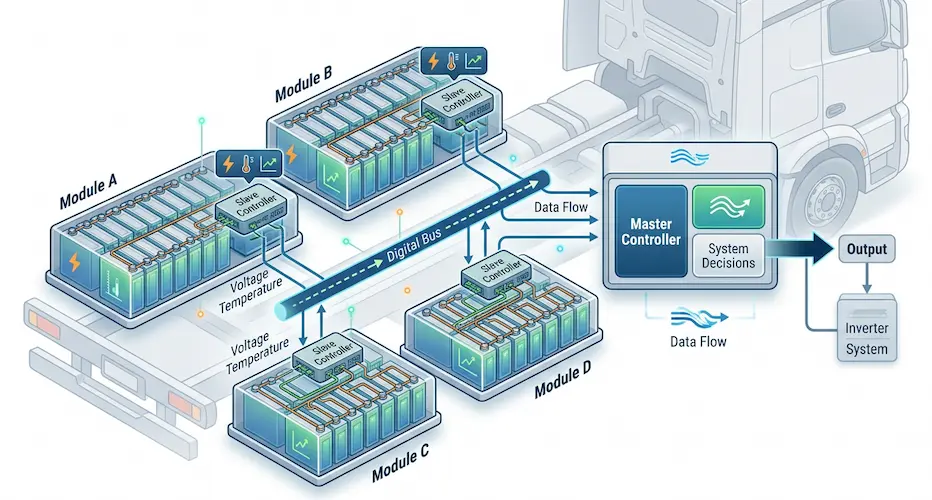
A distributed architecture for large battery packs is a Battery Management System (BMS) design where the monitoring and control functions are split into multiple localized units. Instead of one single central controller, multiple “slave” controllers are mounted directly onto the battery modules to measure voltage and temperature locally. These slaves then communicate via a simple digital bus to a central “master” controller, which makes the overarching system decisions.
If you want to build battery systems that are modular, safe, and truly scalable for demanding real-world applications, you need to master this architecture. Let me walk you through exactly how it works, how it compares to other setups, and how you can seamlessly integrate it into your next major vehicle platform.
What is meant by distributed architecture?
In the world of high-voltage systems, a distributed architecture simply means we are delegating the workload.
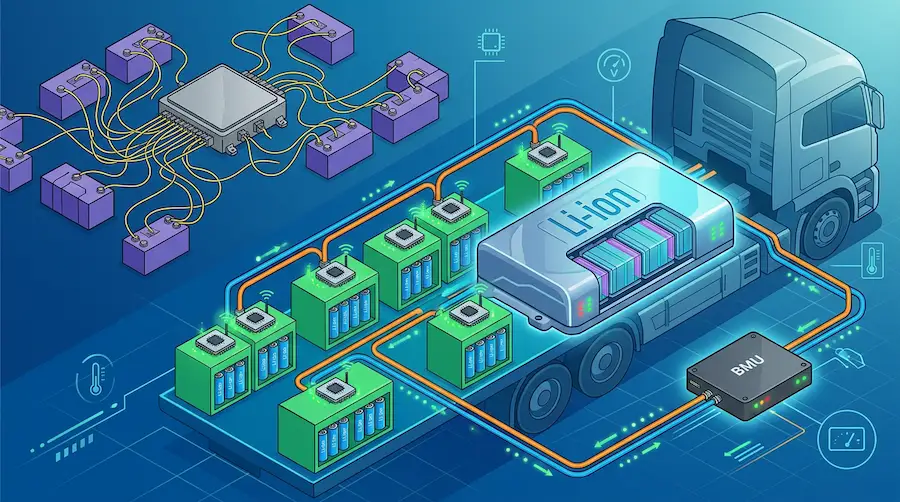
Instead of routing hundreds of delicate sensor wires from every individual battery cell back to one gigantic circuit board, we place small, intelligent printed circuit boards (PCBs) directly on top of the battery modules.
These local boards are often called Cell Supervisory Circuits (CSCs) or Slave Units. Their only job is to measure cell voltages, track temperatures, and perform local cell balancing. Once they gather this data, they digitize it and send it over a robust communication network (like a CAN bus or isolated daisy-chain) to a central Battery Management Unit (BMU).
Think of it like a corporate structure. You have regional managers (the slave units) reporting the day-to-day data to the CEO (the master BMU).
What is the purpose of distributed architecture?
The main purpose of a distributed architecture is scalability and safety.
When you are dealing with EV passenger cars or commercial fleets, you need flexibility. A distributed system allows you to add or remove battery modules without having to completely redesign your wiring harness.
Furthermore, it drastically reduces the length and complexity of low-voltage sensing wires inside a high-voltage environment. Shorter wires mean less electromagnetic interference (EMI), fewer chances for physical wire chafing, and a significantly lower risk of a short circuit.
For companies building heavy-duty platforms—like mining vehicles or electric tractors—this ruggedness is absolutely non-negotiable.
What is the architecture of a high voltage battery pack?
A modern high-voltage battery pack is a complex beast. It is far more than just a box of lithium-ion cells.
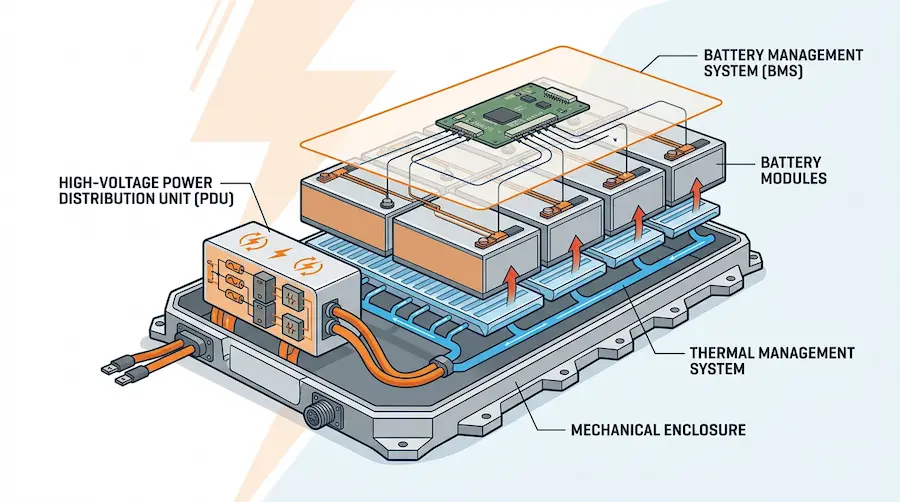
To bridge the gap between raw cell chemistry and your customized vehicle, a high-voltage pack integrates several critical sub-systems. Here is what a typical architecture looks like:
Battery Modules: The core energy storage, usually procured directly from Tier-1 cell manufacturers.
Thermal Management System: Precision liquid cold plates and routing manifolds designed to keep the cells within their optimal temperature window.
High-Voltage Power Distribution Unit (PDU): The electrical nervous system that houses the main contactors, pre-charge circuits, and high-voltage fuses.
Battery Management System (BMS): The brains of the operation, which monitors safety boundaries.
Mechanical Enclosure: A rugged, IP67+ rated aluminum structure designed to protect the system from crashes, water ingress, and extreme vibrations.
At Astraion Dynamics, our in-house engineering team routinely designs these complex systems, combining enclosure engineering, thermal management, HV architecture, and intelligent controls into one coordinated workflow.
How does the distributed architecture work for the large battery packs?
So, how does this actually play out in a large-scale pack?
Let’s say you have an 800V battery pack for an electric boat. This pack might consist of 24 separate battery modules.
In a distributed setup, each of those 24 modules gets its own Slave board. As the system operates, the Slave boards constantly monitor the analog voltage of each individual cell. They also read the local thermistors to check for temperature spikes.
The Slave boards convert these analog signals into digital data. They then transmit this digital payload through an isolated communication line back to the Master BMU.
Because the data is digitized right at the module, the communication is highly resistant to the electrical noise generated by the vehicle’s inverters and motors. The Master BMU receives the data, calculates the State of Charge (SOC) and State of Health (SOH), and communicates with the Vehicle Control Unit (VCU) to command the high-voltage contactors.
What does the distributed architecture consist of in the large battery packs?
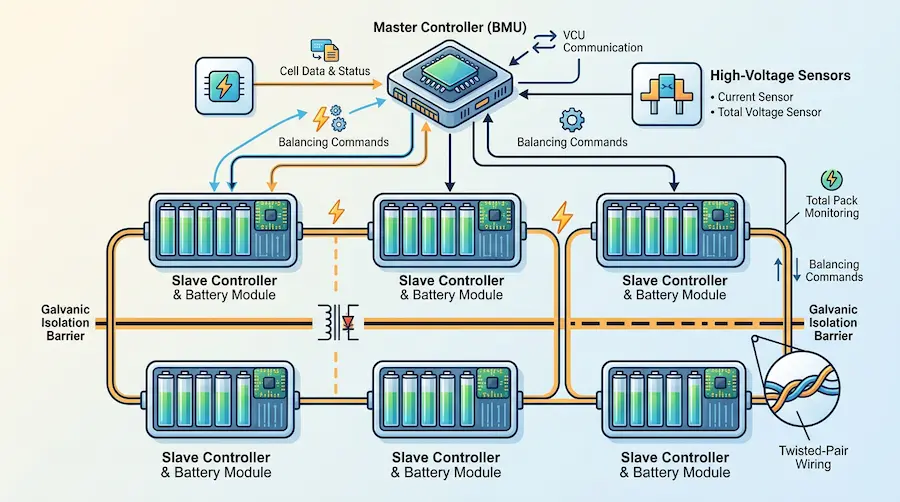
If you are a Battery Systems Engineer or an Electrical / HV Engineer, you will want to know the exact hardware involved. A distributed architecture typically consists of:
The Master Controller (BMU): The central brain. It handles the complex algorithms, VCU communication, and overall pack safety monitoring.
The Slave Controllers (CMU/CSC): Module-level boards equipped with Analog-to-Digital Converters (ADCs) and cell-balancing resistors.
Communication Harness: A simple twisted-pair wire (often just two or four wires) that connects the slaves to the master.
High-Voltage Sensors: Current sensors (like Hall-effect or shunt resistors) and total pack voltage sensors, usually reporting directly to the Master.
Isolation Barriers: Galvanic isolation components (like transformers or optocouplers) that separate the high-voltage module side from the low-voltage vehicle side.
What are the different types of BMS architectures in the electrical vehicles and vessels?
The EV and marine industries generally rely on four main types of BMS architectures:
Centralized BMS: A single board handles everything. All cell sensing wires run from the battery cells directly to this one central board.
Distributed (Modular) BMS: As discussed, functions are split between a master board and multiple module-mounted slave boards.
Daisy-Chain BMS: A sub-type of distributed architecture where the slave boards do not use CAN bus, but instead pass data to one another sequentially (like a daisy chain) using isolated UART or SPI protocols.
Wireless BMS (wBMS): The newest trend. Slave boards communicate with the master controller via a secure wireless protocol, eliminating the communication harness entirely.
What is the difference between centralized and distributed BMS architecture?
Choosing between centralized and distributed is one of the most critical decisions an Engineering Manager or CTO has to make.
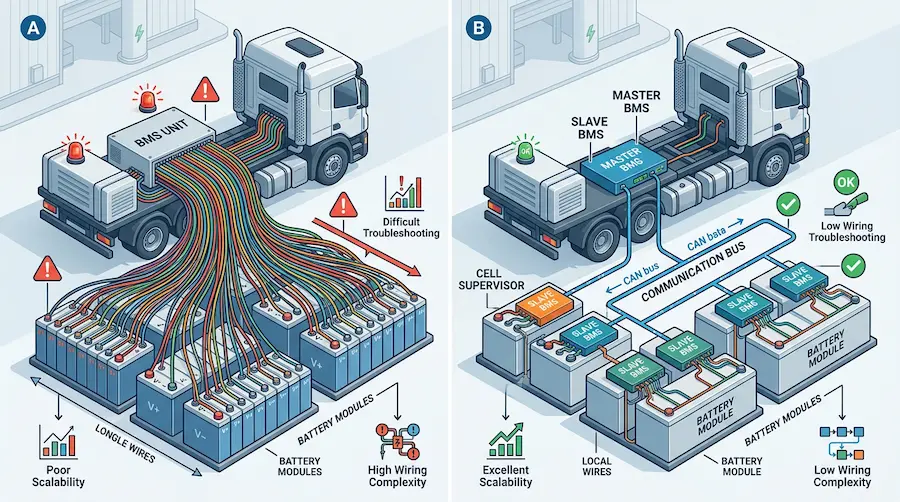
Here is a quick breakdown to help you compare the two:
| Feature | Centralized Architecture | Distributed Architecture |
|---|---|---|
| Wiring Complexity | High. Hundreds of long wires routed across the pack | Low. Only a simple communication bus links the modules. |
| Scalability | Poor. If you add a module, you must redesign the whole BMS board. | Excellent. Just add another Slave board to the communication loop. |
| Cost for Small Packs | Very cost-effective for 48V or 96V systems. | Can be overkill and more expensive due to multiple PCBs. |
| Troubleshooting | Difficult. Finding one pinched wire in a huge harness is a nightmare. | Easier. The Master can pinpoint exactly which Slave module is failing. |
| Ideal Application | Golf carts, small EVs, light industrial equipment. | Heavy-duty trucks, marine vessels, large Energy Storage Systems (ESS). |
What are the benefits of distributed architecture?
Why do the biggest names in heavy-duty and marine electrification lean toward distributed setups? Let’s dive into the core advantages.
1. Unmatched Scalability
If you are designing a platform that will be used across different vehicle lengths, you need a flexible battery pack. With a distributed system, scaling up from a 400kWh system to an 800kWh system simply means plugging in more modules and configuring the Master unit to recognize the new Slaves.
2. Drastic Weight and Space Reduction
Copper is heavy. By eliminating hundreds of long voltage-sensing wires, you save a significant amount of weight and free up valuable packaging space inside the enclosure.
3. Superior Safety and Reliability
Routing low-voltage sensing wires over high-voltage busbars is asking for trouble. A wire casing could chafe, causing a catastrophic short circuit. Distributed systems keep sensing wires incredibly short, dramatically reducing the risk of physical damage and thermal events.
4. Optimized for Harsh Environments
Heavy trucks and marine vessels have stringent requirements for waterproofing, durability, and vibration resistance. A distributed system allows engineers to seal and pot the individual Slave modules separately, creating a highly ruggedized, explosion-proof, and heavy-duty battery system.
What are the disadvantages of distributed architecture?
Of course, no engineering solution is perfect. It is important to be aware of the trade-offs.
1. Higher Initial Component Cost
You are buying multiple PCBs, multiple microcontrollers, and multiple isolated communication ICs. For low-voltage, budget-sensitive applications, this cost can be prohibitive.
2. Software Complexity
Writing the firmware for a centralized board is straightforward. Writing the firmware for a Master unit that has to constantly poll, verify, and synchronize data from 20 different Slave units requires serious software engineering muscle.
3. Environmental Vulnerability of Slave Boards
Because the Slave boards sit directly inside the battery module environment, they are subjected to intense thermal cycling. If your liquid cooling system isn’t perfectly engineered, the localized heat could degrade the electronics over time.
How to design a distributed architecture for the large battery packs?
Designing a distributed architecture requires a coordinated workflow that merges mechanical, thermal, electrical, and control elements. If you are a Product Development Manager or an R&D Director, here is the roadmap you should follow:
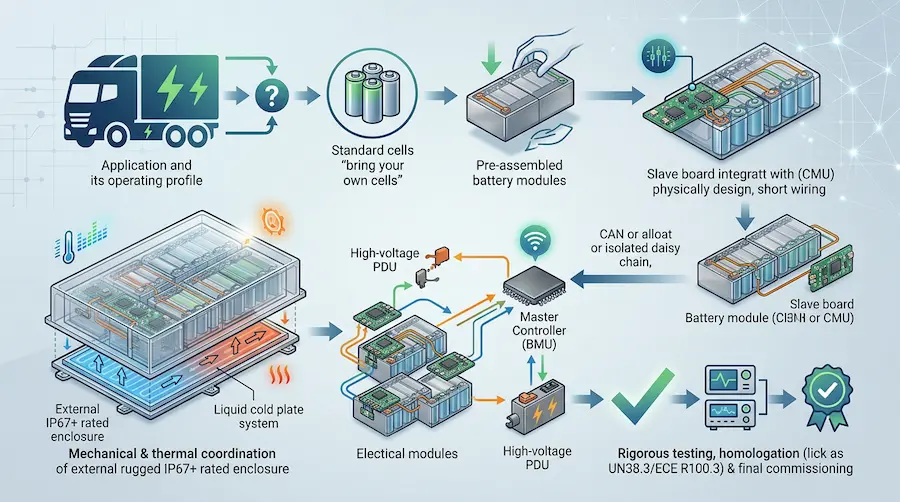
Step 1: Define the Operating Profile
Start with a review of your application, packaging constraints, and electrical targets. How much peak power does your electric boat or heavy-duty truck need? What is the maximum C-rate during fast charging?
Step 2: Source the Right Chemistry
Tier-1 cell manufacturers are built for massive standard volume and often reject deep customization for off-highway or marine applications. They sell you the raw modules, but they leave you with a massive engineering headache. You need a transparent “Bring Your Own Cells/Modules” partnership model, allowing you to secure raw modules at zero middleman markup.
Step 3: Engineer the Local Slaves (CMUs)
Determine how many cells are in series per module. Select a Battery Monitoring IC (like those from TI, NXP, or Analog Devices) that perfectly matches that cell count. Design the slave board to sit flush against the module busbars to keep sensing wires under a few inches.
Step 4: Design the Thermal and Mechanical Integration
This is where many projects fail. You must design rugged IP67+ aluminum enclosures and precision liquid cold plates. Mechanical, thermal, electrical, and control systems cannot be developed in silos—they must be developed as one coordinated solution.
Step 5: Master the High-Voltage and Communication Link
Establish a robust communication link (like isolated CAN or a proprietary daisy chain) between the slaves and the master. Integrate a high-voltage PDU to manage the physical disconnection of the pack.
Step 6: Testing, Homologation, and Commissioning
Finally, subject the entire architecture to rigorous validation. This includes flawless UN38.3 / ECE R100.3 homologation and 100% End-of-Line testing protocols. Remember, you need an engineering-driven integration partner who will stay involved until the system is tested, integrated, and ready to work in the field.
Conclusion
In short, a distributed architecture is the gold standard for large, high-voltage battery packs. By dividing the complex task of battery management into localized, intelligent modules, you unlock the scalability, safety, and reliability demanded by today’s most extreme electrification projects.
Whether you are building electric tractors, marine vessels, or heavy-duty mining trucks, stepping away from centralized wiring and embracing a distributed approach is how you bring battery-powered platforms into operation with greater confidence.
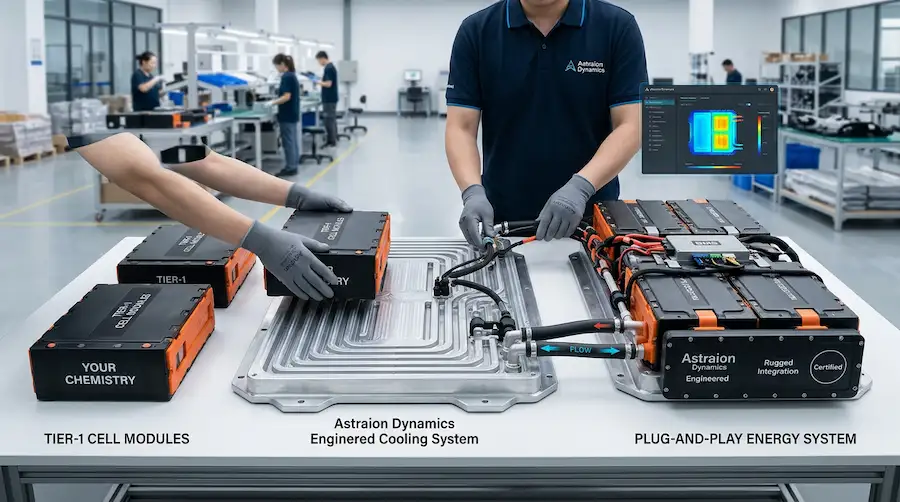
Are you ready to turn your raw battery modules into a fully certified, deployment-ready energy system?
At Astraion Dynamics, we are the ultimate “Bring Your Own Cells / Modules” integration hub for heavy-duty, marine, and off-highway applications. You control the chemistry, and we master the deep engineering.
If you are a Chief Engineer, or Project Manager tired of the massive engineering headaches left by Tier-1 suppliers, let’s talk.
[Click here to schedule a deep-dive Project Review with our in-house engineering team], and let us help you bridge the gap between raw cell chemistry and your customized vehicle.
