
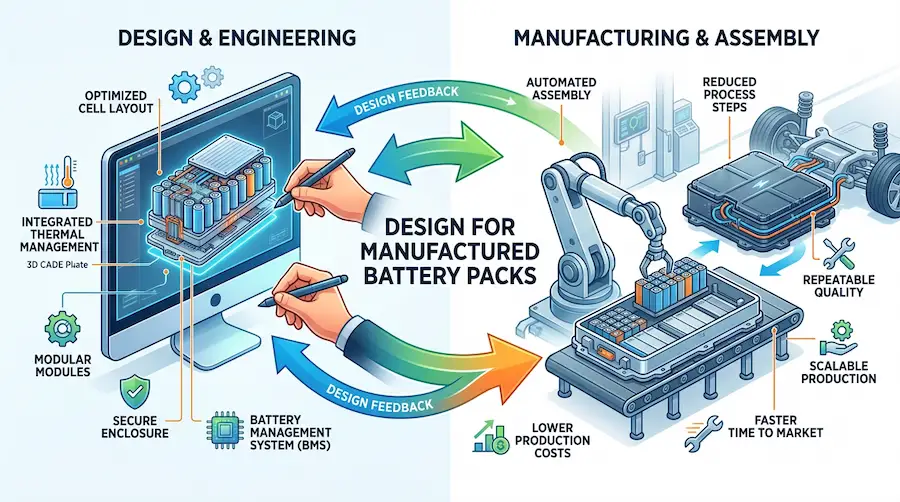
Struggling to move your lithium-ion battery pack from a 3D CAD model to a mass-produced reality? I know exactly how frustrating integration bottlenecks and failed testing protocols can be. In this comprehensive guide, I will walk you through what DFM means for battery pack engineering and how it can help get your energy systems to market faster and safer.
DFM (Design for Manufacturability) in battery pack engineering is the practice of designing lithium-ion systems, enclosures, and thermal plates to be cost-effective and easy to mass-produce. It ensures high reliability and compliance without sacrificing electrical performance.
Want to know how to apply this to your next heavy-duty EV or marine vessel project? Let’s dive deep into the exact steps, core benefits, and technical nuances of a solid DFM strategy.
What does DFM stand for?
DFM stands for Design for Manufacturability.
In the broader engineering world, you might also hear it combined with DFA (Design for Assembly) to form DFMA. Simply put, it is the engineering philosophy of designing a product from the ground up so that it is incredibly easy, efficient, and cost-effective to manufacture.
What is DFM (Design for Manufacturability)?
If you are a Chief Engineer, or R&D Director, you already know that designing a working prototype is only half the battle.
Design for Manufacturability (DFM) is the proactive process of optimizing a product’s design to mitigate manufacturing complexities before a single piece of metal is cut. It is about bridging the gap between a brilliant concept on a computer screen and a repeatable, scalable reality on the factory floor.
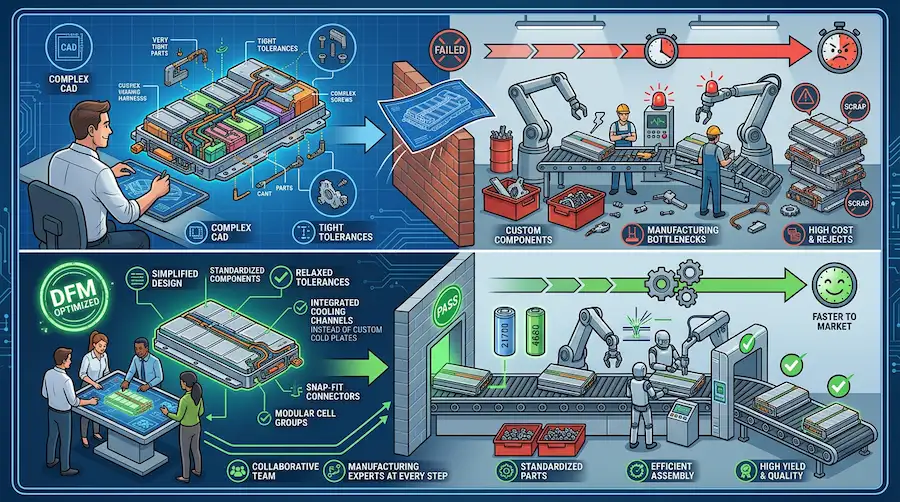
Instead of throwing a finished CAD design over the wall to the manufacturing floor and saying, “Figure out how to build this,” DFM forces your design team to consider the manufacturing equipment, material limits, and supply chain constraints from day one.
When you apply DFM, you strip away unnecessary parts, loosen overly tight tolerances where they aren’t needed, and choose manufacturing methods (like CNC machining, stamping, or extrusion) that match your projected production volumes.
What is the purpose of DFM in battery pack engineering?
The stakes in lithium-ion battery pack engineering are incredibly high. We are dealing with massive energy densities, high-voltage systems, and strict thermal management requirements.
The primary purpose of DFM in this field is to reduce integration risk, shorten development cycles, and bring battery-powered platforms into operation with greater confidence.
Tier-1 cell manufacturers are built for massive standard volume, and they often reject deep customization for off-highway, marine, or specialized commercial fleets. They sell you the raw modules, but they leave you with a massive engineering headache. How do you cool them? How do you package them safely? How do you make them talk to your vehicle?.
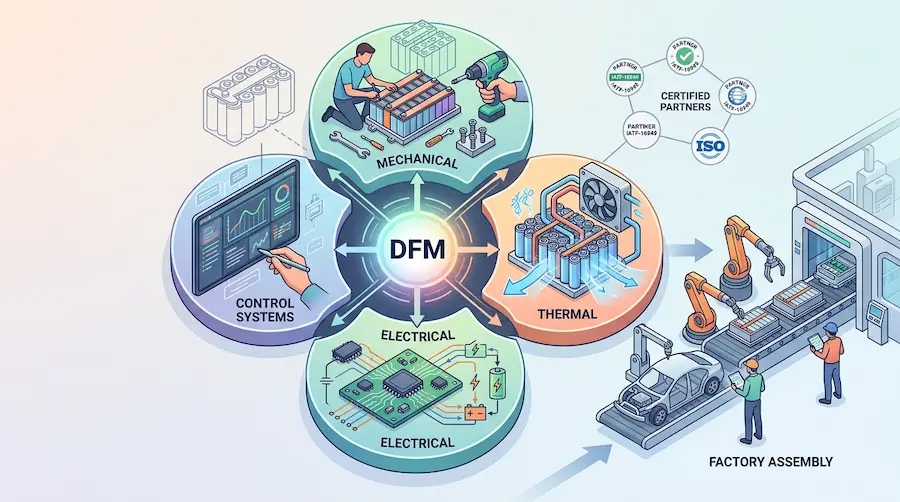
DFM solves this. Its purpose is to ensure that your custom integration across mechanical, thermal, electrical, and control systems is developed as one coordinated solution, rather than a patched-together afterthought. By focusing on DFM, you ensure that the battery pack can physically be built at scale, pass stringent homologation (like UN38.3 and ECE R100.3), and operate flawlessly in real-world environments.
What are the processes of the DFM in battery pack engineering?
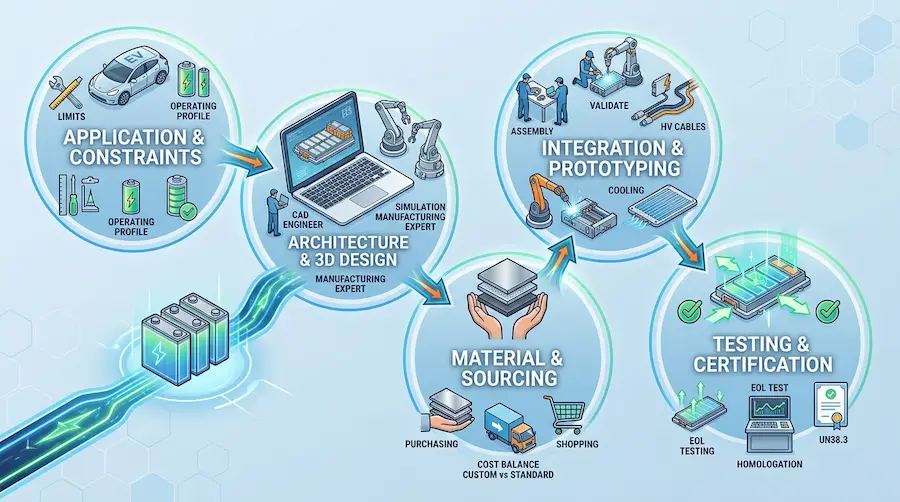
Implementing DFM is not a one-time checklist. It is a continuous, integrated workflow. If you are a Project Manager or Engineering Manager, here is how the DFM process typically unfolds in battery pack engineering:
1. Application and Constraint Review
Projects typically begin with a deep dive into the application, operating profile, packaging constraints, electrical targets, and compliance needs. You cannot design for manufacturing if you don’t know the physical limits of the vehicle or vessel.
2. Architecture and 3D Design
Next, engineers define the system architecture. This involves initial 3D design and thermal simulation. During this phase, CAD engineers work closely with manufacturing experts to ensure that parts can be easily machined, stamped, or welded.
3. Material and Process Selection
This is where Purchasing Managers and Strategic Sourcing Managers shine. DFM requires selecting materials and processes that balance performance with cost. For example, deciding whether a battery enclosure should use an expensive custom extrusion or a standard CNC-machined billet based on the fleet size.
4. Subsystem Integration and Prototyping
The team integrates key mechanical, thermal, electrical, and control elements. We build prototypes to validate the manufacturing assumptions. Can the assembly technicians easily route the high-voltage cables without pinching them? Is the liquid cooling plate warping during the brazing process?
5. End-of-Line (EOL) Testing and Homologation
DFM isn’t complete until the product can be tested efficiently. The design must accommodate 100% End-of-Line testing protocols and flawless UN38.3 / ECE R100.3 homologation. If a pack is too difficult to test on the assembly line, it fails the DFM test.
How does the DFM work in battery pack engineering?
DFM works by breaking down the traditional silos between different engineering disciplines.
Battery projects often fail at the integration stage—not because components are unavailable, but because mechanical, thermal, electrical, and control systems are not developed as one coordinated solution.
Let me explain how it works in practice. A Battery Systems Engineer might want to pack cells as tightly as possible to maximize energy density. However, the Thermal Engineer knows they need space for a liquid cooling plate. Meanwhile, the Manufacturing Technician points out that if the modules are too close, there’s no room for the automated torque drivers to reach the busbar bolts during assembly.
DFM forces these stakeholders into the same room. It works by establishing a “Bring Your Own Cells/Modules” flexibility, where you leverage top cell chemistries but engineer the surrounding architecture entirely around real platform constraints. It relies on a strategic network of IATF-16949 certified partners and resident QA engineers to ensure the designed processes translate perfectly to the factory floor.
What are the benefits of the DFM in battery pack engineering?
Embracing DFM offers transformative advantages for OEMs, electrification startups, and system integrators.
1. Drastically Reduced Costs
By optimizing the design for assembly, you eliminate unnecessary parts, reduce scrap, and lower labor time. Plus, with an engineering-first integrator, you can negotiate directly with top cell manufacturers to secure raw modules at zero middleman markup, while the integration partner handles the complex supply chain ecosystem.
2. Faster Time-to-Market
DFM minimizes the frustrating loop of prototyping, failing, redesigning, and re-prototyping. When you design rugged IP67+ aluminum enclosures and intelligent BMS architectures with manufacturing in mind from day one, you get reliable and compliant energy solutions to market faster.
3. Guaranteed Compliance and Reliability
When DFM is applied correctly, global homologation isn’t a stressful hurdle; it’s a planned milestone. Your system is built for demanding environments and global deployment right out of the gate.
The DFM for the battery pack enclosure
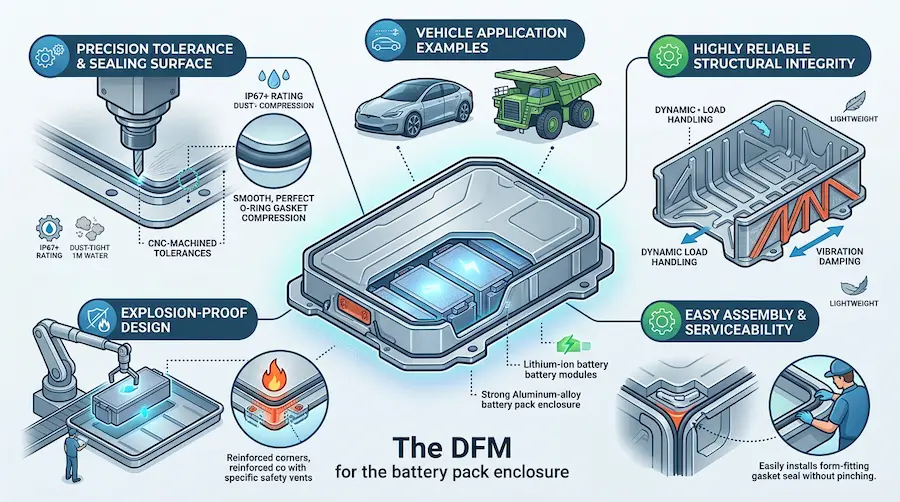
The battery enclosure is the first line of defense for a lithium-ion pack. It must handle structural loads, vibration, and environmental ingress.
When conducting DFM for the battery pack enclosure, my primary focus is always on achieving a rugged IP67+ rating without making the assembly impossible.
For EV passenger cars, European and emerging market brands often outsource these components to reduce costs, requiring high-precision design.
Here are the critical DFM considerations for enclosures:
Machining vs. Casting: We heavily rely on CNC-machined enclosures for specialized commercial fleets because they allow for tight tolerances and excellent sealing surfaces without the massive upfront tooling costs of die-casting.
Sealing and Waterproofing: Electric boats and marine vessels have stringent requirements for waterproofing. DFM ensures the gasket grooves are designed with proper compression ratios, so assembly workers can install seals easily without pinching or rolling them.
Structural Integrity: Battery electric mining vehicles demand highly reliable, explosion-proof, and heavy-duty battery systems. DFM dictates the strategic placement of structural ribs to handle these dynamic loads without adding unnecessary weight.
The DFM for the liquid cold plate
Lithium-ion cells generate significant heat, especially during fast charging or heavy discharge cycles. The liquid cooling plate is the heart of the thermal management system.
Heavy trucks have high demands for battery pack durability and liquid cooling. Similarly, the emerging market for electric tractors and agricultural machinery has a strong need for customized liquid cooling systems.
Designing a precision liquid cold plate is a masterclass in DFM.
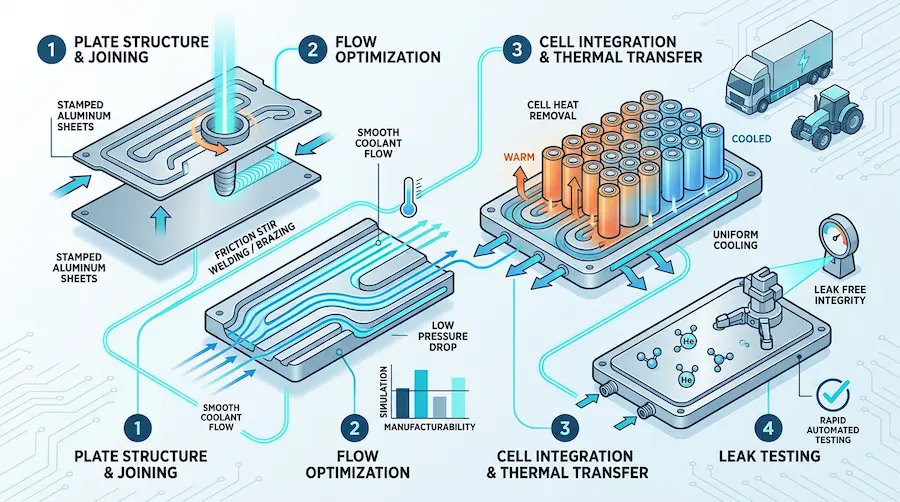
Material Joining: Cold plates typically consist of two stamped or machined aluminum sheets joined together. DFM focuses on the brazing or friction stir welding (FSW) process. If the flow channels are too complex, the plate may warp during brazing.
Flow Channel Optimization: A purely theoretical design might have intricate micro-channels that provide excellent cooling but are impossible to manufacture consistently. DFM balances thermal simulation with manufacturability to ensure even coolant flow with a minimal pressure drop.
Leak Testing Integration: A leak inside a high-voltage battery pack is catastrophic. DFM ensures that the liquid cold plate has accessible inlet and outlet ports that allow for rapid, automated helium leak testing on the production line before the battery modules are ever installed.
Why is the DFM important in the battery back engineering process?
If you take away one thing from this guide, let it be this: Lack of DFM is the number one reason battery integration projects fail.
You can buy the best lithium-ion chemistry in the world. But as we know, Tier-1 cell manufacturers are built for massive standard volume and often reject deep customization. They leave you to figure out the mechanical packaging, thermal management, high-voltage architecture, and intelligent controls yourself.
This massive engineering headache is exactly why DFM is so crucial. DFM acts as the bridge between raw cell chemistry and your customized vehicle.
Without DFM, a Vehicle Integration Engineer might design a brilliant battery system that simply cannot be assembled by human hands, or a system that fails EOL testing because the high-voltage PDUs and VCU communication systems weren’t properly shielded for EMC (Electromagnetic Compatibility) during the layout phase.
DFM forces you to take responsibility for the full integration path. It ensures that whether you are building energy storage systems (ESS) that require large-scale pack assembly, or electric boats that need perfect waterproofing, your system is actually deployment-ready.
Conclusion
Navigating the complexities of EV, marine, and off-highway electrification is tough. DFM (Design for Manufacturability) is not just an engineering buzzword; it is the ultimate risk-mitigation strategy for your battery pack development.
By applying DFM principles to your enclosures, liquid cold plates, and high-voltage integration, you ensure your design is scalable, safe, and cost-effective.
But you don’t have to tackle this massive integration challenge alone. Astraion Dynamics exists to close that exact gap. We serve as your engineering-driven integration partner, offering a transparent “Bring Your Own Cells/Modules” partnership model.
You Control the Chemistry, We Master the Engineering.
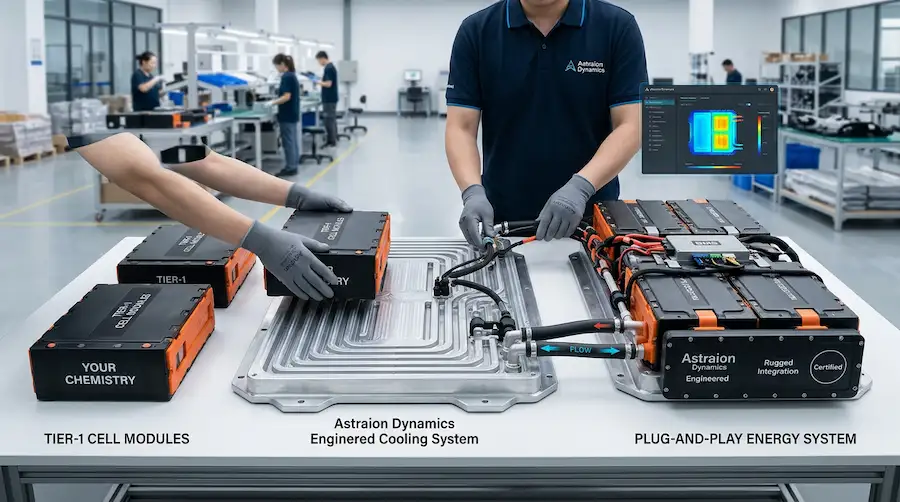
We transform your procured raw modules into a rugged, fully certified, plug-and-play energy system. From CNC-machined enclosures and precision liquid cold plates to intelligent BMS and commissioning support, we stay involved until your system is ready to work in the field.
Are you ready to eliminate integration risks and get your battery program to market faster?
If you’re looking for an integration hub that truly understands DFM for heavy-duty, marine, and off-highway applications, let’s talk. Contact our engineering team today to review your packaging constraints and electrical targets, and let us build a system that works in the real world.