

You’re developing a specialized electric vehicle or electric boat, but massive Tier-1 cell manufacturers refuse to customize a battery pack just for your application. Sound familiar? I’m going to show you exactly how the Bring Your Own Cells (BYOC) architecture solves this massive engineering headache.
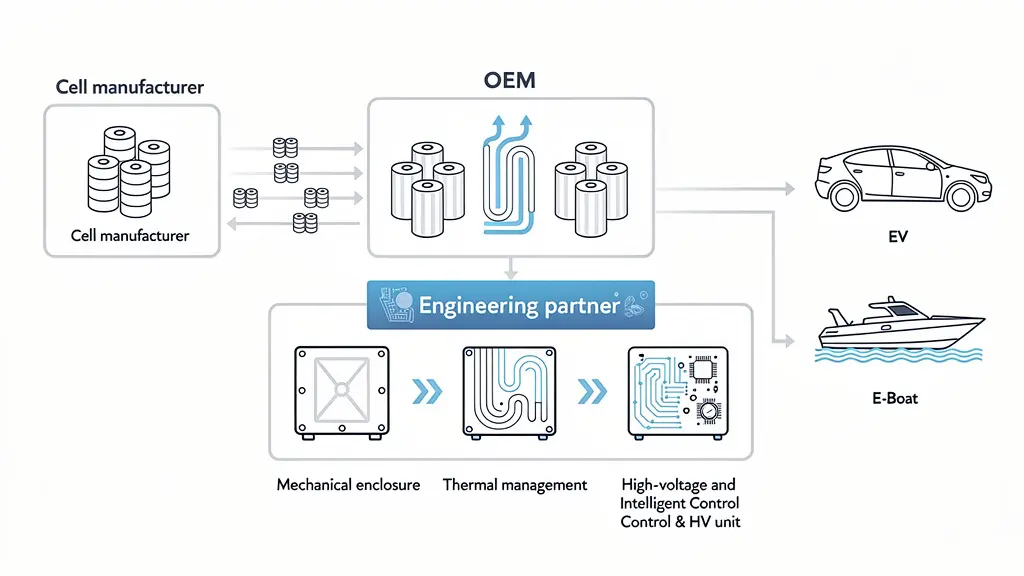
A BYOC (Bring Your Own Cells) battery architecture is a manufacturing model where an OEM procures raw battery cells directly from manufacturers, then partners with a specialized engineering firm to handle the complex integration of the mechanical enclosure, thermal management, and high-voltage & intelligent control units.
It gives you total control over your supply chain while offloading the heavy engineering lifting. Keep reading to learn how this approach can completely transform your next electrification project.
What Does the BYOC Mean?
In the traditional supply chain, you either buy an off-the-shelf battery pack that doesn’t quite fit your vehicle, or you pay exorbitant NRE (Non-Recurring Engineering) fees to a supplier for a custom build.
The Bring Your Own Cells (BYOC) model flips this script.
At its core, BYOC operates on a simple philosophy: you control the chemistry, and your integration partner masters the engineering. In this model, you negotiate directly with top-tier cell manufacturers to secure raw cells. By doing this, you avoid the heavy middleman markup that usually plagues battery procurement.
Once you have your cells, an engineering-driven integration partner takes over. They handle the physical and electrical reality of making those cells work in your machine. This means designing rugged IP67+ aluminum enclosures, precision liquid cold plates, intelligent Battery Management Systems (BMS), and high-voltage Power Distribution Units (PDUs).

In short, BYOC means you bring the raw energy, and we build the engineered system around it.
What Are the Purposes of the BYOC ?
The main purpose of BYOC is to bridge the massive gap between raw cell chemistry and your customized vehicle.
Here’s the deal: Tier-1 cell manufacturers are built to handle massive, standardized volumes. They want to churn out millions of identical units for mega-automakers. Because of this, they frequently reject deep customization requests for off-highway, marine, or specialized commercial fleets.
They will happily sell you the raw modules, but they leave you with a massive engineering headache. Once those cells arrive at your facility, you have to answer some critical questions:
How do you cool them effectively to prevent thermal runaway?
How do you package them safely to survive extreme shock and vibration?
How do you make the battery pack communicate seamlessly with your Vehicle Control Unit (VCU)?
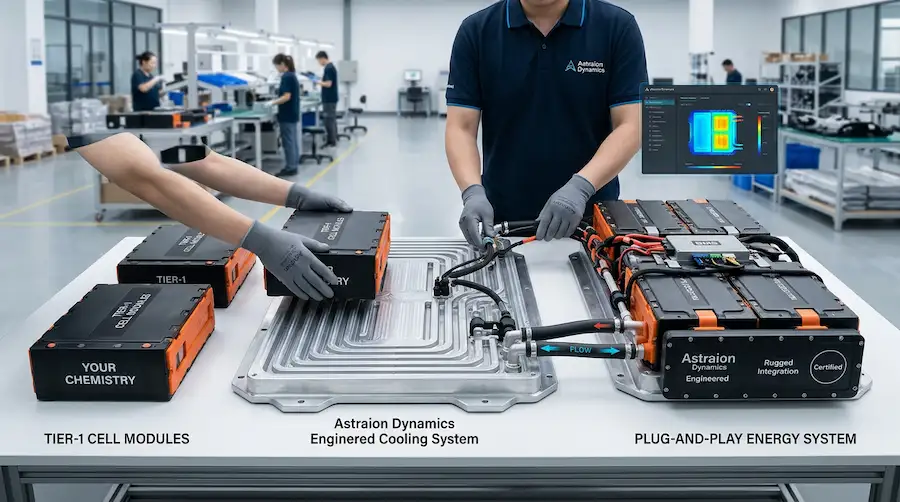
The purpose of BYOC is to answer those questions. It allows you to leverage China’s vast specialized supply chain to transform raw components into a rugged, fully certified, plug-and-play energy system.
How Does the BYOC Work for EVs?
If you are developing electric vehicles—whether passenger cars or heavy-duty electric trucks—the BYOC process is highly structured.

Projects typically begin with a deep dive into your specific application. I always recommend starting with a thorough review of your operating profile, spatial packaging constraints, electrical targets, and compliance needs.
From there, the engineering integrator defines the entire system architecture. For EV passenger cars, this means focusing heavily on high-precision battery pack systems and advanced liquid cooling integration. For heavy-duty electric trucks, the focus shifts. Heavy trucks demand extreme battery pack durability, robust liquid cooling, and complex high-voltage integration to handle high charge/discharge rates.
Once the architecture is set, the integration team handles the mechanical, thermal, electrical, and control elements. They execute initial 3D designs and run thermal fluid dynamics simulations to ensure the liquid cold plates can handle the heat load. Finally, the process moves into flawless UN38.3 and ECE R100.3 homologation, ensuring your EV pack is legally ready for global deployment.
How Does the BYOC Work for ESS?
Energy Storage Systems (ESS) play by a different set of rules than moving vehicles. If you are an ESS integrator or operator, BYOC works by scaling up the electrical control architecture while simplifying the mechanical constraints.
ESS projects require incredibly large-scale battery packs, heavily integrated PDUs, and highly specialized BMS algorithms designed for stationary grid stabilization or peak shaving 8.
Instead of worrying about high-frequency road vibrations, BYOC for ESS focuses heavily on thermal management over long lifecycles and stringent safety testing. An integration partner will typically support you through CAS Energy Storage certification and comprehensive system commissioning 8. This ensures that your massive cell arrays communicate flawlessly with your central energy management system.

What Are the Benefits of the BYOC?
Why should an Engineering Manager care about BYOC? The benefits are both financial and technical.
First, you get Tier-1 chemistry pricing combined with unmatched bespoke engineering. Because you buy the cells directly, you cut out the distributor markup.
Second, you get application-driven engineering built around your actual platform constraints, rather than forcing a square peg into a round hole. You get turnkey integration across mechanical, thermal, electrical, and control systems.
Finally, you shorten your development cycles. By partnering with a firm that already has a strategic network of IATF-16949 certified manufacturing partners and resident QA engineers, you can bring battery-powered platforms into operation with much greater confidence.
What is BYOM (Bring Your Own Modules) and How Does It Work?
So, what exactly is BYOM? Simply put, Bring Your Own Modules (BYOM) is a transparent partnership model where you negotiate directly with top-tier battery manufacturers to secure raw, pre-assembled modules at zero middleman markup.
But how does it actually work in practice?
Here’s the breakdown: Tier-1 suppliers are great at pumping out massive volumes of standard modules, but they typically reject deep customization requests and leave you with a massive engineering headache. That is exactly where an integration partner steps in.
You supply the raw modules, and we combine the enclosure engineering, thermal management, high-voltage architecture, and intelligent controls into one coordinated workflow. Essentially, we transform those procured raw modules into a rugged, fully certified, plug-and-play energy system engineered specifically around your real vehicle or vessel constraints. You get to leverage Tier-1 chemistry pricing while we handle the complex, deep engineering required to bring your platform to life.

What Are the Benefits of the BYOM (Bring Your Own Modules)?
While cells are the rawest form of battery energy, many OEMs prefer to procure pre-assembled modules from Tier-1 suppliers. This is where Bring Your Own Modules (BYOM) comes into play.
The primary benefit of BYOM is that the cell-level electrical connections (like wire bonding or laser welding of busbars) are already handled by the cell manufacturer. This reduces the risk of cell-level thermal imbalances and simplifies the initial stages of assembly.
When you bring your own modules, the integration partner focuses strictly on the macro-level challenges. They design the overarching battery pack enclosure, route the high-voltage cables, configure the master BMS to talk to the module-level slave boards, and integrate the liquid cooling systems that manage the entire module array. It is a fantastic middle-ground that accelerates time-to-market while still allowing for significant physical customization.
Bring Your Own Cells vs. Bring Your Own Modules
So, which one should you choose? It really depends on your engineering bandwidth and your specific vehicle requirements.
Bring Your Own Cells (BYOC):
Pros: Ultimate flexibility. You can arrange the cells in highly unconventional geometries to fit strange cavities in your vehicle frame. It generally offers the absolute lowest cost per kWh since you are buying the rawest material.
Cons: Requires intense micro-level engineering. You need an integration partner capable of executing flawless cell-to-cell laser welding, applying structural adhesives, and designing micro-channel cold plates.

Bring Your Own Modules (BYOM):
Pros: Faster integration and slightly lower engineering risk. The modules already have baseline structural integrity and preliminary cell balancing built-in.
Cons: You are constrained by the physical block dimensions of the module. If the Tier-1 module is a large rectangular block, your pack enclosure must be designed to accommodate those exact block dimensions, which might not perfectly match your vehicle’s spatial constraints.
What Are the Popular Applications of the BYOC?
The BYOC architecture shines brightest in industries that demand high reliability but lack the massive standardization of passenger sedans. Some of the most popular applications include:
Marine Vessels and Electric Boats: The marine sector is experiencing explosive growth, particularly in Europe 8. Electric boats and ferries have incredibly stringent requirements for extreme waterproofing (IP67+) and specialized liquid cooling. BYOC allows marine integrators to build custom packs that fit into tight ship hulls securely.
Off-Highway and Construction Equipment: Excavators and loaders experience violent shock loads. Off-the-shelf EV packs will shatter under these conditions. BYOC allows for custom, ruggedized enclosures tailored for off-highway OEMs.
Electric Agricultural Machinery: The market for electric tractors is emerging rapidly. These machines need highly customized battery packs and liquid cooling systems capable of operating in dusty, high-heat agricultural environments.
Battery Electric Mining Vehicles: Mining trucks demand highly reliable, explosion-proof, and heavy-duty battery systems. Standard cell packs simply won’t survive deep underground; customized BYOC engineering is mandatory here.

Why Is It Important to Use the BYOC Battery Architecture?
I have seen countless battery projects fail at the integration stage.
Why? Not because the individual components were unavailable or defective. They fail because the mechanical, thermal, electrical, and control systems are not developed together as one coordinated solution.
If your thermal engineer isn’t talking perfectly with your BMS software engineer, your battery pack is going to experience thermal throttling—or worse, thermal runaway.
It is incredibly important to use a BYOC architecture because it drastically reduces integration risk. When you work with an engineering-first integrator who stays involved until the system is fully tested, integrated, and ready to work in the field, you eliminate the dangerous silos that cause electric platforms to fail.
Conclusion
Transitioning to electric power is hard enough without having to fight your supply chain. The BYOC (Bring Your Own Cells) architecture puts the control back in your hands. It allows you to secure the best cell chemistry directly from the source, while leaning on specialized experts to master the complex mechanical, thermal, and high-voltage engineering.
If you are a Chief Engineer, or Program Manager struggling to find a battery system that actually fits your heavy-duty, marine, or off-highway platform, it might be time to rethink your integration strategy.
Don’t let rigid Tier-1 suppliers dictate your vehicle’s design. If you need a partner to review your application, operating profile, and packaging constraints, we can help define a system architecture that works for you. Reach out to Astraion Dynamics today to schedule a comprehensive technical review of your battery integration program, and let’s turn your raw cells into a fully certified, deployment-ready power system.
