

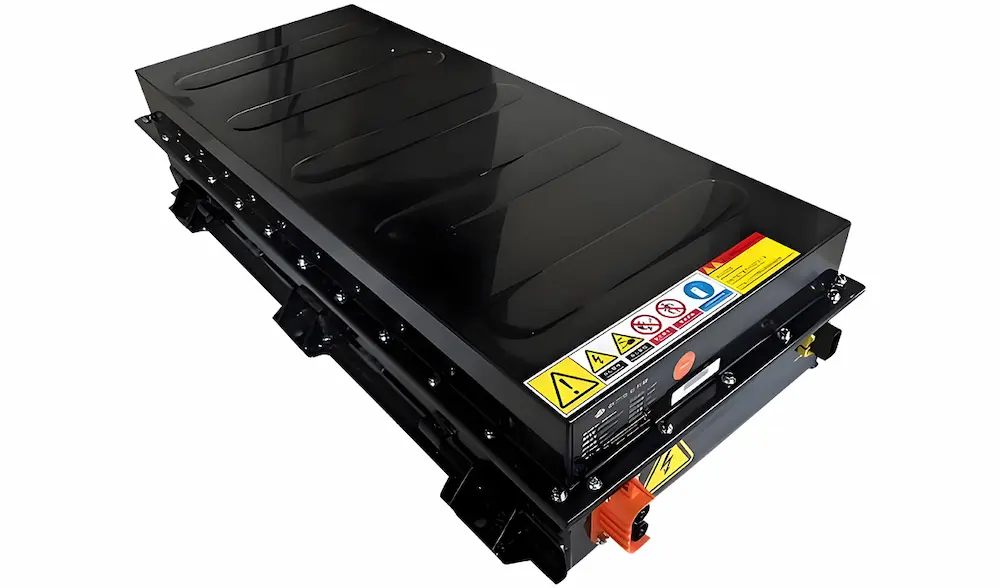
Struggling to protect your custom battery packs from harsh environments? I break down exactly what IP67 and IP68 ratings mean for battery enclosures and how to design them.
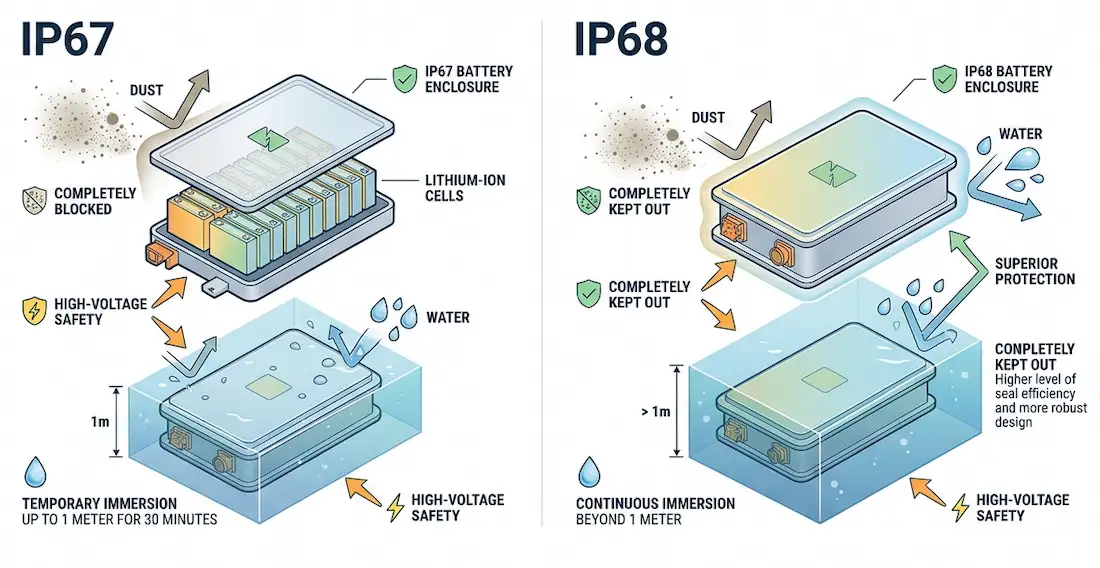
An IP67 battery enclosure protects lithium-ion cells from dust and temporary water immersion up to 1 meter for 30 minutes. An IP68 enclosure offers superior protection, surviving continuous immersion beyond 1 meter. Both ensure high-voltage safety for electric vehicles and heavy-duty applications.
But hitting these ratings takes more than just slapping some silicone on a metal box. Let’s dive deep into what it actually takes to engineer a rugged, waterproof battery system for the real world.
What Does IP67 and IP68 Mean?
Before we design a battery pack, we need to understand the global standard for ingress protection.
The letters “IP” stand for Ingress Protection. This is an international standard (IEC 60529) that engineers use to define exactly how well an electrical enclosure seals against foreign bodies.
The rating always features two numbers.
The first digit represents protection against solid particles, like dirt and dust. In both IP67 and IP68, this first digit is a 6. A “6” means the enclosure is completely dust-tight. No sand, dirt, or debris can get inside, which is critical for preventing electrical shorts.
The second digit represents protection against liquids.
A 7 means the enclosure can survive temporary submersion in water up to 1 meter (about 3.3 feet) deep for exactly 30 minutes.
An 8 means the equipment can survive continuous submersion under conditions specified by the manufacturer (usually deeper than 1 meter and for longer durations).
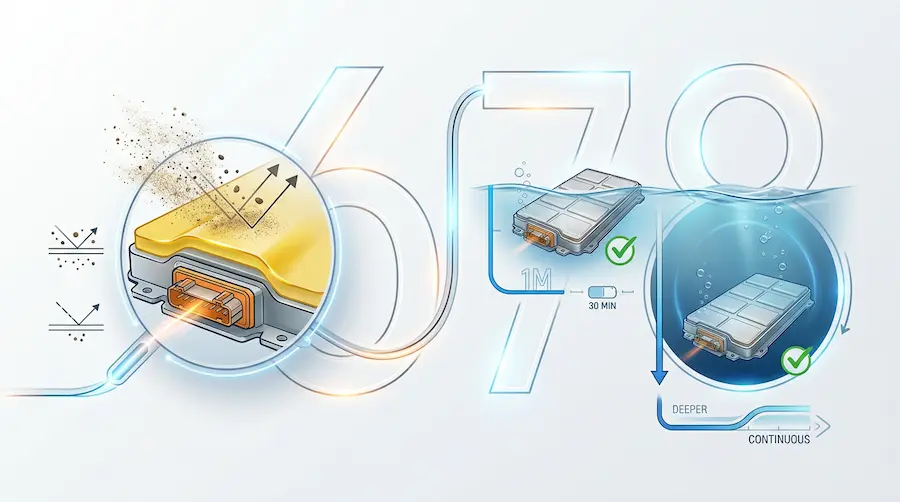
When you build battery systems for heavy-duty commercial fleets, you simply cannot compromise on these numbers.
Is IP67 100% Waterproof?
The short answer is no. IP67 is highly water-resistant, but it is not completely waterproof under every possible condition.
Many engineers make the mistake of treating IP67 like a submarine.
If you drop an IP67-rated battery pack into a shallow puddle, it will survive. But if you hit that same battery pack with a high-pressure pressure washer (which requires an IP69K rating), water might blast right past the seals.
Static pressure is very different from dynamic pressure.
When a battery pack sits underwater at a depth of 1 meter, the static water pressure is relatively low. However, if a vehicle drives through a flooded street at 40 mph, the dynamic force of the water hitting the enclosure’s seals is massive.
If your application involves deep water or high-pressure spray, you might need to look beyond a basic IP67 rating.
What is an IP67 Enclosure?
An IP67 enclosure is a ruggedized housing designed to keep expensive and dangerous high-voltage electronics completely dry during temporary flooding.
For electric vehicles (EVs) and off-highway machinery, this usually means a heavy-duty metal box.
Our in-house engineering team designs rugged IP67+ aluminum enclosures combined with precision liquid cold plates and intelligent BMS architectures. We use CNC-machined aluminum because it provides the rigid structural integrity needed to maintain tight sealing tolerances over the lifetime of the vehicle.
A true IP67 enclosure doesn’t just block water. It also manages internal heat and protects the delicate chemistry inside from mechanical impact.
What is an IP68 Enclosure?
An IP68 enclosure takes water defense to the absolute maximum level.
These enclosures are built to operate completely submerged for extended periods. The exact depth and time are usually defined by the manufacturer, but they always exceed the 1-meter/30-minute limits of IP67.
You usually see IP68 ratings required in extreme operating environments.
For example, electric boats and ferries have stringent requirements for waterproofing, liquid cooling, and system integration. When you build battery systems for the marine sector, continuous moisture exposure is a daily reality.
Mining vehicles also demand highly reliable, explosion-proof, and heavy-duty battery systems where IP68 might be a baseline requirement.
How Does the IP67/IP68 Waterproof Rating Work for the Battery Pack Enclosure?
Creating a waterproof battery pack is an exercise in managing physics.
When you seal a box completely, you create a trapped volume of air. As the lithium-ion cells charge and discharge, they generate heat. This heat causes the trapped air to expand, which creates massive internal pressure.
If you don’t manage this pressure, it will literally blow the waterproof seals out from the inside.
To solve this, engineers use pressure equalization valves, commonly known as breather vents. These vents feature a special ePTFE (expanded polytetrafluoroethylene) membrane.
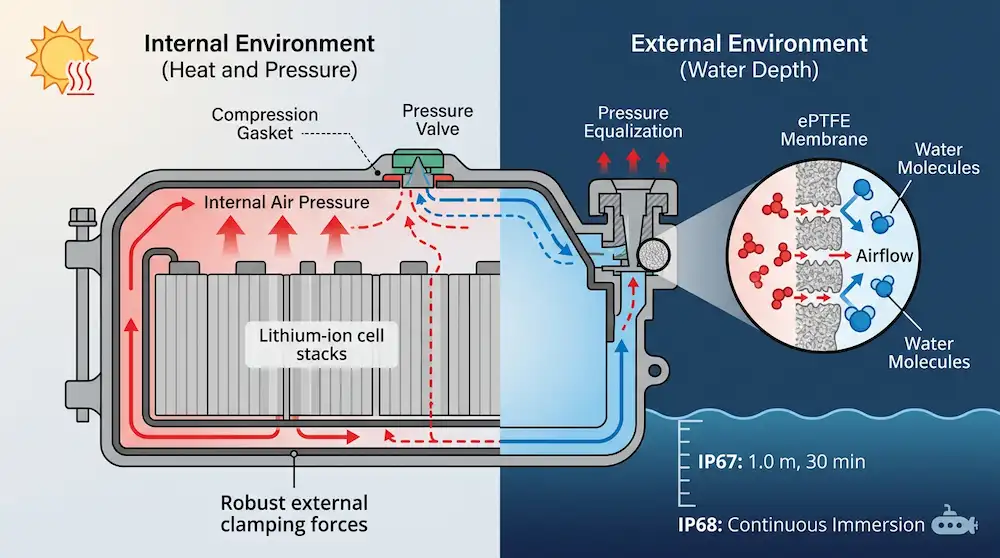
This membrane acts like a bouncer at a club. It allows air molecules to pass through so the internal pressure can equalize with the outside atmosphere. But the microscopic pores are too small to let liquid water molecules pass.
Combined with high-quality compression gaskets and precise clamping forces, these vents allow the enclosure to breathe without taking on water.
What Does an IP67/IP68 Waterproof Battery Pack Enclosure Consist Of?
A rugged battery enclosure is actually a highly complex ecosystem of mechanical, thermal, and electrical components.
Here are the primary components we integrate to achieve these ratings:
The Lower Tray and Upper Cover: Usually made from high-strength aluminum alloys or advanced composites.
Compression Seals: Custom-molded EPDM rubber gaskets or Form-In-Place-Gaskets (FIPG) made of silicone.
Liquid Cold Plates: Active thermal management is required to keep high-capacity modules cool, meaning we integrate precision liquid cold plates directly into the enclosure.
Sealing Gaskets: Usually made of advanced silicone or EPDM elastomers, these gaskets are compressed between the tray and the cover to achieve that critical IP67+ rating.
High-Voltage PDUs: Power Distribution Units (PDUs) must be housed inside the waterproof zone to prevent deadly shorts.
Intelligent BMS: The Battery Management System (BMS) acts as the brain, monitoring temperatures and voltages inside the sealed environment.
IP-Rated Connectors: Every high-voltage cable and VCU communication line entering the box must pass through specialized IP67/IP68 heavy-duty connectors.
We integrate all these key mechanical, thermal, electrical, and control elements to ensure the final product operates flawlessly.
Why is the IP67/IP68 Waterproof Rating Important for the Battery Pack Enclosures?
Water and high-voltage lithium-ion chemistry are a disastrous combination.
If water breaches a battery pack enclosure, it can cause catastrophic short circuits. This often leads to thermal runaway, a chemical chain reaction where the battery rapidly catches fire or explodes.
But safety isn’t the only reason waterproofing matters.
Heavy trucks have high demands for battery pack durability, liquid cooling, and high-voltage integration. If moisture gets inside the pack, it can cause slow galvanic corrosion on the busbars or disrupt the delicate VCU communication signals.
Furthermore, you literally cannot sell your vehicle without meeting strict regulatory standards.
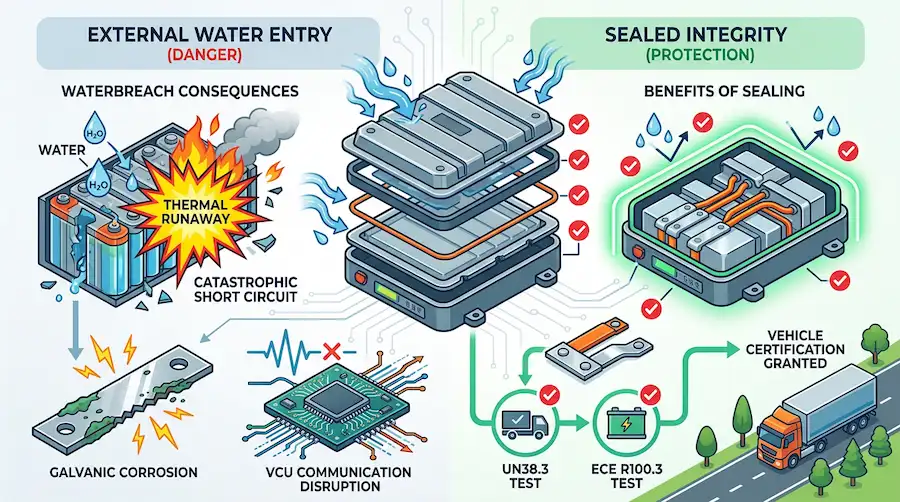
Proper sealing and waterproofing are absolute prerequisites for passing flawless UN38.3 and ECE R100.3 homologation tests. If your pack leaks, you fail certification, and your project grinds to a halt.
Which is Better, IP67 or IP68 Waterproof Rating for the Battery Pack Enclosure?
The “better” rating depends entirely on your specific application and packaging constraints.
If you are designing an electric passenger car, an IP67 rating is generally considered the gold standard. It provides more than enough protection for driving in heavy rain, hitting deep puddles, or surviving a car wash.
However, if your platform operates in extreme conditions, IP68 is the clear winner.
For instance, marine vessel builders and integrators operating in wet environments absolutely need the continuous submersion protection of IP68. The same applies to off-highway and construction equipment OEMs whose machines might get stuck in deep mud or flooded trenches.
But remember, engineering an IP68 enclosure adds significant cost and weight. You require thicker walls, heavier gaskets, and more complex CNC machining.
If your vehicle will never see a boat launch or a flooded mine, IP67 might be the most cost-effective engineering choice.
How to Design an IP67/IP68 Waterproof Rating for the Battery Pack Enclosures?
Designing a fully integrated, tested, and deployment-ready power system is incredibly difficult.
Tier-1 cell manufacturers are built for massive standard volume, often rejecting deep customization for off-highway, marine, or specialized commercial fleets. They sell you the raw modules, but they leave you with a massive engineering headache.
How do you cool them? How do you package them safely? How do you make them talk to your vehicle?
This is exactly where we step in. Here is how to approach the design process:
1. Define the Operating Profile
Projects typically begin with a review of the application, operating profile, packaging constraints, electrical targets, and compliance needs. You must know exactly what environmental hazards your vehicle will face before drawing a single CAD line.
2. Structural and Thermal Simulation
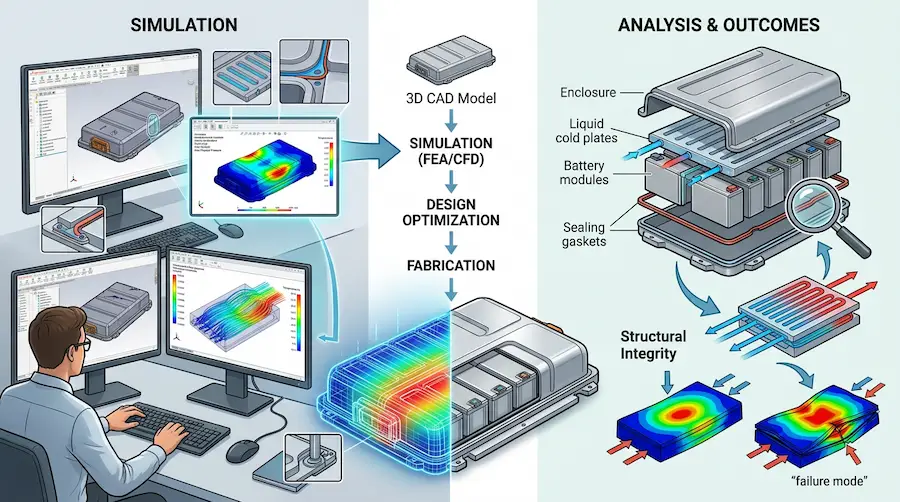
Before cutting any metal, we run extensive initial 3D design and thermal simulations. We analyze how the enclosure will deform under physical stress and how the precision liquid cold plates will dissipate heat. If the metal warps too much under heat, the seals will fail.
3. Master the Tolerances
Waterproofing is all about tight manufacturing tolerances. We utilize CNC-machined enclosures to ensure the mating surfaces between the lid and the tray are perfectly flat.

4. Implement a “Bring Your Own Cells” Strategy
Our defining strength is our transparent “Bring Your Own Cells/Modules” partnership model. You negotiate directly with top cell manufacturers to secure raw modules at zero middleman markup, while we master the deep engineering and complex supply chain ecosystem. We engineer the waterproof box precisely around the chemistry you choose.
5. Validate with End-of-Line Testing
You cannot test a waterproof battery pack by dumping it in a pool of water on the assembly line. Instead, manufacturing is executed by our strategic network of over 20 IATF-16949 certified partners, governed by resident QA engineers and 100% End-of-Line testing protocols. We use high-precision air decay or helium leak testing to verify the IP rating without damaging the electronics.
Summary
Battery projects often fail at the integration stage — not because components are unavailable, but because mechanical, thermal, electrical, and control systems are not developed as one coordinated solution.
Achieving an IP67 or IP68 rating requires deep domain expertise. From pressure equalization and high-voltage PDUs to advanced thermal management, every single detail matters.
If you’re a Chief Engineer, or Program Manager struggling to bridge the gap between raw cell chemistry and your customized vehicle, you don’t have to tackle it alone.
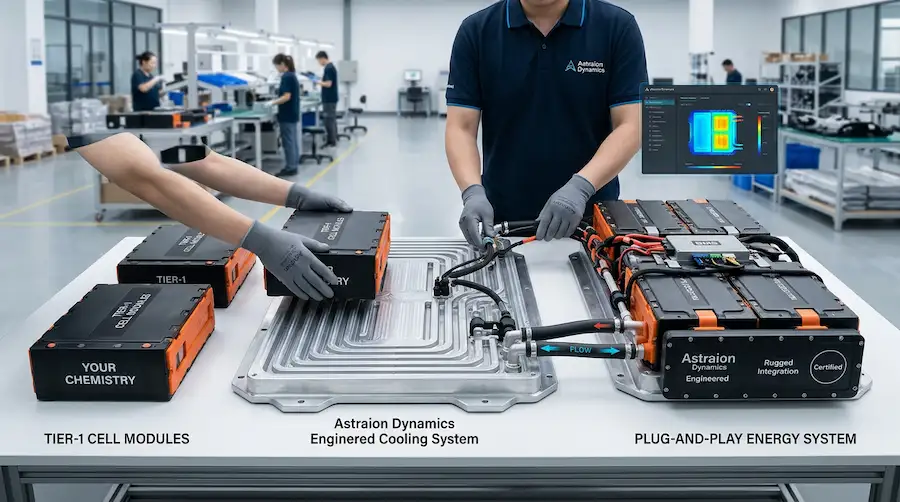
Our business exists to help customers reduce integration risk, shorten development cycles, and bring battery-powered platforms into operation with greater confidence. You control the chemistry, we master the engineering.
Are you ready to turn your raw modules into a rugged, fully certified, plug-and-play energy system? Contact our engineering team today to review your application’s specific packaging and compliance needs.
