

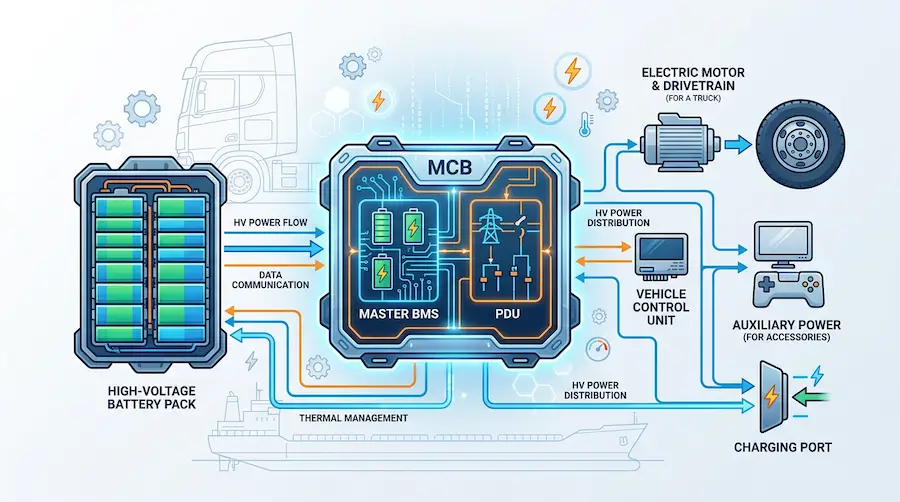
If you are electrifying heavy-duty trucks or marine vessels, you already know that managing massive high-voltage energy systems is a massive engineering headache. In this guide, I will break down everything you need to know about the Master Control Box (MCB). You will learn exactly how it integrates power and logic to keep your commercial fleet running safely, efficiently, and profitably.
A Master Control Box (MCB) in heavy-duty commercial EVs is a centralized hub that integrates the Master Battery Management System (BMS) and the Power Distribution Unit (PDU). It safely manages high-voltage routing, thermal controls, and battery string communication in demanding environments.
Want to know exactly how it differs from a standard PDU or VCU, and why getting it right is the difference between a successful launch and a catastrophic failure? Let’s dive right in.
What is a Master Control Box?
Let’s start with the basics.
When you are dealing with a heavy-duty commercial vehicle, an electric vessel, or industrial equipment, you aren’t just hooking up a few AA batteries. You are dealing with a massive lithium-ion battery pack capable of storing hundreds of kilowatt-hours of energy.
Tier-1 cell manufacturers are built for massive standard volume, but they often reject deep customization for off-highway, marine, or specialized commercial fleets. They gladly sell you the raw modules, but they leave you with a massive engineering headache. How do you package them safely? How do you make them talk to your vehicle?
That is where the Master Control Box comes in.
The Master Control Box is the primary physical and electronic gateway between your battery modules and the rest of the vehicle. Think of it as the ultimate “control center.” It houses the high-voltage electrical routing components (the muscle) and the master control boards (the brain) in one unified, rugged enclosure. Instead of having a scattered mess of wires, fuses, and control boards all over your chassis, the MCB centralizes everything into a single, highly engineered unit.
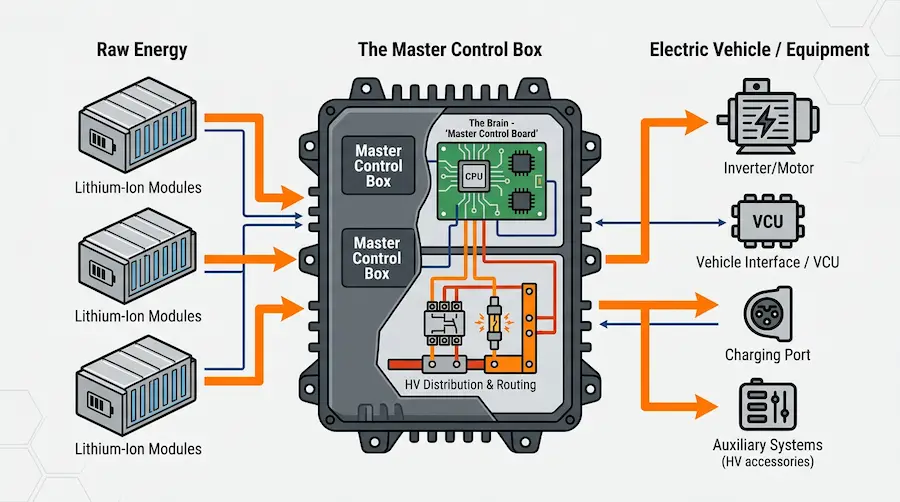
What does the Master Control Box stand for for the Heavy-Duty Commercial and Trucks?
In the commercial sector, the Master Control Box stands for uncompromising safety, system reliability, and seamless integration.
Heavy trucks have high demands for battery pack durability, liquid cooling, and high-voltage integration. Unlike passenger cars that might see a few hours of use a day, heavy-duty trucks, electric agricultural machinery, and battery-electric mining vehicles operate in brutal conditions. Mining vehicles, for instance, demand highly reliable, explosion-proof, and heavy-duty battery systems. Electric boats and ferries have stringent requirements for waterproofing, liquid cooling, and system integration.
For these platforms, the MCB stands for stability. It is the guarantee that mechanical, thermal, electrical, and control systems are developed as one coordinated solution. Without a robust MCB, battery projects often fail at the integration stage.
What is the role of the Master Control Box for the Heavy-Duty Commercial and Trucks?
The MCB plays the role of the Ultimate Gatekeeper and Communicator.
Its primary role is to bridge the gap between raw cell chemistry and your customized vehicle. When you drop a massive lithium-ion battery pack into a heavy-duty chassis, that pack needs a manager.
The MCB sits right at the border of the battery system and the vehicle’s powertrain.
It has two main jobs:
Protect the battery from the vehicle: Ensuring the motors don’t draw too much current and damage the cells.
Protect the vehicle from the battery: Stepping in to cut high-voltage power instantly in the event of a crash, thermal event, or short circuit.
It takes on the role of coordinating intelligent BMS architectures and high-voltage PDUs to ensure that the massive energy reserves are deployed safely and efficiently.
What is the function of the Master Control Box for the Heavy-Duty Commercial and Trucks?
The functions of an MCB are highly complex. Let’s break down exactly what this box does on a second-by-second basis:
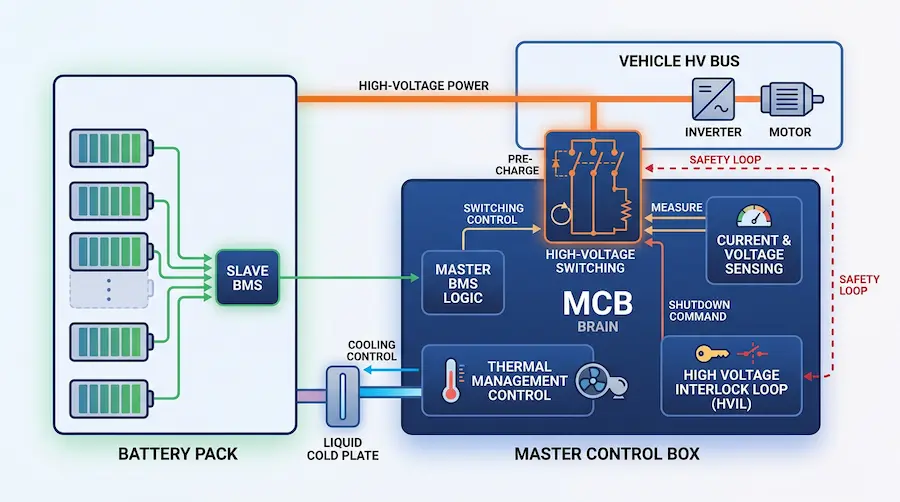
High-Voltage Switching: It uses heavy-duty contactors to physically connect or disconnect the battery pack from the vehicle’s high-voltage bus.
Pre-Charge Sequencing: When you turn a heavy truck on, the MCB routes a small amount of current through a pre-charge resistor first. This prevents massive inrush currents from welding the main contactors shut.
Current & Voltage Sensing: It features highly accurate Hall-effect sensors or shunts to measure exactly how much juice is flowing in and out of the pack.
Master BMS Logic: It aggregates data from all the “slave” BMS boards located on individual battery modules. It calculates the overall State of Charge (SoC) and State of Health (SoH) for the entire system.
Thermal Management Control: It monitors temperature and commands the precision liquid cold plates or cooling pumps to kick in when the cells get too hot.
High Voltage Interlock Loop (HVIL) Monitoring: It constantly sends a low-voltage signal through the system’s high-voltage connectors. If a connector is unplugged or broken, the MCB instantly cuts high-voltage power.
How does the Master Control Box work for the Heavy-Duty Commercial and Trucks?
So, how does all this technology actually work together in the real world?
Here is the step-by-step workflow of an MCB during a typical startup of an electric heavy-duty truck:
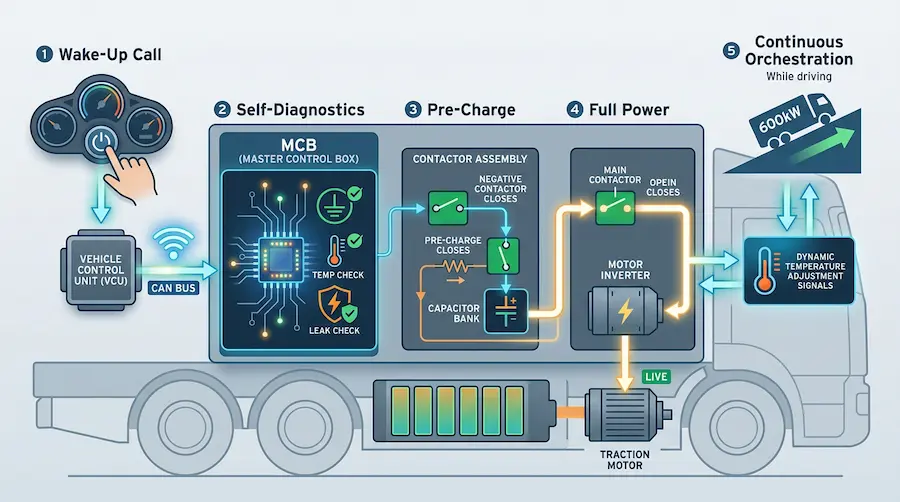
The Wake-Up Call: The driver turns the key. The Vehicle Control Unit (VCU) sends a CAN bus signal to the MCB asking to wake up the battery pack.
Self-Diagnostics: The MCB’s internal master board runs a split-second diagnostic. It checks for ground faults, verifies that all cell temperatures are within safe limits, and ensures no high-voltage leaks are present.
The Pre-Charge: The MCB closes the negative contactor and the pre-charge contactor. Current flows slowly into the motor’s inverter capacitors.
Full Power: Once voltages equalize, the MCB closes the main positive contactor and drops the pre-charge circuit. The vehicle is now live.
Continuous Orchestration: While driving, the MCB continuously talks to the VCU. If the driver hits a massive hill and demands 600kW of power, the MCB calculates if the battery can handle it based on current temperatures. If not, it actively limits the power output to protect the lithium-ion cells.
This level of application-driven engineering is built around real platform constraints to ensure reliable real-world operation.
What does the Master Control Box consist of for the Heavy-Duty Commercial and Trucks?
To achieve this level of performance, you need serious hardware. Here is what is packed inside a commercial-grade Master Control Box:
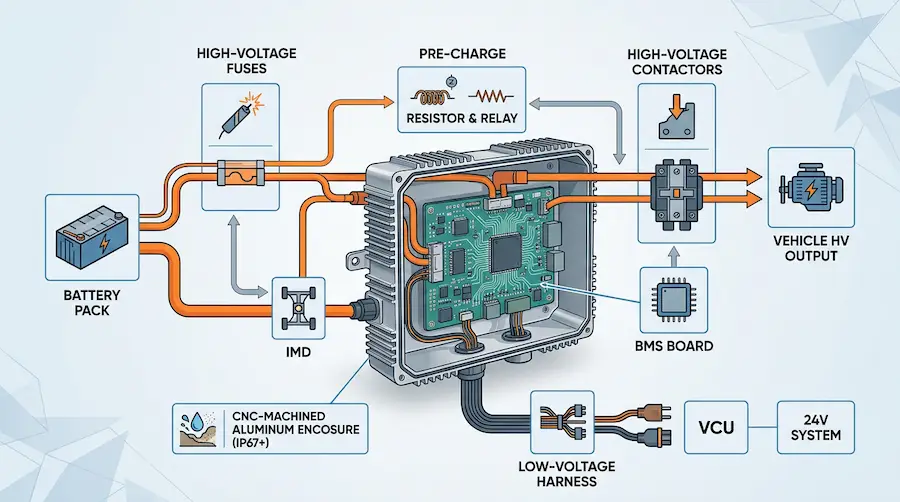
Rugged IP67+ Aluminum Enclosures: Heavy-duty applications require CNC-machined enclosures that keep out dust, water, and vibration.
Master BMS Board: The microprocessor-driven brain that processes complex algorithms.
High-Voltage Contactors: Industrial-grade electromagnets that physically bridge the high-voltage connections.
Pre-Charge Resistor & Relay: The components responsible for the safe startup sequence.
High-Voltage Fuses: Fast-acting pyrotechnic or traditional EV fuses that physically blow during a catastrophic short circuit.
Insulation Monitoring Device (IMD): A specialized sensor that ensures the high-voltage system is completely isolated from the vehicle’s metal chassis.
Low-Voltage Harness Connectors: To interface with the VCU and the vehicle’s 24V system.
Manufacturing these components requires execution by a strategic network of certified partners, governed by strict QA engineers and 100% End-of-Line testing protocols.
What are the benefits of the Master Control Box?
Why go through the trouble of designing a unified MCB instead of just wiring components directly into the chassis?
Here is why top CTOs and Chief Engineers insist on a centralized MCB:
1. Radically Reduced Integration Risk
By combining enclosure engineering, thermal management, HV architecture, and intelligent controls into one coordinated workflow, you drastically reduce the chance of integration failure. It allows for fully integrated, plug-and-play battery systems built for real-world operation.
2. Streamlined Supply Chain & Homologation
A centralized MCB makes global homologation (like UN38.3 and ECE R100.3) much easier. Because the critical safety components are housed in one certified box, vehicle-level testing passes faster.
3. Easier Diagnostics and Maintenance
If a heavy-duty truck goes down, fleets lose money. An MCB centralizes all fault codes. A technician can plug into one CAN port on the MCB and instantly know if a contactor is stuck or a fuse is blown, drastically reducing downtime.
4. Scalability for ESS and Marine
For Energy Storage System (ESS) projects or marine vessels requiring massive scale, a modular MCB allows you to safely link multiple battery packs in parallel.
What are the disadvantages of the Master Control Box?
I like to keep things totally transparent. While an MCB is necessary, it does come with a few challenges you need to plan for.
High Upfront Engineering Cost: Designing an MCB that can handle the massive vibration of a mining truck and the thermal loads of a 1000V architecture requires deep engineering.
Single Point of Failure: Because the MCB houses both the brain (Master BMS) and the brawn (Contactors), if the box gets critically damaged, the entire battery system goes offline.
Packaging Constraints: Heavy-duty MCBs are physically large and heavy. Finding the right packaging space in specialty vehicle development can be a challenge.
What are the differences for the VCU, MCU and Master Control Box?
This is where a lot of early-stage electrification startups and even veteran engineers get tripped up. The alphabet soup of EV components can be confusing. Let’s clarify the exact differences:
VCU (Vehicle Control Unit)
The Role: The CEO of the vehicle.
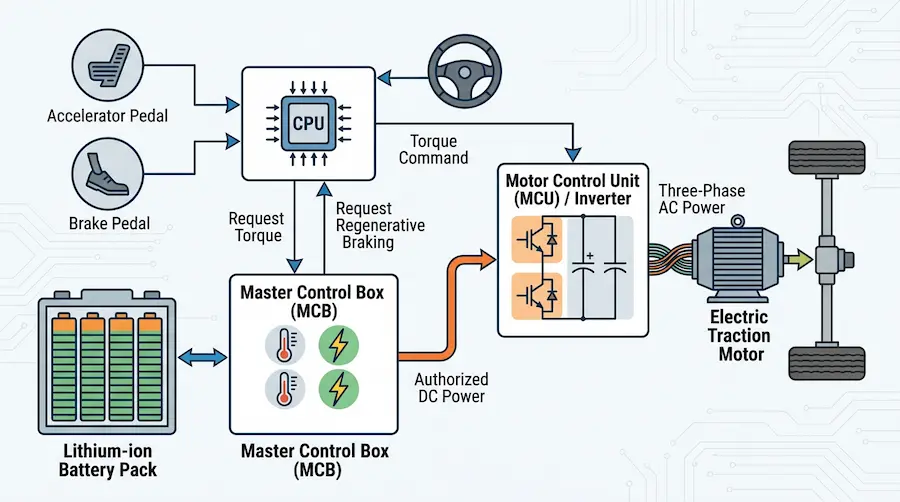
Function: It looks at the accelerator pedal, the brake pedal, and the steering angle. It decides what the vehicle wants to do. It does NOT manage the battery directly; it simply makes requests to the MCB.
MCU (Motor Control Unit / Inverter)
The Role: The Muscle.
Function: It sits between the battery and the electric motor. It takes the direct current (DC) power authorized by the MCB and converts it into the alternating current (AC) required to spin the traction motors.
MCB (Master Control Box)
The Role: The Risk & Compliance Officer.
Function: It manages the energy. The VCU might ask for 500 amps to climb a hill. The MCB looks at the battery’s temperature and SoC, and replies: “No, the cells are too hot. I’m only giving you 300 amps.” It has the final say on power delivery.
High-Voltage Control Box vs. Master Control Box
You will often hear the terms “High-Voltage Control Box” (HV Box / PDU) and “Master Control Box” used interchangeably. But they are not the same thing.
A High-Voltage Control Box (or PDU) is essentially a “dumb” distribution panel. It contains the contactors, the busbars, and the fuses. It distributes the power, but it has no intelligence of its own. It relies on an external BMS to tell it when to open or close the circuits.
A Master Control Box (MCB) is the marriage of a PDU and a Master BMS. It contains all the high-voltage distribution hardware, but it also houses the microprocessors, the intelligent BMS architectures, and the VCU communication gateways. It is a fully self-contained smart unit.
For targeted customers seeking supply chain outsourcing, customized integration, and high-reliability testing, opting for a unified MCB over a separate, fragmented PDU and BMS setup is almost always the smarter, safer play.
Conclusion
Building a heavy-duty electric vehicle, a marine vessel, or industrial equipment isn’t just about buying cells. It is about how you control them.
The Master Control Box is the beating heart of your heavy-duty commercial EV. It takes the raw, volatile energy of a massive lithium-ion battery pack and turns it into safe, reliable, and intelligent power.
But getting the mechanical, thermal, electrical, and control systems to work perfectly together is notoriously difficult. If you are a CTO, Chief Engineer, Battery Systems Engineer, or Program Manager, you don’t have time to waste on integration failures.
That is exactly where we step in.
At Astraion Dynamics, our mission is to make battery system integration more practical, more reliable, and more deployment-ready for demanding real-world applications. We operate on a transparent “Bring Your Own Cells/Modules” partnership model. You negotiate directly with top cell manufacturers to secure raw modules at zero middleman markup, while we master the deep engineering and complex supply chain ecosystem.
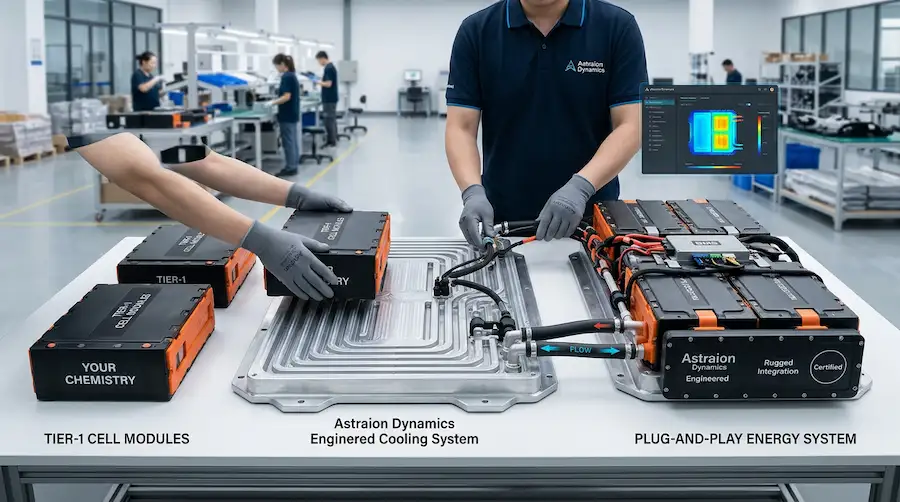
From precision liquid cooling and intelligent BMS architectures to rugged IP67+ MCB enclosures and global homologation, we transform your procured raw modules into a rugged, fully certified, plug-and-play energy system.
You Control the Chemistry, We Master the Engineering.
Ready to shorten your development cycles and bring your battery-powered platforms into operation with total confidence? Reach out to our engineering team today to discuss your system architecture, packaging constraints, and compliance needs. Let’s build something powerful together.
