

You’re staring at a stack of raw lithium-ion cells, wondering how to safely power a multi-ton vessel through corrosive saltwater and continuous hydrodynamic drag. Integrating battery systems for marine environments is a massive engineering headache. Let’s break down exactly what makes a battery system truly ready for the water.
A marine-grade battery pack is a deeply integrated, highly fortified energy storage system engineered specifically for aquatic environments. It features ruggedized IP67+ waterproof enclosures, precision liquid cooling, and specialized high-voltage architecture to ensure absolute safety and reliability on the water.
But slapping a waterproof plastic box around some standard cells simply won’t cut it in commercial applications. Read on to discover the specific mechanical engineering elements, thermal management strategies, and the exact differences between marine and standard passenger EV battery systems.
What is an electric boat?
An electric boat is a marine vessel driven entirely or partially by electric motors, drawing power from an integrated energy storage system rather than a traditional internal combustion engine (ICE).
Instead of diesel tanks and loud, vibrating combustion engines, these vessels rely on a high-voltage lithium-ion battery pack to deliver quiet, emission-free propulsion. We are seeing a massive shift in the maritime industry right now. The European market, in particular, is experiencing rapid growth in this sector, driven by strict environmental regulations and the push for decarbonized waterways.
Electric boats range from small recreational leisure crafts to massive commercial ferries and specialized workboats. Regardless of the size, the core challenge remains the same: storing and deploying large amounts of electrical energy in an environment that is naturally hostile to electricity.
What are the purposes of the marine-grade battery pack?
The primary purpose of a marine-grade battery pack is to store and deliver high-voltage direct current (DC) safely and consistently, regardless of how harsh the external environment gets.
When you put an energy storage system on a boat, you face a unique set of brutal conditions. Electric boats and ferries have stringent requirements for waterproofing, liquid cooling, and overall system integration. A standard battery pack would quickly fail—or worse, catch fire—under these conditions.
Therefore, a marine-grade pack serves several critical engineering purposes:
Environmental Isolation: It must completely protect the volatile lithium-ion chemistry from saltwater, high humidity, and corrosive salt fog.
Thermal Stabilization: It must maintain optimal cell temperatures during extreme, continuous discharge cycles.
Structural Integrity: It has to absorb continuous mechanical shock, vibration, and hull slamming without compromising electrical connections or the cooling loop.
Intelligent Safety: It must monitor cell voltages and temperatures at a granular level to prevent thermal runaway.

Our mission is to make battery system integration more practical, more reliable, and more deployment-ready for these demanding real-world applications .
How does the marine-grade battery pack work for electric boats?
If you want to understand how these systems work, you have to understand the physics of moving a boat through water.
Water is nearly 800 times denser than air. When you drive a passenger EV on a highway, you accelerate to your cruising speed and then the motor only needs to overcome rolling resistance and aerodynamic drag. The battery output drops significantly.
Boats don’t have that luxury. A boat is essentially driving uphill 100% of the time. Overcoming hydrodynamic drag requires continuous, high-torque power delivery. This means the battery pack must sustain high continuous discharge rates (C-rates) for hours on end.
Here is how the system handles that workload:
Energy Dispatch: The Vehicle Control Unit (VCU) requests a specific torque from the electric motor.
BMS Validation: The Battery Management System (BMS) instantly checks the State of Charge (SoC), State of Health (SoH), and cell temperatures to ensure the request is safe.
High-Voltage Delivery: The high-voltage Power Distribution Unit (PDU) closes the contactors, allowing the DC current to flow from the modules to the motor inverter.
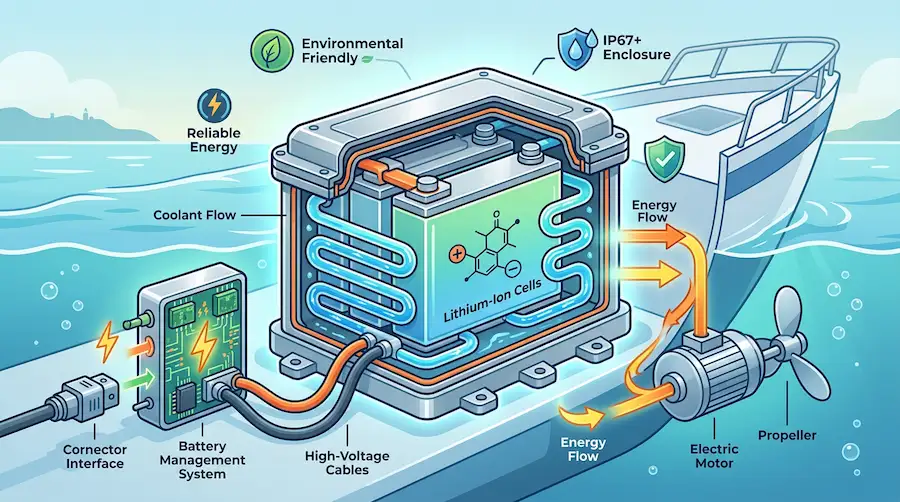
Active Thermal Management: Because discharging at high continuous C-rates generates massive amounts of internal heat, the system’s thermal management kicks in. Coolant is pumped through a precision liquid cold plate located directly beneath or between the cell modules, pulling heat away from the chemistry to prevent degradation or thermal runaway.

Every single one of these steps must happen flawlessly. Battery projects often fail at the integration stage because mechanical, thermal, electrical, and control systems are not developed as one coordinated solution.
What does the marine-grade battery pack consist of?
A reliable marine-grade system is a symphony of highly engineered components. If you are an engineering manager, you know that the magic is in the integration. Here are the core components:
1. Lithium-Ion Cells and Modules
This is the raw energy. Tier-1 cell manufacturers are built for massive standard volume, and they sell you the raw modules, but they leave you with a massive engineering headache on how to package and cool them. Whether you use LFP (Lithium Iron Phosphate) for maximum cycle life or NMC (Nickel Manganese Cobalt) for higher energy density, the cells are just the starting point.
2. Battery Pack Enclosure
You can’t cut corners here. For marine environments, we rely on CNC-machined enclosures built from ruggedized aluminum. The battery pack enclosure must be rated IP67+ (or even IP6K9K) to guarantee absolutely no water ingress, even during temporary submersion. Aluminum is preferred over steel or composites because it offers excellent structural rigidity, acts as a secondary heat sink, and provides critical electromagnetic shielding (EMC) for the high-voltage components inside.
3. Precision Liquid Cold Plate
Air cooling does not work for commercial marine applications. You need liquid cooling. A liquid cold plate is a custom-machined aluminum component with internal micro-channels that circulate a water-glycol mixture. It sits in direct thermal contact with the battery modules. Because boats demand continuous high-power output, the liquid cold plate is responsible for keeping the temperature delta between the hottest and coldest cells strictly under 3°C to 5°C. This maximizes cycle life and guarantees safety.
4. Battery Management System (BMS) & High-Voltage PDU
The intelligent BMS architecture monitors every single cell voltage, temperature, and current in real-time. It communicates with the vessel’s master controller via CAN bus. Paired with this is the High-Voltage Power Distribution Unit (PDU), which houses the contactors, fuses, and pre-charge circuits necessary to safely connect and disconnect the massive electrical load.

What are the benefits of the marine-grade battery pack?
Investing in a properly engineered marine-grade system might require more upfront capital, but the operational benefits are undeniable.
Unmatched Reliability: By designing around real platform constraints, you get a rugged, fully certified, plug-and-play energy system that won’t fail when you are miles offshore.
Extended Lifespan: Thanks to the precision liquid cold plate, the cells operate in their ideal temperature window, drastically slowing down chemical degradation and extending the pack’s operational life.
Lower Total Cost of Ownership (TCO): While the initial integration cost is higher, the sheer reduction in maintenance (no oil changes, no diesel fuel, fewer moving parts) means commercial fleet operators recover their costs quickly.
Zero Emissions and Silent Operation: This is crucial for operating in protected marine reserves or providing a premium, noise-free experience on luxury vessels.
What are the disadvantages of the marine-grade battery pack?
I always believe in being transparent about engineering challenges. It’s not all smooth sailing.
Deep Engineering Complexity: You cannot just buy off-the-shelf standard modules and put them on a boat. Tier-1 cell manufacturers often reject deep customization for marine or specialized commercial fleets. This leaves OEMs and vessel builders with the heavy lifting of thermal and mechanical integration.
Weight Penalties: Lithium-ion battery packs are heavy. While weight is slightly less critical on a boat than in an airplane, it still affects the vessel’s draft and hydrodynamic efficiency. You must carefully calculate your energy density requirements.
Stringent Certification Hurdles: Getting a marine system certified (e.g., DNV, Lloyd’s Register, UN38.3, ECE R100.3) is an exhaustive, expensive process requiring rigorous validation.
What are the differences between marine-grade and Passenger EV battery packs?
This is a question I hear all the time from vehicle integration engineers and procurement leads. If EV passenger car manufacturers already have great battery packs, why not just drop a Tesla or VW pack into a boat?
The operating profiles are entirely different. EV passenger car manufacturers require high-precision battery pack systems tailored for standardized, high-volume production lines. Cars spend most of their time parked or cruising at low continuous loads.
Marine vessels operate more like heavy-duty off-highway equipment. They face continuous maximum load. Therefore, the differences are stark:
Thermal Management: A passenger EV pack might survive with a basic cooling plate. A marine-grade pack requires a highly optimized liquid cold plate capable of rejecting massive amounts of continuous heat.
Structural Rigidity: Cars rely on the vehicle chassis to protect the battery. In a boat, the battery pack enclosure itself must handle extreme multi-axis vibration and hull slamming impacts independently.
Customization: Automotive packs are locked into one shape for hundreds of thousands of identical cars. Marine vessel builders need application-driven engineering built around highly specific, constrained hull spaces.
What are the applications for the marine-grade battery pack?
Our target customers are OEMs, vessel manufacturers, system integrators, and electrification startups developing platforms for demanding applications. A heavily integrated marine-grade pack is perfect for:

Electric Ferries and Water Taxis: These vessels run predictable routes with fast-charging intervals. They require massive capacity and flawless liquid cooling to handle continuous daily cycling.
Leisure and Luxury Yachts: Owners demand silent, fume-free operation for hotel loads and low-speed cruising.
Commercial Workboats and Tugboats: These applications require extreme torque bursts. We transform procured raw modules into a rugged, fully certified energy system built to handle this brutal industrial use.
Autonomous Marine Vehicles: Unmanned surface vessels (USVs) mapping the ocean floor rely entirely on deeply integrated, fail-safe battery architecture.
Conclusion
Building an electric boat is not as simple as swapping a diesel engine for an electric motor. The heart of the vessel—the energy storage system—dictates everything from safety and range to commercial viability.
If you are a Chief Engineer, or Program Manager, you know that navigating the gap between raw cell chemistry and your customized vehicle is a monumental task. You might have secured great pricing on raw modules, but integrating the IP67+ aluminum enclosures, precision liquid cold plates, intelligent BMS, and high-voltage PDUs requires specialized, heavy-duty expertise.
That is exactly where we step in. At Astraion Dynamics, our corporate positioning is simple: The Ultimate “Bring Your Own Cells / Modules” Integration Hub for Heavy-Duty, Marine and Off-Highway Applications. You control the chemistry, we master the engineering.
If your engineering team is tired of the integration headache and wants to bring battery-powered platforms into operation with greater confidence, let’s talk. Contact our engineering team today to review your application, operating profile, and packaging constraints—and let us design a turnkey battery system architecture that actually works in the real world.
