

You are engineering a heavy-duty electric truck, and you need to route hundreds of volts of raw power from your lithium-ion battery pack safely.
But how exactly do you manage this extreme energy without risking a catastrophic failure, electrical arcing, or a blown inverter?
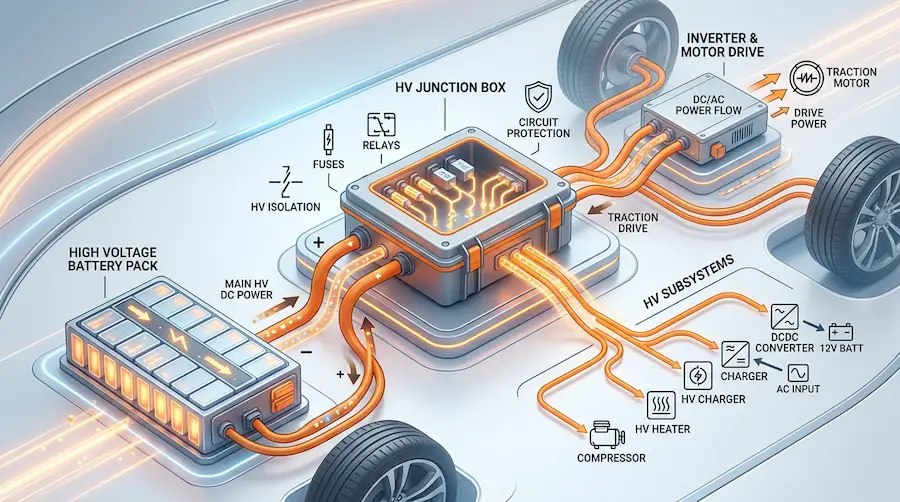
A high-voltage (HV) junction box is a crucial electrical enclosure in electric vehicles (EVs) that safely distributes, connects, and protects high-voltage power between the battery pack, inverter, and other HV subsystems. It acts as the central power routing hub, ensuring electrical isolation, circuit protection, and system safety.
Sounds simple enough, right?
But when you dig into engineering—especially for heavy-duty applications—it’s a whole different beast. Let’s break down exactly how this component keeps your EV running safely and efficiently.
What is high voltage HV?
If you work in traditional automotive engineering, you are probably used to 12V or 24V systems.
But in the world of electric vehicles, “high voltage” takes on a completely different meaning.
According to UN ECE R100 (the global standard for EV safety), any DC voltage operating between 60V and 1,500V is classified as Class B high voltage.
In a modern passenger EV, the architecture is typically around 400V. However, if you are building an electric truck, marine vessel, or heavy-duty mining equipment, you are likely pushing into 800V or even 1,000V+ territory.
Why? Because heavy vehicles require massive amounts of power.

Higher voltage allows you to deliver the same amount of power using less current. Less current means thinner cables, less heat generation, and improved overall system efficiency.
But with these massive voltage levels comes a massive engineering headache. You cannot simply connect a raw battery module directly to your motor.
That is exactly where the high-voltage junction box steps in.
What’s the difference between HV and LV?
To understand the EV architecture, you need to draw a hard line between High Voltage (HV) and Low Voltage (LV).
High Voltage (HV) Systems:
These are the heavy lifters. The HV system handles everything that requires massive energy to move the vehicle or regulate its temperature.
Lithium-ion battery pack
Traction motors and inverters
Electric air conditioning compressor (e-compressor)
PTC cabin heaters
On-Board Charger (OBC)

Low Voltage (LV) Systems:
These operate at 12V or 24V DC. The LV system is the “brains” and the traditional accessories of the vehicle.
Infotainment screens and lighting
Vehicle Control Unit (VCU)
Battery Management System (BMS) logic board
Coolant pumps and fans

You absolutely must keep these two systems physically and electrically isolated. If 800V from your battery pack accidentally jumps into your 12V VCU, your vehicle’s computers will instantly fry.
The HV junction box is designed to safely route the high-voltage power while keeping it completely separated from your low-voltage control signals.
What is an HV junction box used for?
Think of the HV junction box as the breaker panel in your house, but engineered for a moving, vibrating, extreme-temperature environment.
It serves three core purposes:
1. Power Distribution
Your lithium-ion battery pack produces one massive output of DC power. But your vehicle has multiple HV components. The junction box splits this main power feed into separate channels for the traction inverter, the AC compressor, the heater, and the DC-DC converter.
2. Circuit Protection
If your electric truck’s inverter shorts out, you don’t want the battery pack to keep dumping thousands of amps into the fault. The junction box uses high-voltage fuses to instantly break the circuit and prevent a fire.
3. Safety and Isolation
When a technician unplugs a cable, or if the vehicle is in a crash, the system must shut down instantly. The junction box manages this safety barrier.
How does the HV junction box work in EVs?
The operation of an HV junction box isn’t just about passive routing; it’s a highly orchestrated sequence.
When you turn the key (or press the start button) on an electric truck, the vehicle doesn’t just instantly connect the battery to the motor. If it did, the massive inrush of current into the inverter’s capacitors would literally weld the contactors (relays) permanently shut.
Instead, the junction box performs a pre-charge sequence.
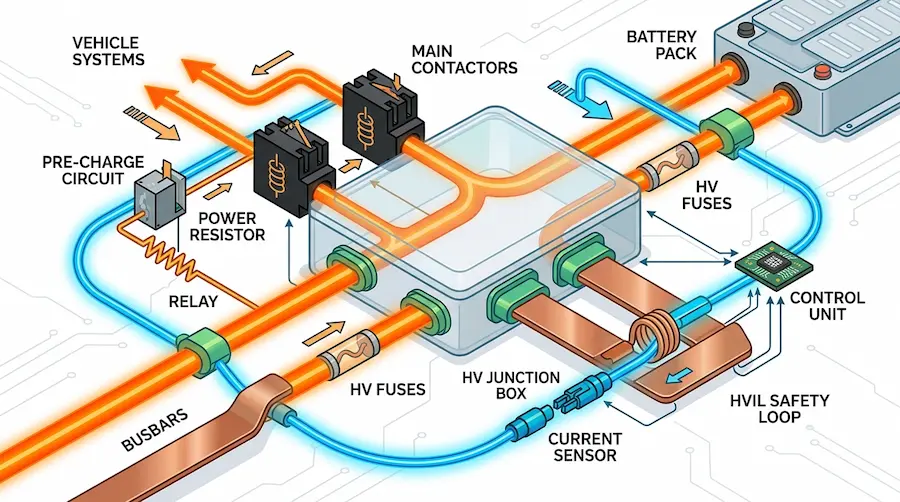
First, it closes a small pre-charge relay. This forces the high-voltage electricity to flow through a pre-charge resistor, trickling the power into the inverter slowly.
Once the inverter’s voltage matches the battery pack’s voltage, the system safely closes the main contactors. Finally, it opens the pre-charge relay.
All of this happens in milliseconds.
This is why heavy trucks have such high demands for battery pack durability and high-voltage integration. If this sequence fails in a heavy-duty commercial vehicle, the downtime is incredibly costly.

What does the HV junction box contain?
If you open up an HV junction box, you will find a highly engineered layout of components. Here is exactly what is inside:
Main Contactors: These are heavy-duty electromagnetic relays. They act as the main physical switches that connect or disconnect the battery pack from the rest of the vehicle.
Pre-charge Circuit: As I mentioned above, this includes a smaller relay and a power resistor to safely charge the system capacitors before full power is unleashed.
High-Voltage Fuses: Fast-acting physical fuses that blow in the event of an overcurrent or short circuit.
Busbars: Thick, solid strips of copper or aluminum that carry the massive electrical currents between components.
Current Sensors: High-precision shunts or Hall-effect sensors that constantly measure exactly how much current is flowing in and out of the battery pack.
HVIL (High Voltage Interlock Loop): This is a continuous low-voltage safety wire that runs through every high-voltage connector. If a connector is unplugged, the HVIL circuit breaks, and the junction box instantly commands the main contactors to open.
What are the advantages of the HV junction box?
Why not just wire everything directly and scatter fuses around the vehicle?
1. Centralized Safety
By putting all your high-voltage switches and fuses in one rugged, sealed enclosure, you dramatically reduce the risk of accidental exposure.
2. Simplified Manufacturing and Maintenance
A centralized junction box makes wiring harnesses much simpler. When a technician needs to diagnose a power issue on an electric truck, they only need to look in one place.
3. Excellent EMC Shielding
High-voltage cables act like giant antennas, radiating electromagnetic interference (EMI) that can scramble your VCU or radio. A properly designed aluminum junction box acts as a Faraday cage, blocking this noise.
This is highly critical for heavy-duty vehicle manufacturers and marine vessel builders who operate in complex electronic environments.
What are the differences between PDU and HV junction boxes?
If you spend enough time talking to a Battery Systems Engineer or an Electrical / HV Engineer, you will hear the terms “HV Junction Box” and “PDU” (Power Distribution Unit) used interchangeably.
But technically, they are different.
An HV Junction Box is traditionally a “dumb” component. It houses the busbars, fuses, and contactors, but it relies on an external computer (like the VCU or BMS) to tell it what to do.
A PDU (Power Distribution Unit) is the intelligent evolution of the junction box. A true PDU has its own control logic board built right in.
Instead of just blindly holding fuses, an advanced PDU can monitor its own temperatures, measure current down to the milliamp, and communicate directly with the vehicle via CAN bus.
At Astraion Dynamics, our in-house engineering team designs both rugged IP67+ aluminum enclosures and these highly intelligent, high-voltage PDUs.
What is the connection between the PDU and the HV junction box?
In modern EV architecture, the lines between the two are blurring.
Often, the HV junction box acts as the physical, mechanical shell, while the PDU is the entire functional assembly inside it. In many heavy-duty applications, the PDU is physically integrated directly into the lithium-ion battery pack enclosure to save space and reduce cable length.
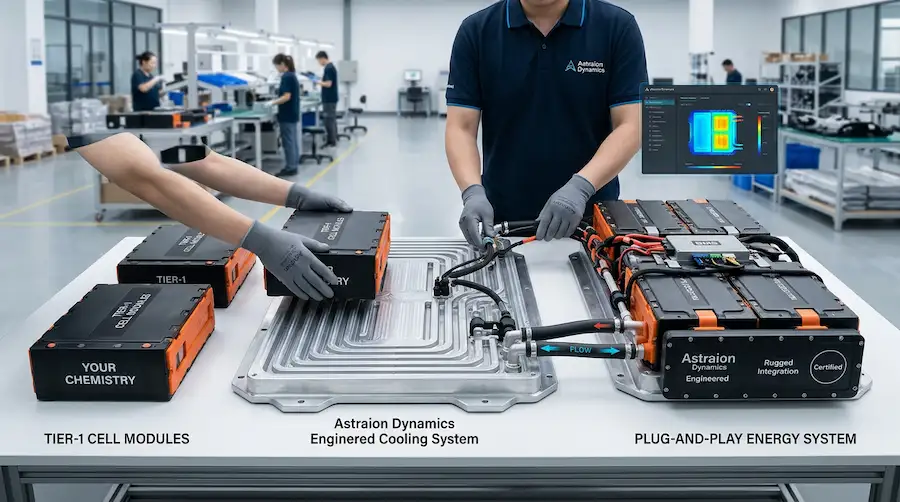
Tier-1 cell manufacturers are built for massive standard volume and often reject deep customization for off-highway or specialized commercial fleets. They sell you the raw modules, but they leave you with a massive engineering headache.
How do you make them talk to your vehicle? How do you package the PDU safely?
As an engineering-first integrator, Astraion Dynamics steps in right here. We transform your procured raw modules into a rugged, fully certified, plug-and-play energy system. We design the system architecture, seamlessly bridging the connection between the raw cell chemistry, the intelligent BMS, and the high-voltage PDU.
Conclusion
Let’s recap what we’ve covered today:
HV vs LV: EVs separate the high-voltage muscle (400V-1000V) from the low-voltage brains (12V/24V).
Core Function: The HV junction box distributes power, protects circuits, and isolates dangerous voltage.
Internal Anatomy: It relies on contactors, pre-charge circuits, fuses, and HVIL loops to operate safely.
PDU Evolution: While junction boxes are passive, modern PDUs add intelligent control, thermal monitoring, and CAN communication.
Navigating high-voltage integration is no easy task. Battery projects often fail at the integration stage—not because components are unavailable, but because mechanical, thermal, electrical, and control systems are not developed as one coordinated solution.
If you are a Chief Engineer, or Purchasing Manager developing a new electric truck, marine vessel, or industrial platform, you don’t have to tackle this alone.
You Control the Chemistry, We Master the Engineering.
Astraion Dynamics offers a transparent “Bring Your Own Cells/Modules” partnership model. You negotiate directly with top cell manufacturers to secure raw modules at zero middleman markup, and we handle the deep engineering—from precision liquid cold plates and intelligent BMS architectures to high-voltage PDUs and complete vehicle commissioning.
Ready to shorten your development cycle and bring your battery-powered platform into operation with confidence?
[Contact Astraion Dynamics today to schedule a technical project review with our HV engineering team.]
