

You’re engineering the next generation of off-highway electric vehicles, and you’ve hit a wall. Designing a power system that survives extreme vibrations, massive continuous power draws, and harsh environments is no joke. I get it.
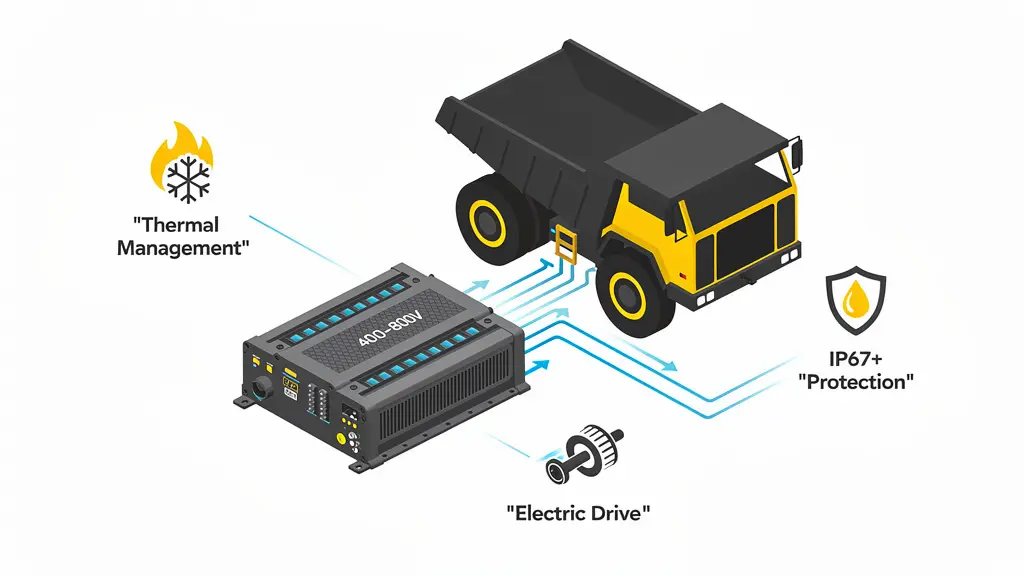
A high-voltage battery pack for off-highway vehicles is a ruggedized lithium-ion energy storage system operating typically between 400V and 800V. It delivers massive, sustained power to propel heavy-duty construction, mining, and agricultural machinery while utilizing advanced thermal management and robust IP67+ enclosures to survive extreme operational environments.
But knowing the basic definition is not enough to get your 50-ton machinery moving. Let’s dive deep into exactly how these systems work, what goes inside them, and how you can conquer the toughest integration challenges in the industry.
What is a high-voltage battery pack?
In the standard EV world, anything over 60V is technically classified as “high voltage.” But when we talk about off-highway vehicles, we are usually looking at a massive power plant operating at 400V, 800V, or even up to 1000V.
This isn’t just a bigger version of what you find in a golf cart. A high-voltage battery pack for heavy machinery is a highly complex, self-contained energy ecosystem. It requires specialized engineering to manage severe electrical loads safely.
Tier-1 cell manufacturers are built for massive standard volume, often rejecting deep customization for off-highway, marine, or specialized commercial fleets. They will gladly sell you the raw modules, but they leave you with a massive engineering headache. You are left to figure out how to cool them, how to package them safely, and how to make them communicate with your vehicle. That is where specialized high-voltage pack engineering comes into play.

Low-Voltage vs. High-Voltage Battery Pack
To truly understand the value of high voltage, you need to see how it stacks up against traditional low-voltage systems (like 48V or 96V packs).
If you remember Ohm’s Law and the power equation (Power = Voltage × Current), you know that to deliver high power, you have two choices. You can either crank up the current, or you can crank up the voltage.
Here is how they compare in the real world:
- Current Draw: Low-voltage systems require massive amounts of current to deliver heavy power, which generates extreme heat. High-voltage systems deliver the exact same power using a fraction of the current.
- Cable Thickness: Because low-voltage systems run high current, they require thick, heavy, and expensive copper cables. High-voltage systems allow you to use much thinner wiring, saving weight and space.
- Power Delivery: Low voltage is fine for auxiliary power or small forklifts. High voltage is mandatory for moving earthmovers, driving massive hydraulic pumps, and propelling heavy-duty trucks.
- Thermal Losses: High current leads to massive I^2-R losses (joule heating). High voltage minimizes these losses, resulting in a significantly more efficient electrical drivetrain.
If you are building battery-powered platforms for demanding applications, a high-voltage architecture is absolutely non-negotiable.

What are the purposes of the high-voltage battery pack?
The primary purpose of a high-voltage battery pack is to deliver sheer, unrelenting force.
Off-highway vehicles do not just drive down a smooth highway. They dig, they lift, they haul, and they crush. This requires massive amounts of continuous torque. A high-voltage system allows the electric motors to access instantaneous peak power without melting the electrical infrastructure.
Furthermore, heavy trucks and machinery have high demands for battery pack durability, liquid cooling, and high-voltage integration. These vehicles often run complex auxiliary systems. Think of the heavy hydraulic cylinders on an excavator or the PTO (Power Take-Off) on an electric tractor. A high-voltage pack acts as the central power hub, running both the propulsion motors and the heavy-duty auxiliary inverters simultaneously.
How does the high-voltage battery pack work for off-highway vehicles?
A high-voltage battery pack works by intelligently managing the flow of stored chemical energy into usable electrical power, all while keeping temperatures safely under control.
Here is what happens when the operator presses the pedal:

First, the Vehicle Control Unit (VCU) requests a specific amount of torque. This signal goes to the battery pack. The intelligent Battery Management System (BMS) instantly checks the state of charge, cell temperatures, and voltage limits.
If everything is safe, the high-voltage Power Distribution Unit (PDU) closes its heavy-duty contactors. The direct current (DC) surges out of the pack and into the motor inverter, which flips it into alternating current (AC) to spin the motor.
But doing this generates a massive amount of heat. If you ignore the thermal dynamics, your system will derate or trigger thermal runaway. This is why liquid cooling integration is critical. As the pack discharges, a dedicated pump circulates coolant through the pack’s internal liquid cold plate, pulling heat away from the cells and exhausting it through a radiator.
This continuous loop of energy delivery, communication, and thermal management allows the machine to operate safely through grueling 12-hour shifts.
What does the high-voltage battery pack consist of for off-highway vehicles?
Building a reliable system means integrating multiple complex subsystems. Our business exists to help customers reduce integration risk, shorten development cycles, and bring battery-powered platforms into operation with greater confidence.
Here is exactly what goes inside a professional-grade high-voltage system:

Lithium-Ion Battery Modules
Chemistry is the heart of the system. Depending on the application, you might use LFP (Lithium Iron Phosphate) for maximum cycle life and safety, or NMC (Nickel Manganese Cobalt) for high energy density. What sets Astraion Dynamics apart is our transparent “Bring Your Own Cells/Modules” partnership model. You negotiate directly with top cell manufacturers to secure raw modules at zero middleman markup, while we master the deep engineering and complex supply chain ecosystem.
Rugged Battery Pack Enclosure
Off-highway environments are brutal. A plastic box will not survive. Our in-house engineering team designs rugged IP67+ aluminum enclosures built for demanding environments and global deployment. These enclosures must resist heavy water ingress, massive shock loads, and severe vibrations found in mining and construction sites.
Precision Liquid Cold Plate
Air cooling is dead when it comes to high-power off-highway EVs. To keep the cells perfectly balanced, you need a highly engineered thermal management system. We integrate precision liquid cold plates directly underneath or between the modules. These CNC-machined plates feature optimized micro-channels that ensure uniform coolant flow, preventing hot spots and extending the life of the pack.
Intelligent BMS and High-Voltage PDU
You need a brain to manage the brawn. The intelligent BMS architectures monitor individual cell voltages and temperatures in real-time. Meanwhile, the high-voltage PDU acts as the gatekeeper, housing the contactors, fuses, and high-voltage interlock loops (HVIL) to ensure the system is electrically safe during operation and maintenance.
We take responsibility for the full integration path, combining enclosure engineering, thermal management, HV architecture, intelligent controls, and commissioning support in one coordinated workflow.
What are the benefits of the high-voltage battery pack?
Transitioning your machinery to a high-voltage architecture brings incredible operational advantages:
Extreme Efficiency: Higher voltage means lower current for the same power output. This drastically reduces thermal losses in the cables and inverters, giving your machine a longer run time per charge.
Reduced Vehicle Weight: Because you can use thinner copper cables and smaller electrical connectors, the overall weight of the vehicle’s wiring harness drops significantly.
Lightning-Fast Charging: Off-highway operators cannot wait all day for a machine to charge. High-voltage architectures (especially 800V+) accept DC fast charging at much higher C-rates, getting your equipment back to work in minutes rather than hours.
Superior Motor Performance: High voltage allows motors to spin faster and operate in their peak efficiency zones for longer durations, resulting in better torque delivery at the wheels or tracks.
What are the disadvantages of the high-voltage battery pack?
It is not all smooth sailing. There are real hurdles you need to anticipate.
The biggest disadvantage is integration complexity. Battery projects often fail at the integration stage — not because components are unavailable, but because mechanical, thermal, electrical, and control systems are not developed as one coordinated solution.
Safety is another massive factor. Working with 800V DC power introduces severe risks of arc flashes and fatal electrocution if handled improperly. The system requires strict global homologation, flawless UN38.3 / ECE R100.3 testing, and heavy-duty high-voltage interlock loops.
Finally, sourcing can be a nightmare. Because Tier-1 suppliers prefer standard high-volume automotive contracts, getting bespoke high-voltage integration for lower-volume off-highway fleets is incredibly difficult. You are forced to engineer solutions from scratch.
What are the applications for the high-voltage battery pack?
The demand for customized, ruggedized high-voltage packs is exploding across several heavy industries. We primarily serve off-highway and construction equipment OEMs, specialty vehicle developers, and heavy-duty vehicle manufacturers.
Here are the specific sectors pushing this technology forward:

Battery Electric Mining Vehicles: Mining vehicles demand highly reliable, explosion-proof, and heavy-duty battery systems. High voltage gives them the massive torque needed to haul ore up steep, unpaved grades.
Electric Agricultural Machinery: The market for electric tractors and agricultural machinery is emerging, with a strong need for customized battery packs and liquid cooling systems.
Marine Vessels: Electric boats and ferries have stringent requirements for waterproofing, liquid cooling, and system integration.
Energy Storage Systems (ESS): ESS projects require large-scale battery packs, PDUs/BMS, and thorough testing.
Conclusion
Building a high-voltage battery pack for off-highway vehicles is a massive engineering challenge. It requires an uncompromising approach to enclosure durability, precision thermal management, and complex electrical integration.
If you are a Chief Engineer, or Procurement Lead trying to bridge the gap between raw cell chemistry and your customized vehicle, you do not have to tackle this alone.
At Astraion Dynamics, our motto is: You Control the Chemistry, We Master the Engineering. As an engineering-first integrator, we transform your procured raw modules into a rugged, fully certified, plug-and-play energy system, leveraging China’s vast specialized supply chain.
If you want to reduce integration risk and bring your battery-powered platforms into operation with greater confidence, we need to talk. Reach out to our engineering team today to review your application, packaging constraints, and electrical targets, and let’s get your platform field-ready.
