

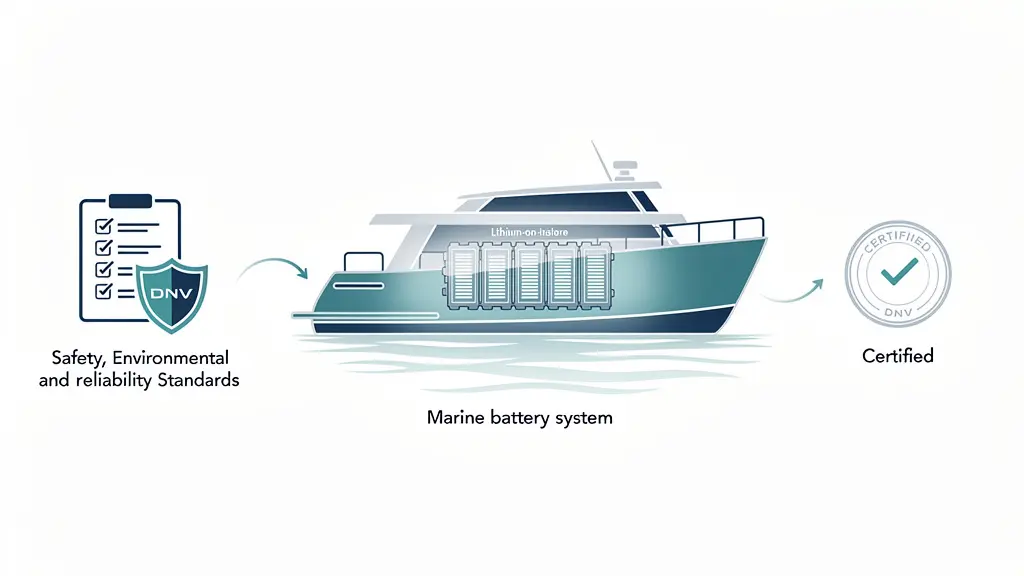
Designing an electric marine vessel is a massive engineering challenge. Navigating the murky waters of marine battery compliance is an entirely different beast. If you’re building a battery-powered platform for the high seas, you need to know about DNV certification.
DNV certification for marine battery systems is an independent, globally recognized maritime approval process. It verifies that large lithium-ion battery packs (typically over 50 kWh) meet stringent safety, environmental, and reliability standards for demanding offshore and marine environments.
Want to know exactly what it takes to get your battery pack certified and deployed? Let’s dive into the details, costs, and timelines so you can confidently launch your marine electrification project.
What does DNV stand for?
If you’re new to the maritime industry, you’ve probably seen those three letters everywhere.
DNV stands for Det Norske Veritas. It’s a Norwegian international accredited registrar and classification society headquartered in Høvik, Norway.
Basically, they are the gold standard for maritime safety.
They’ve been around since 1864, meaning they have well over a century of independent assurance experience under their belts. When DNV puts their stamp of approval on a product, the global maritime industry trusts it. If you want your equipment on a commercial ship, this is the name you need to know.
What does DNV certification mean?
DNV certification is essentially a passport for your marine equipment.
For marine battery systems, it means your energy storage solution has been rigorously tested and verified to operate safely in highly demanding environments. We’re talking extreme vibrations, high humidity, saltwater corrosion, and the constant pounding of the open ocean.
When a battery pack achieves this certification, it proves to ship owners, shipyards, and marine vessel manufacturers that the system complies with strict maritime regulations.
As a Chief Engineer, getting this certification means you can bring your battery-powered platforms into operation with greater confidence. It significantly reduces integration risk and proves your system is deployment-ready.

What is the difference between ISO and DNV?
This is a question I hear all the time from electrification startups and seasoned engineering teams alike.
ISO (International Organization for Standardization) creates general standards for nearly every industry on earth. Getting an ISO 9001 certification, for instance, just means your facility has a solid quality management system in place.
DNV, on the other hand, is maritime-specific.
While an ISO standard might dictate how you manufacture a lithium-ion battery pack, DNV rules (like DNV-CG-0339 or DNV-RU-SHIP) dictate how that battery must perform when physically installed on a ship.
DNV class rules focus heavily on preventing catastrophic failures at sea. This includes specific mandates on thermal runaway propagation, off-gas ventilation, and redundant Battery Management Systems (BMS) architectures. In short: ISO is broad, while DNV is specialized and uncompromising.
What is a Marine Battery System?
A marine battery system is a heavy-duty energy storage solution built specifically to power watercraft.
These aren’t your typical passenger EV batteries. A maritime battery might be 10 to 100 times larger than a traditional electric vehicle battery. They have to handle massive load variations, dynamic positioning demands, and high charge/discharge C-rates.
Electric boats and ferries have extremely stringent requirements for waterproofing, liquid cooling, and overall system integration. Because they operate in unpredictable environments, they require rugged IP67+ aluminum enclosures and precision liquid cold plates.
Tier-1 cell manufacturers are built for massive stand ard volume, often rejecting deep customization for marine or specialized commercial fleets. They sell you the raw modules, but they leave you with a massive engineering headache. How do you cool them? How do you package them safely? How do you make them talk to your vessel’s main controller?
That’s exactly where we step in. As an engineering-driven integration partner, we transform those procured raw modules into a fully certified, plug-and-play energy system.
What are the purposes of the DNV Certification for Marine Battery Systems?
Safety is the absolute priority here.
When you’re miles from shore, a battery fire or electrical failure isn’t just an inconvenience—it’s a life-threatening emergency.
The primary purpose of DNV certification is to prevent those disasters. It ensures the battery system can handle extreme charging and operational patterns without succumbing to thermal runaway.
It also serves a massive commercial purpose. Large vessels actually require “classification” to operate legally. Without a DNV certificate, European and global maritime markets are essentially closed to your product.
For system integrators and OEMs, DNV certification opens the door to the rapidly growing electric boat and ferry market.
What are the requirements for DNV certification?
Getting a DNV type approval is not a walk in the park.
The requirements are function-based and generally apply to all DNV-classed vessels having batteries larger than 50 kWh.
Here are the critical technical hurdles your lithium-ion battery pack needs to clear:

Thermal Runaway Protection: You must pass strict propagation tests. This proves that if one cell fails due to a short circuit, the entire battery pack enclosure won’t go up in flames.
Off-Gas Management: The system needs dedicated ventilation and gas detection to safely exhaust hazardous gases before they can ignite or harm the crew.
Environmental Testing: Your system must survive brutal mechanical vibration, salt mist exposure, and extreme temperature fluctuations.
Electromagnetic Compatibility (EMC): High-voltage components must not interfere with the ship’s critical navigation and communication equipment.
High-Voltage Interlock (HVIL): You must have physical and electrical fail-safes that immediately cut high-voltage power if a connector is breached.
Intelligent Controls: The BMS must act as a fail-safe, with redundant safety checks and deep integration with the vessel’s power management system.
At Astraion Dynamics, our in-house engineering team designs intelligent BMS architectures and high-voltage PDUs specifically to meet these intense homologation standards.
What’s the estimated lead-time for the DNV certification?
Let’s talk about timelines.
If you think you can wrap this up in a few weeks, think again.
Certification takes months. For a complex marine battery system, you should expect a lead time of 4 to 6 months minimum.
This includes the time needed for the initial 3D design review, thermal simulation approvals, physical testing at an accredited lab, and the final documentation audit by DNV surveyors.
My advice? Start early. Begin the certification process well before you actually need the certificate for specific vessel orders. Working with a turnkey integration partner can seriously shorten development cycles.
What is the validity period of DNV certification?
A DNV Type Approval Certificate is typically valid for 5 years.
But don’t pack up your paperwork just yet.
To maintain that certificate, you usually have to undergo periodic assessments or annual retention surveys. This ensures that your manufacturing quality control remains consistent over time.
If you change your cell chemistry, update your BMS algorithm significantly, or alter your battery pack enclosure design, you will need to apply for a design modification approval.
How to choose an agent to do the DNV Certification?
You don’t want to navigate this alone. Choosing the right testing and certification agent is critical for your project’s success.
Here’s what you should look for:
- Marine Experience: Don’t use an agent that only tests passenger car EVs. Marine requirements are entirely different. They need to understand DNV-CG-0339 and DNV-RU-SHIP backwards and forwards.
- Accreditation: Ensure the lab is specifically accredited by DNV to perform the necessary foundational tests (like IEC 62619 or UN38.3).
- End-to-End Support: Look for a partner that offers full turnkey battery system support.
We coordinate the complex supply chain ecosystem so you don’t have to. By manufacturing through our strategic network of over 20 IATF-16949 certified partners, governed by resident QA engineers, we bridge the gap between raw cell chemistry and your customized vehicle.
How to pass the DNV Certification for Marine Battery Systems?
Passing the DNV audit isn’t just about brilliant engineering. It’s about flawless supply chain orchestration.
You can’t just slap a standard liquid cooling plate onto a commercial cell module and expect DNV surveyors to sign off.
It starts with the chemistry. The smartest move is leveraging a “Bring Your Own Cells/Modules” strategy. You negotiate directly with top-tier cell brands to secure the exact raw modules you need, without the middleman markup. Then, you let an integration expert coordinate the heavy lifting.
DNV’s strict thermal runaway and environmental mandates mean your mechanical supply chain must be perfectly aligned. We coordinate the production of heavy-duty, marine-grade battery pack enclosures that guarantee IP67+ waterproofing and extreme salt-mist corrosion resistance.
Inside that enclosure, thermal management is everything. We source and integrate precision liquid cold plates—often utilizing advanced Friction Stir Welding (FSW)—to ensure zero coolant leakage and maintain a strict temperature variance (ΔT) of less than 2°C across the entire pack.
By tightly synchronizing these specialized supply chains—from the raw cell makers to the manufacturers of bespoke enclosures and thermal plates—we eliminate the integration blind spots that fail DNV audits. That coordinated ecosystem is exactly how you prove your system is deployment-ready.
Why is it necessary for the DNV Certification for Marine Battery Systems?
Without DNV certification, you simply cannot sell battery systems into the mainstream commercial marine market.
Shipowners, offshore vessel operators, and electric ferry integrators will not buy uncertified equipment. The financial and safety liabilities are just too high.

Furthermore, getting DNV certified proves to your buyers—whether they are Purchasing Managers, R&D Directors, or Founders—that your product is world-class.
Our business exists to help customers reduce integration risk and bring reliable, compliant energy solutions to market faster. Battery projects often fail at the integration stage because mechanical, thermal, electrical, and control systems are not developed as one coordinated solution. DNV certification forces you to perfect that coordination.
Conclusion
Getting DNV certification for your marine battery system is a tough but necessary journey.
It requires deep engineering expertise, rigorous safety testing, and an uncompromising approach to thermal and high-voltage management. But once you have it, the global maritime market is yours for the taking.
Are you an OEM, system builder, or electrification team struggling with marine battery integration?
Stop fighting with massive cell manufacturers who won’t customize for your heavy-duty needs.
At Astraion Dynamics, we master the engineering while you control the chemistry. We handle everything from initial 3D design and thermal simulation to flawless UN38.3 homologation and global logistics.
Ready to get your marine battery system certified and deployment-ready?
Reach out to our engineering team today. We’ll review your application, operating profile, packaging constraints, and compliance needs. Let’s build a rugged energy system that actually works in the real world.
