

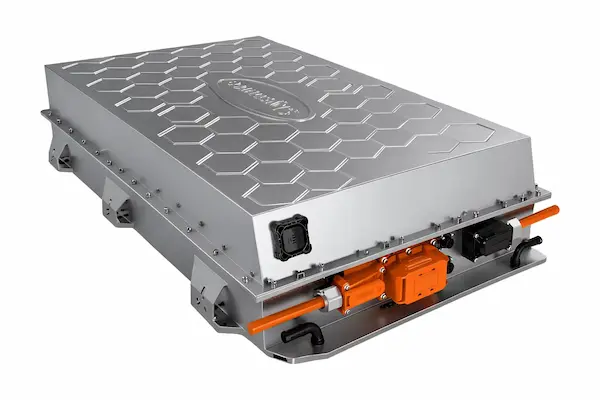
You’ve secured the best lithium-ion cells for your new heavy-duty platform. But now you’re facing a massive engineering headache: how do you safely package, cool, and integrate them? If you’re struggling to bridge the gap between raw chemistry and a field-ready vehicle, you’re in the right place.
A custom battery pack enclosure is a highly engineered structural housing designed to protect lithium-ion battery modules from physical impact, environmental ingress, and thermal events. It integrates mechanical support, liquid cooling systems, and high-voltage routing while ensuring strict compliance with global safety standards like UN38.3 and ECE R100.3.
Sounds simple on paper, right? But as any Vehicle Integration Engineer knows, the devil is entirely in the details. Let’s break down exactly what goes into engineering these critical components.
What is a metal enclosure?
Before we dive into the EV-specific nuances, let’s look at the baseline.
A metal enclosure, in the broader engineering world, is a fabricated cabinet or box designed to house electrical or electronic equipment. Its primary job is twofold: keep the internal components in, and keep the external environment out.
In traditional industrial applications, a standard metal enclosure might just need to meet a basic NEMA rating to keep dust and splashed water away from a low-voltage circuit board.
But when we talk about a metal enclosure for a battery system, the stakes skyrocket. We aren’t just housing a few wires; we are packaging hundreds of kilograms of volatile electrochemistry. The enclosure must become a structural backbone, a thermal manager, and a fail-safe vault all at once.
What does the battery pack enclosure do?
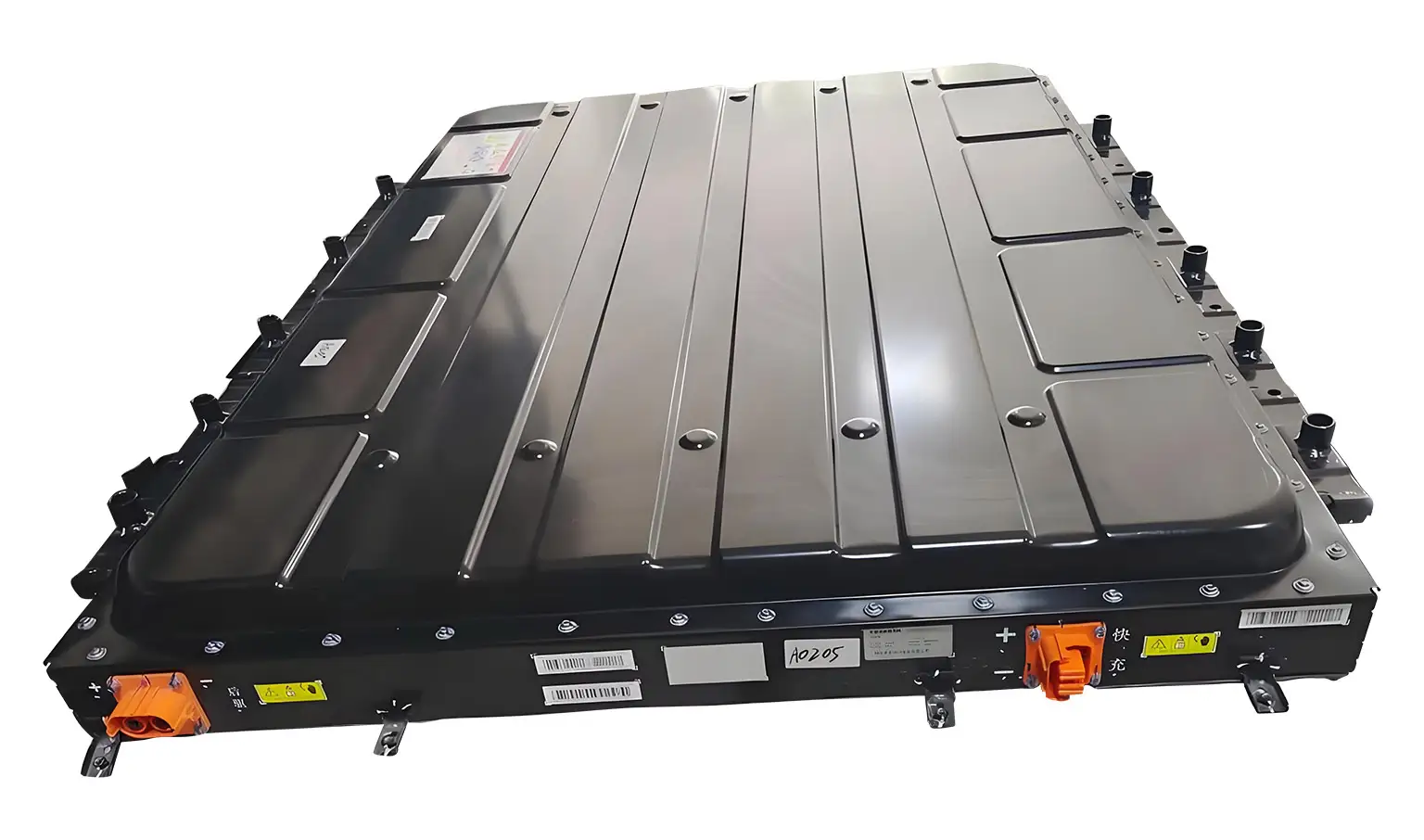
A custom battery pack enclosure is the unsung hero of the entire three-electric (battery, motor, electronic control) system. It performs several critical functions simultaneously:
Mechanical Protection: It shields delicate battery cells from road debris, extreme vibrations, and catastrophic crash impacts. For heavy trucks and off-highway equipment, the durability demands are exponentially higher than standard passenger cars.
Environmental Sealing: Water and high voltage do not mix. The enclosure must maintain a strict IP67 or even IP69K rating to prevent moisture, dust, and salt fog from causing catastrophic short circuits. This is especially critical for electric boat and marine vessel manufacturers, who have stringent requirements for waterproofing.
Thermal Management: Batteries like to operate at room temperature. The enclosure integrates with precision liquid cold plates to extract heat during fast charging and retain heat during freezing operations.
EMI/EMC Shielding: High-voltage systems generate massive electromagnetic interference. A properly designed metal enclosure acts as a Faraday cage, preventing your battery’s electrical noise from scrambling the vehicle’s VCU (Vehicle Control Unit) communications.
Thermal Runaway Containment: If a cell fails and goes into thermal runaway, the enclosure must safely channel the explosive gases away from passengers through directional pressure relief valves, preventing the entire vehicle from instantly catching fire.
How does the battery pack enclosure work?

The enclosure works by acting as the physical interface between the volatile battery chemistry and the harsh reality of the outside world.
It starts with load distribution. When your electric truck hits a pothole at 60 mph, the battery pack experiences massive G-forces. The enclosure works by transferring those kinetic loads through structural cross-members and away from the fragile cell tabs.
Thermally, it works through conductive pathways. The cells sit on thermal interface materials (TIM), which bridge the microscopic gaps between the cell bottom and the liquid cold plates. Coolant flows through these plates, absorbs the heat, and exits the enclosure to the vehicle’s radiator.
Electrically, it works as a secure vault. It houses the intelligent BMS architectures and high-voltage PDUs (Power Distribution Units), ensuring that high-voltage interlocks (HVIL) remain unbroken. If the enclosure cover is removed or breached, the system immediately cuts the high-voltage contactors to prevent electrocution.
What is a battery pack enclosure made of?
It’s easy to think of it as just a metal box, but a modern battery enclosure is actually a complex, multi-component assembly.
Here is what it typically consists of:
The Lower Tray (Base): This is the heavy-duty foundation. It bears the entire weight of the battery modules and is usually integrated directly into the vehicle’s chassis.
The Upper Cover (Lid): Often made of a lighter material, the cover seals the top of the pack. It must be easily removable for servicing but completely impenetrable to water when bolted down.
Precision Liquid Cold Plates: These are often friction-stir welded into the bottom of the tray to provide active thermal management.
Sealing Gaskets: Usually made of advanced silicone or EPDM elastomers, these gaskets are compressed between the tray and the cover to achieve that critical IP67+ rating.

High-Voltage Busbars
You can’t rely on standard loose wiring to handle the massive currents of a modern EV. Instead, enclosures are fitted with rigid busbars.
These are essentially the high-capacity electrical highways of your pack. Made from precision-stamped copper or aluminum, busbars route power between the battery modules, the High Voltage Distribution Unit (PDU), and the external vehicle powertrain. We securely mount and heavily insulate these busbars directly within the enclosure’s architecture to prevent vibration-induced arcing and ensure they can handle high charge/discharge ampacity without overheating.
Critical Interfaces
A perfectly sealed box is useless if it can’t interact with the rest of the vehicle. We engineer dedicated interface panels directly into the enclosure walls. These include:
HV and LV Connectors: Heavy-duty, waterproof receptacles for high-voltage power delivery and low-voltage communication (allowing the BMS to talk to the vehicle’s ECU).
Coolant Ports: Precision-machined inlet and outlet fluid fittings that feed directly into the enclosure’s internal liquid cooling plates.
Pressure Relief Valves (PRV): This is your ultimate safety interface. If a cell enters thermal runaway, the rapidly expanding gases need an immediate escape route. The PRV (or burst disc) automatically vents this pressure outside the vehicle, preventing a catastrophic structural rupture.
Thermal & Sealing Materials
Finally, the enclosure is lined with specialized materials. We lay down Form-In-Place Gaskets (FIPG) to ensure IP67/IP68 waterproof sealing, and apply Thermal Interface Materials (TIM) to bridge the gap between the battery modules and the cold plates for optimized heat transfer.
If you are currently struggling to package your busbar routing, cooling lines, and high-voltage interfaces into a tightly constrained vehicle space, you don’t have to figure it out alone. [Click here to schedule a technical review with our system architecture team], and we can help you lay out a fully integrated enclosure design that balances safety, weight, and assembly efficiency.
What is the material of the battery pack enclosure?
When I sit down with OEM engineers, material selection is usually the very first thing we debate.
Why? Because your enclosure isn’t just a simple box. It is the primary physical barrier protecting highly volatile lithium-ion cells from high-speed crash impacts, road debris, and harsh weather.
Here is a breakdown of the specific alloys we rely on to balance lightweighting, thermal management, and raw structural rigidity.
The Aluminum Alloys (The Lightweight Champions)
Aluminum is the undisputed king of NEV passenger cars right now. But you can’t just use any standard off-the-shelf metal. You need specific temper and alloy profiles.
6061-T6 Aluminum: This is our structural workhorse. Because it offers incredible yield strength and machines beautifully, I always recommend the 6061 for load-bearing extruded frames and complex CNC-machined base plates. If you need maximum rigid crash protection without adding massive weight, this is your go-to.
5052 Aluminum: Think of 5052 as the flexible problem-solver. It doesn’t have the brute strength of 6061, but it bends and forms perfectly without micro-cracking. We typically use this for stamped upper covers, where sealing and formability matter far more than bottom-up impact resistance.
5083 Aluminum: Building a pack for rugged environments? 5083 is legendary for its post-weld strength and marine-grade corrosion resistance. We spec this alloy heavily when a battery pack needs to survive harsh, long-term salt-spray testing or aggressive off-road conditions.
The Stainless Steels (The Heavy-Duty Heroes)
If you are designing a high-voltage system for a commercial electric mining truck, agricultural equipment, or marine vessels, aluminum won’t always cut it. You need the heavy-duty stuff.
304 Stainless Steel (304 SS): This is the baseline standard for heavy commercial enclosures. It offers fantastic tensile strength and solid everyday corrosion resistance. Yes, it’s significantly heavier than aluminum, but it provides incredible physical puncture resistance and acts as a superb barrier against localized thermal runaway.
316L Stainless Steel (316L SS): The “L” stands for low carbon, which makes this specific alloy a dream for high-strength welding. Thanks to added molybdenum, 316L is practically bulletproof against harsh chlorides, salt water, and industrial chemicals. If your battery pack is going into a highly corrosive environment, stepping up to 316L is a no-brainer.
At the end of the day, there is no single “perfect” material. It all comes down to your vehicle’s payload limits, operating environment, and budget.
If you are currently stuck deciding between a 6061 extruded frame or a heavy-duty 316L welded box for your next prototype, you can always reach out to our engineering team for a quick, no-nonsense material feasibility review.
How to design a battery pack enclosure?
Designing a custom battery pack enclosure is not a standalone task; it requires a coordinated workflow across mechanical, thermal, and electrical domains. Battery projects often fail at the integration stage because these systems are not developed as one coordinated solution 7.
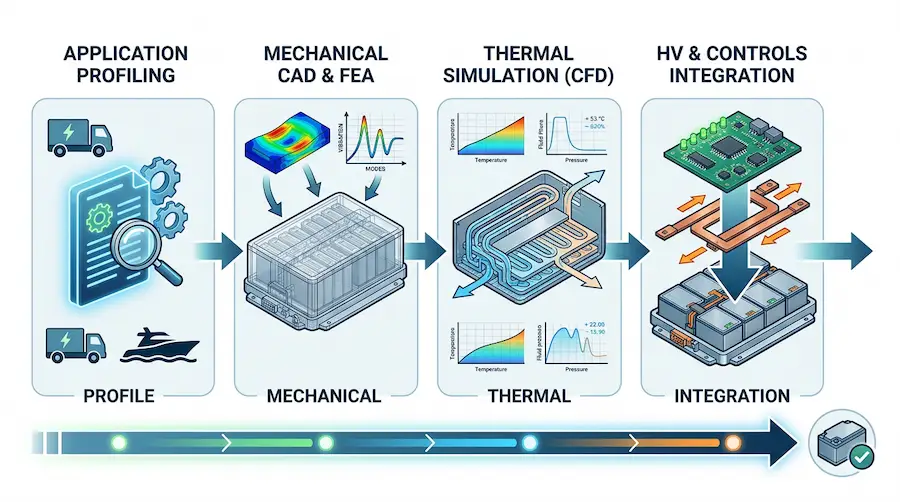
Here is how we approach the design process:
1. Application Profiling
Projects typically begin with a deep review of the application, operating profile, packaging constraints, and electrical targets. A marine vessel enclosure will look vastly different from an electric tractor enclosure.
2. Mechanical CAD & FEA
We define the system architecture and layout the modules. We then run exhaustive Finite Element Analysis (FEA). We simulate modal frequencies to ensure the pack won’t shake itself apart, and we run crash simulations to ensure structural integrity during an impact.
3. Thermal Simulation (CFD)
Next, we run Computational Fluid Dynamics (CFD) to design the cooling channels. From initial 3D design to thermal simulation, we ensure that coolant flow is uniform and that pressure drops are minimized.
4. HV and Controls Integration
We integrate the key mechanical, thermal, electrical, and control elements. We map out the high-voltage busbars, ensure proper clearance and creepage distances, and strategically place the intelligent BMS architectures.
Tier-1 cell manufacturers are built for massive standard volume and often reject deep customization for off-highway or marine fleets. They sell you the raw modules, but they leave you with a massive engineering headache. That is exactly where an engineering-first integrator steps in to handle this complex design phase.
How to produce the battery pack enclosure?
Once your CAD models and thermal simulations are completely locked in, it’s time to turn pixels into physical metal.
Let me be clear: manufacturing a high-voltage enclosure isn’t like stamping out a standard sheet metal box. It requires microscopic tolerances and absolute structural integrity. To achieve this level of precision, manufacturing is executed by our strategic network of over 20 IATF-16949 certified partners, governed by resident QA engineers.
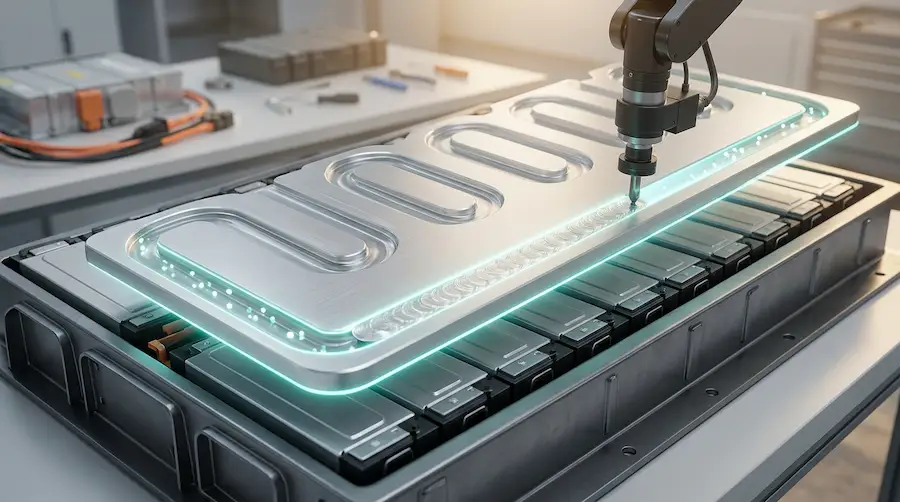
Broadly speaking, there are three primary ways to bring an aluminum battery pack enclosure to life:
1. Extrusion and Welding
This is a fantastic method for creating highly customized, heavy-duty frames. We take custom extruded aluminum profiles and fuse them together. But instead of using traditional MIG or TIG welding—which can easily warp thin aluminum through excess heat—top-tier manufacturers rely on Friction Stir Welding (FSW). This advanced process uses a spinning tool to plasticize and forge the metals together without actually melting them. The result? A perfectly flush, leak-proof seam that is absolutely essential for building rugged IP67+ aluminum enclosures.
2. CNC Machining
When you need extreme precision, CNC machining is your best friend. With our deep expertise in CNC-machined enclosures, we take raw aluminum billets (or previously welded extrusions) and use massive, computer-controlled gantry machines to carve away the excess material 1. This process cuts out the precise mounting holes, coolant ports, and sealing grooves, ensuring that every single mating surface aligns flawlessly.
3. Die-Casting Aluminum
If you are looking at massive, high-volume production runs, die-casting is the heavyweight champion. Molten aluminum is injected directly into a giant steel mold under extreme pressure. This allows you to form incredibly complex geometries in a single shot.
Once the core structure is formed using one of these three methods, the pack moves into final assembly. Robotic dispensers lay down custom silicone gaskets, and critical internal components like precision liquid cold plates and high-voltage PDUs are carefully integrated 1. Finally, to guarantee safety and reliability, every single unit is subjected to strict 100% End-of-Line testing protocols before it ever leaves the factory floor.
CNC Machining vs. Die-casting Aluminum Enclosure
When deciding how to manufacture your aluminum enclosure, you’ll generally choose between CNC machining (often combined with extrusion/welding) and Die-casting.
CNC Machined Enclosures

This process involves taking raw aluminum extrusions or billet plates and carving away the excess material using computer-controlled cutting tools.
Pros: Incredible precision, no tooling costs, highly customizable, and perfect for low-to-medium volume runs. It allows for rapid iteration.
Cons: Higher per-unit cost and slower cycle times.
Best for: Heavy-duty vehicle manufacturers, specialty vehicle developers, and marine vessel builders who need extreme ruggedness and highly customized dimensions.
Die-casting Aluminum Enclosures

This involves injecting molten aluminum into a massive steel mold under extreme pressure.
Pros: Extremely fast production speeds and very low per-unit costs at scale. Complex geometries can be formed in a single shot.
Cons: The initial mold (tooling) cost can be hundreds of thousands of dollars. Design changes are almost impossible once the tool is cut.
Best for: High-volume EV passenger car manufacturers producing hundreds of thousands of identical vehicles.
For most electrification startups, industrial equipment builders, and heavy-duty OEMs, CNC-machined enclosures offer the flexibility and ruggedness needed without the crippling upfront tooling costs.
Powder Coat vs. Anodizing
Surface treatment isn’t just about aesthetics; it’s about surviving harsh environments.
Powder Coating
This involves spraying a dry powder electrostatically onto the enclosure and then curing it in an oven.
It creates a thick, tough, and highly electrically insulative layer. It’s fantastic for preventing galvanic corrosion and adding an extra layer of high-voltage safety. The downside is that it adds thickness, which can interfere with precise CNC-machined sealing grooves if not masked properly.
Anodizing
Anodizing is an electrochemical process that converts the metal surface into a durable, corrosion-resistant anodic oxide finish.
It integrates with the underlying aluminum, meaning it won’t chip or peel. It maintains incredibly tight dimensional tolerances, making it ideal for precision mating surfaces. However, it does not offer the same level of electrical insulation as powder coating.
Often, an enclosure will utilize a combination of both—anodized internal structures for precision cooling plates, and a powder-coated exterior for rugged environmental protection.
Types of battery pack enclosures
The EV industry is evolving rapidly, and so is enclosure architecture.
Cell-to-Module (CTM)
This is the traditional approach. Individual cells are packed into modules, and then those modules are bolted into the main enclosure. It offers great serviceability and safety but wastes a lot of physical space on modular housings.

Cell-to-Pack (CTP)
Here, we skip the module phase completely. The individual cells are integrated directly into the main battery pack enclosure. This dramatically improves volumetric efficiency (more energy in the same space) and reduces weight. However, it requires highly advanced enclosure engineering to manage structural loads and thermal runaway containment.
Cell-to-Chassis (CTC)
The bleeding edge of integration. The battery enclosure disappears entirely as a separate component. Instead, the vehicle’s structural chassis acts as the battery enclosure. While fantastic for passenger car weight reduction, it is exceptionally difficult to engineer and repair, making it less practical for demanding off-highway or marine applications where modularity and ruggedness are prioritized.
How to test the battery pack enclosure?
An enclosure is only as good as the tests it can pass. Because our business exists to help customers reduce integration risk, we stay involved until the system is tested, integrated, and ready to work in the field.
Before a pack ever sees a vehicle, it must pass a grueling battery of validations:
Leak Testing (IP-Rating):
Every single enclosure should undergo 100% End-of-Line testing protocols. This usually involves pressure decay testing, where the sealed pack is pumped with air to check for microscopic pressure drops that would indicate a leak.
Vibration and Shock Validation:
The enclosure is bolted to a massive shaker table and subjected to multi-axis vibration profiles (like ISO 16750-3) to simulate a lifetime of road abuse.
Thermal Cycling:
The pack is placed in an environmental chamber and swung from -40°C to +85°C repeatedly to ensure that the metal expansion and contraction don’t compromise the seals.
Global Homologation Standards:
To sell your vehicle globally, the integrated system must pass flawless UN38.3 (for global transport) and ECE R100.3 (European EV safety standard) homologation. This involves drop testing, crush testing, and exposing the enclosure to a direct external fuel fire to ensure passenger evacuation time.

Which battery pack enclosure is best for the EV?
There is no single “best” enclosure. The optimal design depends entirely on your vehicle’s operating profile and packaging constraints.
For Electric Boats and Marine Vessels:
The European market is experiencing rapid growth in this sector. For marine applications, the best enclosure is a heavily sealed, CNC-machined aluminum box with redundant liquid cooling and absolute IP67+ waterproofing to prevent saltwater ingress.
For Mining Vehicles and Heavy Trucks:
Mining vehicles demand highly reliable, explosion-proof, and heavy-duty battery systems 5. Heavy trucks have high demands for battery pack durability and liquid cooling . The best enclosure here favors thick-walled, reinforced extruded aluminum that can survive rock strikes and continuous high-vibration operation.
For Energy Storage Systems (ESS):
ESS projects require large-scale battery packs and thorough testing 5. Weight is less of an issue, so standard sheet metal or cost-effective AHSS steel enclosures with strong thermal management systems are often the best fit.
What are the advantages to customizing a battery pack enclosure?
You might be wondering: why not just buy an off-the-shelf battery pack and call it a day?
If you are building a standard golf cart, an off-the-shelf box might work. But if you are engineering a heavy-duty platform, off-the-shelf simply doesn’t cut it. Going the custom route offers several massive advantages that directly impact your bottom line and vehicle performance.
Application-Driven Engineering
Standard packs force you to compromise your vehicle’s design to fit their box. A custom enclosure flips that script. It is engineered entirely around the real requirements of your specific vehicle, vessel, or machine. Whether you need extreme waterproofing for an electric boat or a heavy-duty, explosion-proof design for a mining vehicle, custom engineering is built around your real platform constraints.
Zero Middleman Markup on Cells
Customizing your enclosure gives you the freedom to separate your chemistry sourcing from your mechanical engineering. It allows you to leverage a transparent “Bring Your Own Cells/Modules” partnership model. You can negotiate directly with top cell manufacturers to secure raw modules at zero middleman markup. Ultimately, you get Tier-1 chemistry pricing combined with unmatched bespoke engineering.
Solving the “Big Cell Maker” Headache
Let’s be honest about the battery supply chain. Tier-1 cell manufacturers are built for massive standard volume, often rejecting deep customization for off-highway, marine, or specialized commercial fleets. They will happily sell you the raw modules, but they leave you with a massive engineering headache. How do you cool them, package them safely, and make them talk to your vehicle? A custom enclosure takes care of this by turning raw modules into a fully integrated system that manages the thermal, mechanical, and electrical integration as one coordinated solution.
Reduced Integration Risk and Faster Deployment
Battery projects often fail at the integration stage because the subsystems aren’t designed to work perfectly together. By reviewing your specific operating profile, compliance needs, and electrical targets from day one, a custom enclosure dramatically reduces integration risk. This upfront heavy lifting helps you shorten development cycles, bringing reliable and compliant energy solutions to market much faster.
Summary
If you are an Engineering Manager trying to source cells, design cold plates, and figure out how to make your VCU talk to a raw module, you are fighting an uphill battle.
Tier-1 cell giants sell you raw chemistry, but they don’t solve your vehicle constraints. Astraion Dynamics is built to close that gap. Our mission is to make battery system integration more practical, more reliable, and more deployment-ready for demanding real-world applications.
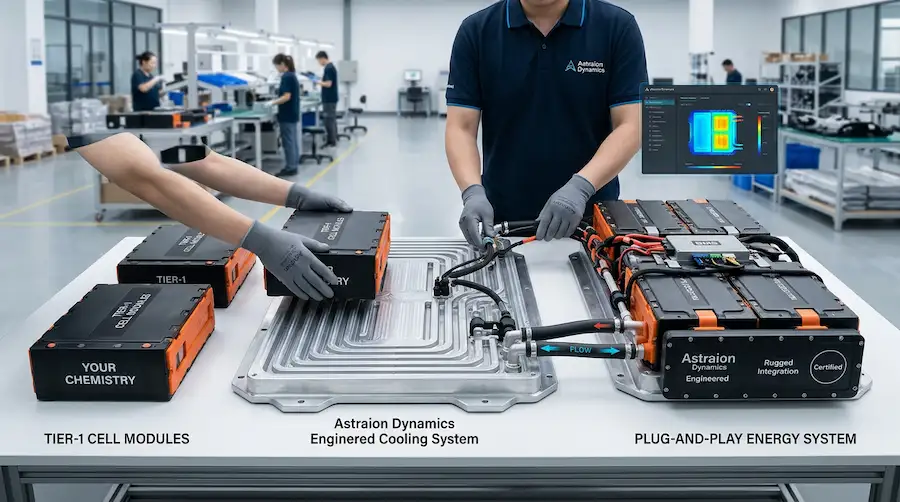
We offer a transparent “Bring Your Own Cells/Modules” partnership model. You negotiate directly with top cell manufacturers at zero middleman markup, and we transform your procured raw modules into a rugged, fully certified, plug-and-play energy system.
You Control the Chemistry, We Master the Engineering.
If you’re ready to shorten development cycles and bring your battery-powered platform into operation with greater confidence, let’s talk. Contact our engineering team today to discuss your packaging constraints and application profile. Let us handle the integration path from concept to commissioning.
