

Commercial electric vehicles face brutal environments every single day.
Whether you are designing a heavy-duty electric truck, an electric mining vehicle, or an off-highway construction machine, your battery systems take a massive beating.
You need a battery tray that won’t fail when things go wrong.
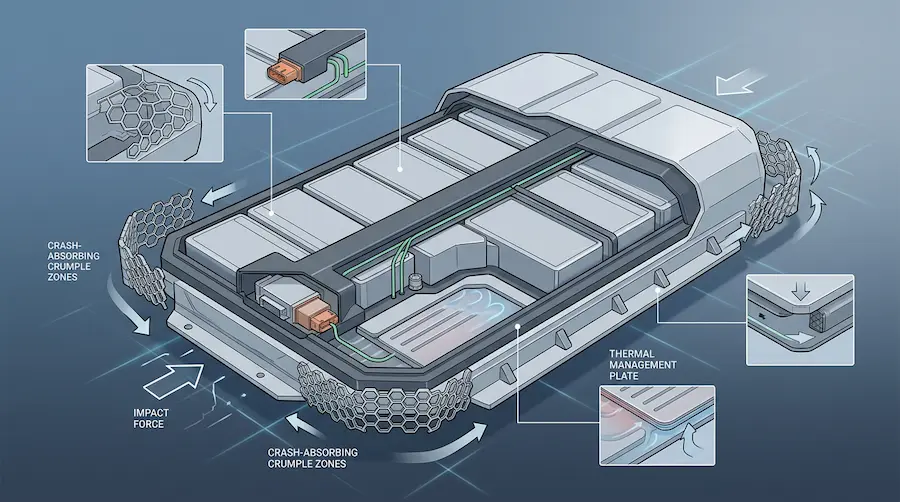
A crash-proof battery tray for commercial vehicles is a reinforced structural enclosure designed to house and protect lithium-ion modules from severe mechanical impacts. It integrates crash-absorbing crumple zones, high-strength alloys, and thermal management systems to prevent catastrophic failure, high-voltage leaks, or thermal runaway during collisions.
But designing a truly crash-proof tray isn’t just about slapping thick metal together.
Let’s dive into exactly how these systems work, how they are built, and why getting this right is the difference between a successful vehicle launch and a massive engineering headache.
What is a battery pack tray?
A battery pack tray is the foundational mechanical skeleton of any electric vehicle’s energy storage system.
Think of it as the chassis for your battery modules.
It forms the lower half of the battery enclosure and serves as the primary mounting structure that connects the raw battery chemistry to the vehicle’s frame.
This isn’t just a simple metal box.
The tray has to carry massive dynamic loads while housing ultra-sensitive components. It supports the heavy lithium-ion battery modules, liquid cold plates, high-voltage cables, and the Battery Management System (BMS).

For passenger cars, trays are often designed for light weight and high precision. But for commercial platforms, the game completely changes.
In heavy-duty applications, the tray must be a rugged fortress. It has to survive years of severe vibrations, extreme weather, and the constant threat of high-impact collisions without compromising the high-voltage architecture inside.
How does the battery tray work for Commercial Vehicles?
For commercial vehicles, the battery tray works by acting as a highly engineered energy diversion system.
When a heavy-duty truck or an off-highway vehicle experiences a crash, the kinetic energy involved is massive. The tray works by intercepting that energy before it reaches the battery cells.

Here is exactly how it does that:
1. Load Path Distribution
The tray features specifically designed structural cross-members. When a side or front impact occurs, these cross-members channel the crash forces away from the battery modules and transfer them directly into the vehicle’s main chassis.
2. Controlled Deformation
You don’t want a completely rigid box. If the tray is too stiff, the G-forces transfer directly into the cells, causing internal short circuits. A crash-proof tray incorporates engineered crumple zones—usually in the outer aluminum extrusions—that crush predictably to absorb the impact energy.
3. Vibration and Torsional Damping
Mining vehicles and agricultural machinery operate on terrible terrain. The tray works by isolating the internal modules from chassis twisting. Flexible mounting points and high-strength base plates ensure the battery modules aren’t torn apart by the vehicle’s own movement.
What is the purpose of a battery tray for Commercial Vehicles?
The primary purpose of a battery tray is to eliminate integration risk and keep the vehicle operating safely in demanding real-world applications.
Specifically, the tray serves four critical purposes:
Mechanical Protection
Commercial vehicles demand highly reliable and heavy-duty battery systems. The tray prevents road debris, rocks, and foreign objects from puncturing the battery cells. A single puncture can lead to thermal runaway—a scenario that is catastrophic for heavy fleets.
Environmental Sealing
Water and high voltage do not mix. Electric boats, ferries, and off-highway vehicles have stringent requirements for waterproofing 4. Our in-house engineering team designs rugged IP67+ aluminum enclosures to ensure absolute isolation from water, dust, and corrosive elements.
Thermal Management Anchoring
Heavy trucks have extremely high demands for liquid cooling. The tray provides the structural mounting point for precision liquid cold plates, ensuring optimal thermal contact with the battery modules to keep them within safe operating temperatures.
Global Compliance
You cannot sell a commercial EV without passing brutal safety tests. The purpose of a heavily engineered tray is to ensure flawless UN38.3 and ECE R100.3 homologation. It is designed to pass drop tests, crush tests, and fire exposure tests so your vehicle can hit the market legally.

What are the advantages and disadvantages of the battery tray?
Every engineering decision comes with trade-offs. Here is the reality of using heavy-duty, crash-proof battery trays.
The Advantages
1. Ultimate Safety and Reliability
The biggest advantage is peace of mind. A heavily engineered tray dramatically reduces the risk of thermal runaway during an accident, protecting the driver, the payload, and the vehicle.
2. Bridging the Gap
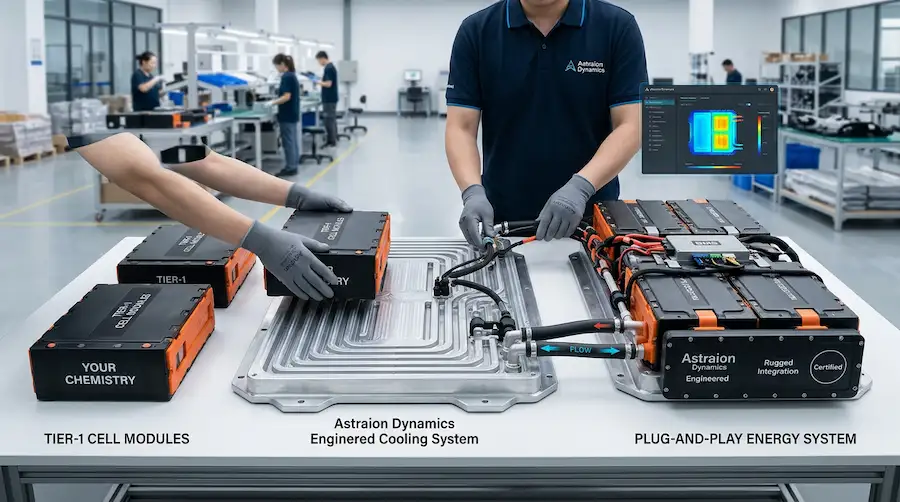
Tier-1 cell manufacturers are built for massive standard volume and often reject deep customization for specialized commercial fleets. They sell you raw modules, but they leave you with a massive engineering headache. A custom-engineered crash-proof tray solves this by packaging the cells safely and making them communicate with your vehicle.
3. Turnkey Integration
With a well-designed tray, you get application-driven engineering built around real platform constraints. It allows for turnkey integration across mechanical, thermal, electrical, and control elements.
The Disadvantages
1. Increased Weight
Crash-proof means heavy-duty materials. Thick aluminum extrusions and high-strength steel add mass to the vehicle, which can slightly reduce the overall payload capacity or vehicle range.
2. Higher R&D and Tooling Costs
You can’t buy a truly custom crash-proof tray off the shelf. It requires deep engineering, thermal simulation, and 3D design. This increases upfront development costs.
3. Supply Chain Complexity
Manufacturing these trays requires advanced techniques like CNC machining and Friction Stir Welding (FSW). If you don’t have a reliable integration partner, managing the supply chain for these components can be a nightmare.
Struggling to integrate Tier-1 battery modules into your commercial vehicle platform? Stop wrestling with raw chemistry.
👉 [Download our Heavy-Duty Battery Integration Blueprint] to see how we turn raw modules into rugged, certified, plug-and-play energy systems.
What does the battery tray consist of for Commercial Vehicles?
A commercial vehicle battery tray is an advanced electromechanical ecosystem. Because modern vehicle architectures now neatly package the high-voltage controls and pressure relief valves (PRV) inside an external PDU, the tray itself strictly houses core power and thermal elements:
Extruded Aluminum Side Frames & High-Strength Base Plate: This forms the rugged, crash-absorbing foundation designed to handle severe torsion and chassis vibration.
Lithium-Ion Battery Modules: The beating heart of the energy storage system, bolted securely into the structural compartments.
Precision Liquid Cold Plates & TIM: Placed directly beneath the modules for rapid heat extraction during heavy-duty fast charging.
Heavy-Duty Busbars: Rigid copper or aluminum strips that safely route hundreds of amps of continuous current between modules.
Battery Management System (BMS): The onboard brain that constantly monitors individual cell voltages, current limits, and pack temperatures.
External Interfaces: Shielded high-voltage connectors, low-voltage CAN pins, and quick-disconnect fluid ports that link the pack to the chassis.

Why do I need a battery tray for the battery back enclosure?
You might be wondering: Can’t I just strap the battery modules directly to the vehicle frame and cover them with a lightweight shell?
Absolutely not.
Battery projects often fail at the integration stage because mechanical, thermal, electrical, and control systems are not developed as one coordinated solution.
The battery tray is the literal and figurative foundation of this coordinated solution.
Without a crash-proof tray, your battery modules are completely exposed to chassis torsion. As your commercial truck drives over potholes or uneven construction sites, the chassis flexes. If the modules are bolted directly to the frame, that twisting force will rip the internal busbars apart, causing an instant high-voltage short circuit.
Furthermore, you need a tray to satisfy compliance. You cannot achieve a flawless ECE R100.3 homologation without a dedicated, highly engineered lower housing that proves the cells are protected during simulated crashes.
By utilizing an integration partner, we transform your procured raw modules into a rugged, fully certified, plug-and-play energy system.
How to design a battery tray?
Designing a crash-proof tray requires a systematic, engineering-driven approach.
We work with customers as an engineering-driven integration partner, and our projects always begin with a deep dive into the vehicle’s specific requirements.
Here is our step-by-step design process:
Step 1: Define Constraints
We begin with a review of the application, operating profile, packaging constraints, electrical targets, and compliance needs. A marine vessel has different structural needs than an electric mining truck.
Step 2: 3D CAD Modeling
Our engineers map out the exact dimensions of the “Bring Your Own Cells/Modules” that you have procured. We design the structural cross-members around these specific modules to ensure zero wasted space.
Step 3: Thermal Simulation (CFD)
We use Computational Fluid Dynamics (CFD) to design precision liquid cold plates. We simulate worst-case scenarios—like a heavy truck pulling a massive load up a hill in 40°C heat—to ensure the tray’s cooling channels can extract the heat fast enough.
Step 4: Finite Element Analysis (FEA) for Crash Simulation
This is where the “crash-proof” element is born. We subject the 3D model to virtual crash tests. We simulate side-pole impacts, rear-end collisions, and bottom-up penetrations. If the FEA shows the stress reaching the battery cells, we thicken the extrusions or add crumple zones until the cells remain perfectly safe.
Step 5: High-Voltage Architecture Layout
Finally, we map out the routing for VCU communication cables, the intelligent BMS, and the high-voltage PDU. Everything must be perfectly packaged within the protective boundaries of the tray.

How to produce a battery tray?
Once your design is locked in, producing a commercial-grade battery tray requires elite manufacturing capabilities.
You can’t rely on simple sheet metal bending for this level of structural safety.
So, how exactly is it done?
-
High-Pressure Aluminum Die-Casting
In most commercial applications, the absolute go-to manufacturing method is high-pressure aluminum die-casting (HPDC).
Why? Because it allows you to form the tray’s complex geometries—like integrated cooling channels, structural crash ribs, and precise module mounting points—into a single, solid piece of metal. This drastically reduces the total part count, cuts down on weight, and eliminates weak weld joints where fatigue failures usually start.
Our in-house engineering team designs rugged IP67+ aluminum enclosures that are specifically optimized for this advanced casting process.
-
Precision CNC Machining
Die-casting gets you the incredibly strong foundational shape, but you still need razor-sharp tolerances to keep water and dust out.
After casting, the trays undergo secondary operations to become high-precision CNC-machined enclosures. We machine the sealing flanges, threaded holes, and mating surfaces to guarantee a perfect IP67+ waterproof seal for demanding marine and off-highway environments.

-
Tapping into a Certified Supply Chain
You don’t want to leave heavy-duty production to chance.
Scaling up die-cast production requires serious tooling and quality control. That is why manufacturing is executed by our strategic network of over 20 IATF-16949 certified partners. This automotive-grade certification ensures your die-cast trays are produced to strict, repeatable quality standards every single time.
- 100% End-of-Line Testing
Here is a secret about die-cast aluminum: it can sometimes suffer from micro-porosity (tiny air bubbles trapped inside the metal during the casting process). If those bubbles connect, your tray could leak coolant into the high-voltage battery modules.
That is exactly why production must be governed by resident QA engineers and 100% End-of-Line testing protocols. Before a tray ever sees a battery cell, we run rigorous helium leak tests to guarantee the internal cooling channels and the main enclosure are flawlessly sealed.
Which battery tray is best for a commercial vehicle?
The best battery tray for a commercial vehicle is one that is perfectly matched to your specific chemistry and vehicle platform.
There is no “one-size-fits-all” in heavy-duty electrification.
The ultimate solution leverages a transparent “Bring Your Own Cells/Modules” partnership model .
Here is why this is the best approach:
You negotiate directly with top cell manufacturers to secure raw modules at zero middleman markup, getting Tier-1 chemistry pricing .
Then, you partner with an engineering-first integrator who designs an application-driven tray around those exact cells.
If you are building an electric boat, the best tray prioritizes waterproofing and liquid cooling . If you are building a mining truck, the best tray prioritizes explosion-proof designs and heavy-duty structural rigidity.
By partnering with an integration hub, you control the chemistry, and we master the engineering. We stay involved until the system is tested, integrated, and ready to work in the field.
Conclusion
Electrifying commercial vehicles is notoriously difficult.
Tier-1 cell giants will sell you the raw modules, but they leave you with the massive engineering headache of figuring out how to cool them, package them safely, and make them talk to your vehicle.
A highly engineered, crash-proof battery tray is the definitive answer to that headache.
It is the critical component that transforms raw lithium-ion chemistry into a rugged, fully certified, plug-and-play energy system. By integrating structural crash protection, precision thermal management, and flawless high-voltage architecture, the battery tray ensures your vehicle can survive the most demanding real-world applications.
Ready to bring your battery-powered platform into operation with total confidence?
At Astraion Dynamics, we are the ultimate “Bring Your Own Cells / Modules” integration hub for heavy-duty, marine, and off-highway applications.
Whether you are a Chief Engineer, or Supply Chain Manager, we can help you shorten development cycles and reduce integration risk.
