

Looking to understand the Battery Management System (BMS) for commercial EVs? I break down exactly how an intelligent BMS works, its core benefits, and how to seamlessly integrate one into heavy-duty applications.
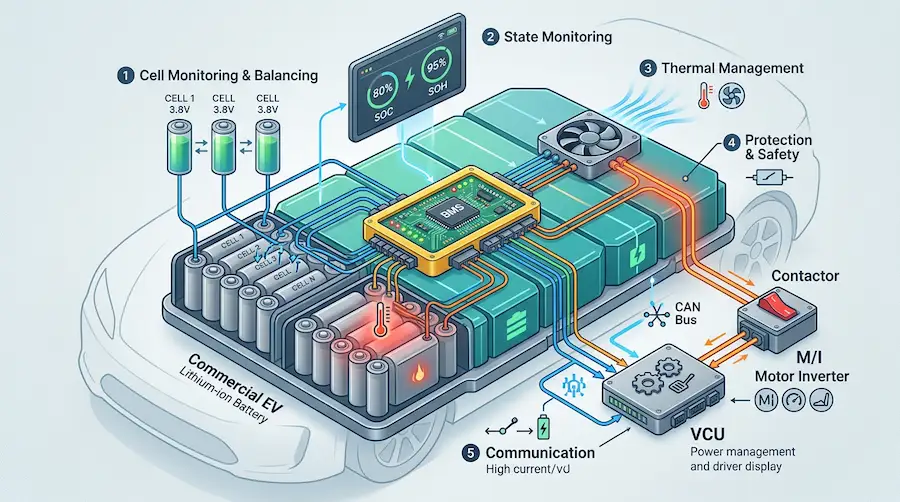
A Battery Management System (BMS) for commercial EVs is an electronic control unit that monitors and regulates battery performance. It ensures optimal safety, balances cell voltages, manages thermal output, and communicates vital data to the Vehicle Control Unit (VCU) to prevent battery failure.
But knowing the basic definition is just the tip of the iceberg.
If you are a Chief Engineer, or Program Manager integrating battery systems for heavy-duty trucks, marine vessels, or agricultural machinery, you already know the stakes are high.
Let’s dive right in.
What is a Battery Management System ( BMS) in a battery pack?
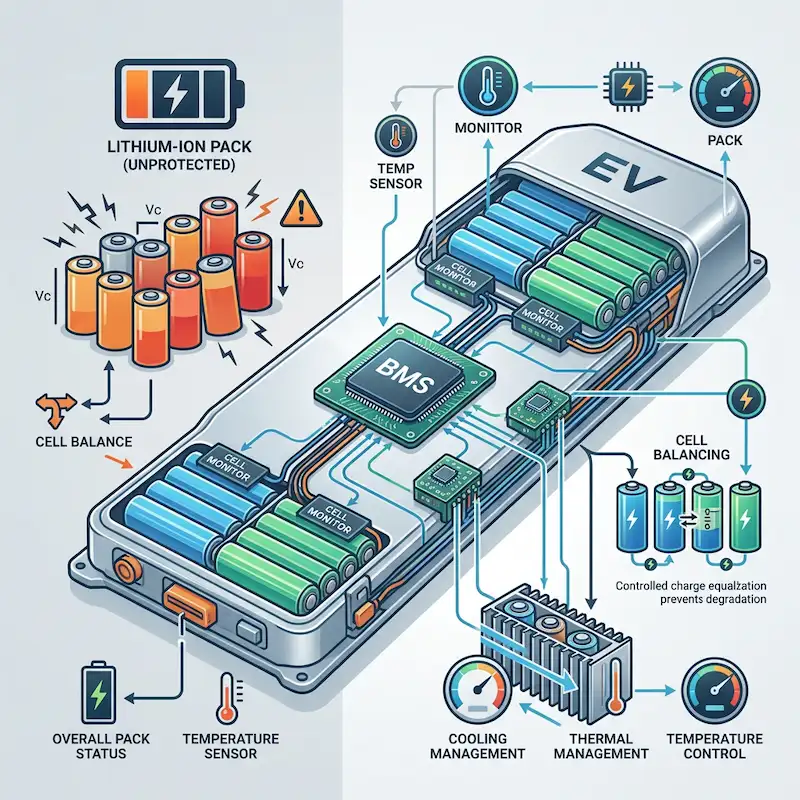
Think of a lithium-ion battery pack without a BMS as pure, unbridled chemical energy.
It has incredible potential, but absolutely zero intelligence.
In a battery pack, the BMS acts as the central brain. It is a highly sophisticated electronic circuit board (or a master-slave network of boards) embedded directly inside the battery enclosure.
Its primary job is to watch over every single cell.
Tier-1 cell manufacturers produce incredible raw chemistry, but they sell you those raw modules leaving you with a massive engineering headache.
How do you keep them from overcharging? How do you package them safely?
That is exactly where the BMS comes in. It constantly measures the voltage, current, and temperature of the cells inside the pack.
If one cell starts getting too hot or degrading faster than the others, the BMS intervenes. It balances the energy across the pack so that all cells degrade at the same rate, maximizing the lifespan of your expensive raw materials.
What is a Battery Management System ( BMS) in an Electrical Vehicle?
When we zoom out from the pack to the entire commercial electrical vehicle (EV), the role of the BMS shifts from a “cell babysitter” to a critical powertrain commander.
In a commercial EV, the BMS is the bridge between the high-voltage energy storage and the Vehicle Control Unit (VCU).
It tells the vehicle exactly how much power is available to the electric motors at any given millisecond.
Heavy trucks, mining vehicles, and marine vessels have intense, highly variable operating profiles. A mining truck might need massive torque to climb a steep grade while fully loaded.
The VCU asks for maximum power. The BMS checks the real-time health and temperature of the battery pack and decides if it is safe to deliver that power.
If the pack is overheating, the BMS will throttle the power output and communicate with the precision liquid cold plates and thermal management systems to cool things down.
Without this intelligent communication, you risk catastrophic thermal runaway or leaving your specialized commercial fleet stranded.

What is the battery management system used for?
In the commercial EV space, the BMS is used for three core objectives: uncompromising safety, maximum longevity, and optimized performance.
First, safety. Commercial applications like electric boats and ferries have stringent requirements for waterproofing and system integration. Mining vehicles demand highly reliable, explosion-proof systems.
The BMS is the ultimate failsafe. It uses high-voltage contactors to instantly disconnect the battery from the vehicle if it detects a short circuit, extreme temperature spike, or high-voltage isolation fault.
Second, longevity. Heavy-duty vehicle operators care about Total Cost of Ownership (TCO). The BMS calculates the State of Health (SOH) of the battery over time. By actively or passively balancing the cells during charging, it ensures that no single cell is over-stressed.
Third, performance. The BMS calculates the State of Charge (SOC) with extreme precision. This gives the driver or operator an accurate range estimation, completely eliminating range anxiety for critical logistics operations.
How does a battery management system work?
This is where the engineering gets fascinating.
A modern BMS operates through a continuous loop of sensing, calculating, and acting.

1. Sensing (Data Collection)
The BMS relies on a network of sensors wired to the battery modules.
It measures:
Individual Cell Voltages: Ensuring no cell drops below a safe minimum or charges above a safe maximum.
Pack Current: Using highly accurate Hall-effect sensors or shunt resistors to track exactly how many amps are flowing in and out.
Temperatures: Using thermistors strategically placed across the module busbars and cooling channels to monitor localized hot spots.
2. Calculating (The Algorithms)
Once the BMS collects this raw data, its microcontrollers go to work.
It uses complex algorithms (like Kalman filtering) to estimate the SOC and SOH. Because you can’t “see” how much chemical energy is left in a battery, the BMS must calculate it dynamically based on voltage curves, current integration (Coulomb counting), and temperature compensation.
3. Acting (Execution and Protection)
If the BMS detects an imbalance, it triggers balancing circuits.
If it detects a critical fault (like an impending thermal event), it commands the High-Voltage Power Distribution Unit (PDU) to open the main contactors, physically breaking the electrical circuit.
4. Communicating
Simultaneously, the BMS transmits all this processed data over the vehicle’s CAN bus (Controller Area Network) to the VCU and charger.
What does a battery management system consist of?
A robust BMS is never just a single component. It is a deeply integrated architecture of hardware and software.
Here is what it typically consists of:
Master Control Unit (MCU): The main processor that handles the heavy mathematical lifting and CAN communication.
Slave / Cell Monitoring Units (CMUs): Smaller circuit boards attached directly to the battery modules that measure local voltage and temperature, sending data back to the Master.
High-Voltage Contactors & Relays: Heavy-duty electromechanical switches that connect or disconnect the battery from the vehicle.
Pre-charge Circuit: A specialized resistor circuit that prevents inrush current spikes from damaging the vehicle’s motor controllers when the battery is first turned on.
Current Sensors: High-precision shunts to measure charge and discharge rates.
Thermal Management Interfaces: Hardware that communicates directly with liquid cooling pumps and chillers.
Battery projects often fail at the integration stage because these electrical and control systems are not developed as one coordinated solution.

What are the benefits of the BMS for the Commercial EVs?
Integrating a top-tier BMS offers massive advantages for OEMs and fleet operators.
Extended Asset Lifespan
Commercial EVs are capital-intensive. An intelligent BMS ensures the battery pack easily survives its 8-to-10-year warranty period by preventing micro-degradation caused by overcharging or deep discharging.
Maximum Operational Uptime
For off-highway and construction equipment OEMs, vehicle downtime means lost revenue. A highly engineered BMS provides predictive maintenance data. It flags a weak cell module long before it completely fails, allowing maintenance teams to schedule repairs proactively.
Global Homologation and Compliance
You cannot sell a commercial EV without passing brutal safety certifications. An advanced BMS is strictly required to pass tests like the UN38.3 and ECE R100.3 homologation. It orchestrates the safety responses needed to pass thermal propagation and short-circuit tests.
Optimized Charging
For large-scale Energy Storage Systems (ESS) or electric agricultural machinery, charging needs to be fast and safe. The BMS constantly tells the DC fast charger exactly how much current the pack can accept without overheating.
What are the disadvantages of the BMS?
While indispensable, integrating a BMS does come with highly specific engineering challenges.
High Development Complexity
You can’t just buy an off-the-shelf BMS and slap it into an electric tractor. The software parameters must be painstakingly tuned to match the specific electrochemistry of your cells.
Supply Chain Bottlenecks
Sourcing reliable automotive-grade microchips and contactors for the BMS can be a nightmare. Many early-stage electrification companies struggle to secure tier-1 electrical components at low volumes.
Integration Friction
Tier-1 cell giants are built for massive standard volume and often reject deep customization for specialized commercial fleets. They provide the chemistry but leave you to figure out how to make the BMS talk to your specific VCU.
If your mechanical enclosures, thermal fluid dynamics, and BMS algorithms aren’t perfectly aligned, the system will fail.
How to choose a suitable BMS brand for the Commercial EVs?
Choosing the right BMS is a make-or-break decision for your Chief Engineer and Product Development Manager.
Here is how you evaluate your options:
1. Match the BMS to your Operating Profile
An electric passenger car BMS will not survive in an electric mining vehicle. You need a system rated for high vibration, extreme temperature swings, and heavy-duty cycle life.
2. Look for Intelligent Architecture
Ensure the BMS supports a modular Master-Slave architecture. This allows you to scale your battery pack from 400V up to 800V or even 1000V+ without redesigning the entire control system.
3. Demand Transparent Supply Chains
Avoid black-box suppliers who lock you into their proprietary, marked-up battery cells.
The smartest approach is separating the chemistry from the engineering. You should negotiate directly with top cell manufacturers to secure raw modules at zero middleman markup, while relying on a specialized partner to design the intelligent BMS architecture.
How to custom a battery management system for the Commercial EVs?
If you are developing battery-powered platforms for demanding real-world applications, off-the-shelf solutions usually fall short. You need application-driven engineering built around your real platform constraints.
This is exactly where Astraion Dynamics steps in.
We are a turnkey integration partner for lithium-ion battery power systems serving heavy-duty, marine, and off-highway applications.
Our business exists to help customers reduce integration risk, shorten development cycles, and bring battery-powered platforms into operation with greater confidence.
Here is how we custom-build and integrate your system:
1. The “Bring Your Own Cells/Modules” Model
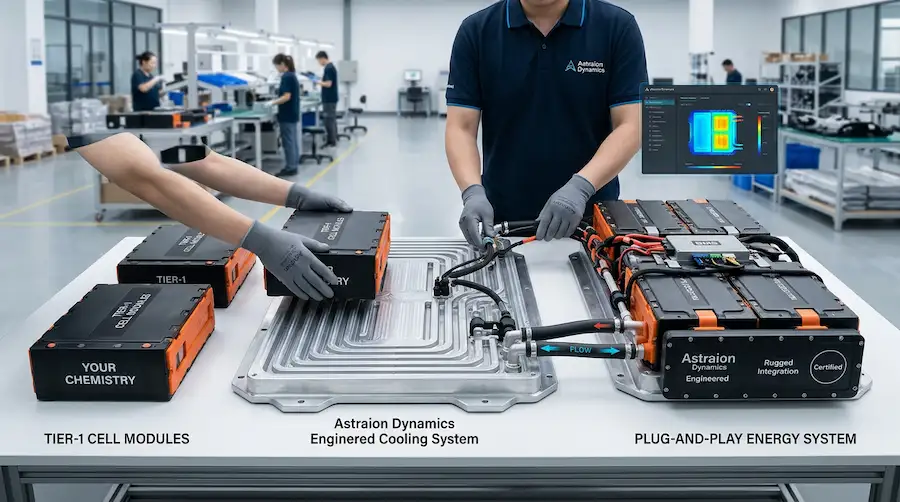
Our defining strength is our transparent partnership model. You retain full control over your chemistry. You buy your preferred cells; we transform your procured raw modules into a rugged, fully certified, plug-and-play energy system.
2. Deep System Architecture Review
Projects typically begin with a deep review of your application, operating profile, packaging constraints, and electrical targets.
3. Turnkey Integration
We don’t just supply a BMS board. We combine rugged IP67+ aluminum enclosures, precision liquid cold plates, intelligent BMS architectures, and high-voltage PDUs in one coordinated workflow.
4. End-of-Line Testing and Homologation
We leverage a strategic network of over 20 IATF-16949 certified partners to manufacture your custom systems. We then run 100% End-of-Line testing protocols and support you through flawless ECE R100.3 global homologation.
We stay involved until the system is tested, integrated, and ready to work in the field.
Conclusion
Bottom line?
A Battery Management System is the undisputed brain of your commercial EV. It dictates the safety, power output, and lifespan of your expensive battery cells.
Getting the chemistry right is only half the battle. If your mechanical, thermal, electrical, and control systems are not developed as one coordinated solution, the project is at massive risk.
If you are a Technical Procurement Lead, VCU Engineer, or R&D Director tired of wrestling with cell giants who reject deep customization, we should talk.
We master the deep engineering and complex supply chain ecosystem so you don’t have to.
Ready to stop struggling with integration and get your commercial EV platform deployment-ready?
Reach out to Astraion Dynamics today. Let’s review your application, define your ideal system architecture, and turn your raw modules into a highly reliable, homologated power system.
