

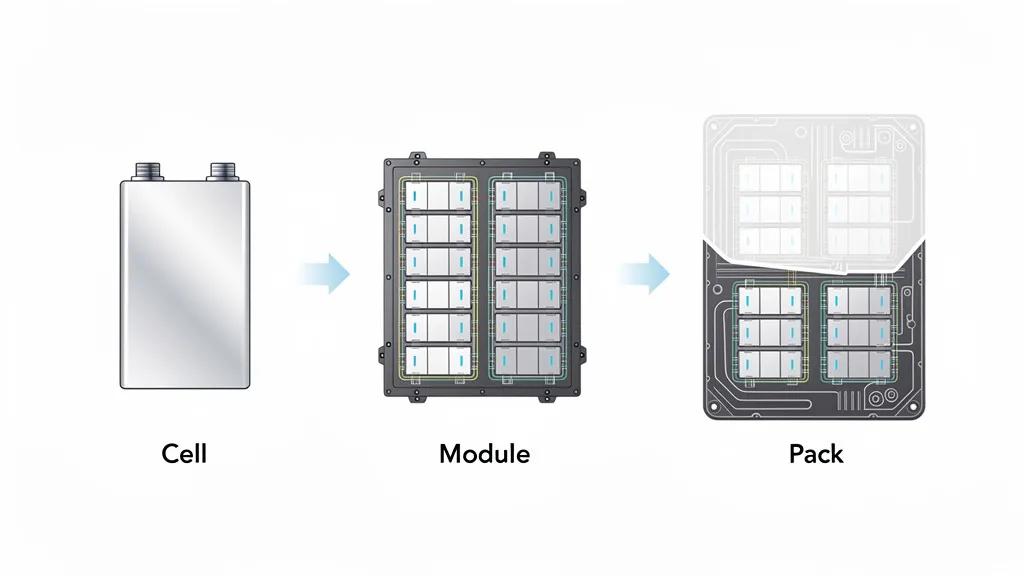
If you are building an electric vehicle, marine vessel, or energy storage platform, you know that battery terminology can get confusing quickly. In this guide, I will break down exactly how lithium cells, modules, and battery packs differ. I will also show you why getting the final system integration right is the most crucial step for your project’s success.
A battery cell is the basic chemical unit that stores electrical energy. A battery module is a clustered assembly of multiple cells connected in series and parallel within a mechanical frame. A battery pack is the final, deployment-ready system that integrates modules with thermal management, a Battery Management System (BMS), and high-voltage controls.
Sounds simple enough, right? But the engineering leap from a single cell to a fully functional pack is massive. Let’s dive deeper into each stage of the battery integration process so you can make the best engineering and procurement decisions for your platform.
What is a lithium-ion battery cell?
A lithium-ion battery cell is the foundational building block of any modern energy storage system.
It is the raw, individual unit where the actual electrochemistry happens. Inside every cell, you have a cathode, an anode, a separator, and liquid or solid electrolyte. When you charge the cell, lithium ions move from the cathode to the anode. When you discharge it, they move back, generating an electrical current.
Cells come in three primary form factors:
- Cylindrical: Looks like a traditional AA battery (e.g., 18650, 21700, or 4680).
- Prismatic: Rigid, rectangular aluminum or steel cans that offer excellent packaging efficiency.
- Pouch: Soft, flexible aluminum-polymer bags that are lightweight but require careful structural support.
These cells are manufactured by massive Tier-1 companies. However, a single cell only outputs around 3.2V to 3.7V. To power an electric truck or a marine vessel, you need a lot more juice.

What is a lithium-ion battery module?
A lithium-ion battery module is a grouped assembly of individual cells.
Because a single cell cannot provide the voltage or capacity required to drive a heavy-duty electric motor, engineers group them together. We connect these cells in specific series and parallel configurations using conductive busbars (often laser-welded for reliability).
But a module is more than just cells welded together. It includes structural components like aluminum end plates and side plates to hold the cells tightly together. This physical compression is critical to prevent the cells from swelling during aggressive charge and discharge cycles.
A module also features basic sensing lines. These thin wires connect to the cell terminals to measure individual cell voltages and temperatures.
However, a module cannot operate a vehicle on its own. It is an intermediate subsystem.

What is a lithium-ion battery pack?
A lithium-ion battery pack is the complete, fully integrated power system.
This is the final product that actually gets bolted into the chassis of an EV or installed into an energy storage container. The battery pack houses multiple modules and surrounds them with the critical hardware and software required for safe, high-performance operation.
When we talk about a battery pack, we are talking about serious engineering. It combines enclosure engineering, thermal management, HV architecture, intelligent controls, and commissioning support in one coordinated workflow.
The pack takes the raw, dumb power of the modules and transforms it into a smart, rugged, and deployment-ready energy system.

What are the differences between a lithium cell and module?
The easiest way to understand the difference is scale and mechanical complexity.
A cell is purely chemical. Its performance is dictated by its internal chemistry (like NMC or LFP), electrode thickness, and electrolyte composition. Handling individual cells requires extreme care because they are vulnerable to punctures, short circuits, and environmental exposure.
A module, on the other hand, is a mechanical assembly. It takes dozens of delicate cells and binds them into a rigid, manageable block.
While a cell might output 3.7 volts, a module might output 48 volts. The module introduces the first layer of structural integrity and electrical routing, making it easier and safer for factory workers and automated robots to handle during the manufacturing process.
What are the differences between a lithium module and battery pack?
This is where many electrification projects hit a wall.
Tier-1 cell manufacturers are built for massive standard volume, and they are happy to sell you raw modules. But they leave you with a massive engineering headache.
A module is just a dumb block of energy. It has no brain, no cooling system, and no safety contactors to disconnect power in an emergency.
A battery pack is a highly complex, intelligent system. How do you cool the modules? How do you package them safely? How do you make them talk to your vehicle? That is exactly where battery pack integration steps in.

The pack adds the heavy-duty enclosure, the liquid cooling loops, the high-voltage relays, and the overarching brain (BMS) that keeps everything from catching fire.
How does the lithium battery cell, module and battery pack work for ESS?
Energy Storage Systems (ESS) operate on a massive scale.
In an ESS application, the cells are usually optimized for deep, steady cycling rather than rapid bursts of power. LFP (Lithium Iron Phosphate) cells are highly popular here due to their incredible cycle life and thermal stability.
The modules are typically designed to slide into standard 19-inch server racks.
The battery pack in an ESS is often a massive, room-sized cabinet or a shipping container. Because ESS projects require large-scale battery packs, PDUs/BMS, and thorough testing, the system must manage thousands of modules simultaneously. The pack architecture works closely with grid inverters to capture solar/wind energy during the day and discharge it into the grid during peak hours.

How does the lithium battery cell, module and battery pack work for EVs?
Electric Vehicles demand highly dynamic performance.
The cells inside an EV must handle harsh acceleration (high discharge rates) and regenerative braking (rapid charge spikes).
The modules must be designed to withstand brutal road vibration and mechanical shock. They are carefully arranged to fit within the vehicle’s specific packaging constraints, optimizing the center of gravity.
The battery pack is the ultimate guardian of the vehicle. For heavy trucks, the pack must meet high demands for durability, liquid cooling, and high-voltage integration. During driving, the pack’s thermal management system constantly pumps coolant around the modules to prevent overheating, while the BMS calculates range and throttles power if things get too hot.

What does a lithium battery module consist of?
If you tear down a lithium battery module, you will find several highly engineered components:
Bare Cells: The core energy storage units (cylindrical, prismatic, or pouch).
Structural Frame: Aluminum or composite end plates, side panels, and tie rods that compress the cells.
Busbars: Highly conductive copper or aluminum strips that link the positive and negative terminals of the cells.
Cell Supervisory Circuit (CSC) / FPC: A flexible printed circuit board that runs across the top of the cells to monitor voltage and temperature.
Thermal Interface Material (TIM): Thermally conductive pads placed at the bottom or sides of the cells to help transfer heat out of the module.
Insulation: Flame-retardant plastics and isolation sheets to prevent high-voltage arcing.

What does a lithium battery pack consist of for the ESS and EV?
When we build a battery system engineered around the real requirements of a vehicle, vessel, or machine, we must integrate several complex subsystems .
Here is what makes up a true deployment-ready battery pack:
Battery Pack Enclosure
The enclosure is the first line of defense against the elements. For marine and off-highway applications, you cannot rely on flimsy sheet metal. We utilize rugged, CNC-machined IP67+ aluminum enclosures to ensure absolute protection against water, dust, and mechanical impact.
Liquid Cold Plate
High-performance modules generate immense heat. If you don’t remove this heat, the cells will degrade rapidly or enter thermal runaway. Precision liquid cold plates sit beneath or between the modules. A water-glycol mixture flows through micro-channels within these plates, absorbing heat from the modules and maintaining a uniform temperature gradient across the entire pack.
BMS (Battery Management System)
The BMS is the brain of the battery pack. It constantly monitors cell voltages, temperatures, and current flow. We integrate intelligent BMS architectures that actively balance cell voltages, calculate State of Charge (SoC) and State of Health (SoH), and communicate seamlessly with the Vehicle Control Unit (VCU).
PDU / HV Control Box
The Power Distribution Unit (PDU) or High-Voltage (HV) Control Box acts as the pack’s electrical switchboard. It houses heavy-duty contactors, fuses, and pre-charge circuits. When you turn the key, the PDU safely connects the high-voltage battery to the motor inverter. In the event of a crash or a short circuit, the high-voltage PDUs physically sever the connection in milliseconds to keep the operator safe.

How to make a lithium battery cell, module and battery pack?
Making these components requires totally different manufacturing environments.
Making a Cell:
This is a highly automated, chemical process. It involves mixing toxic slurries, coating copper and aluminum foils, baking them in massive ovens, calendering (compressing) the foils, and tightly winding them. Finally, the cells are injected with liquid electrolyte and put through a rigorous “formation” charging process to activate the chemistry.
Making a Module:
Module manufacturing shifts from chemistry to precision mechanical assembly. Robots pick and place the cells into a frame. Automated laser welding machines zap the busbars onto the cell terminals with microscopic accuracy.
Making a Battery Pack:
Pack integration is where the magic happens. We work with customers as an engineering-driven integration partner. The process starts by taking raw modules and lowering them into the heavy-duty enclosure. We plumb the liquid cooling hoses to the cold plates, run the low-voltage communication wire harnesses to the BMS, and torque down the high-voltage power cables to the PDU. Finally, the lid is sealed, and the pack undergoes strict leak testing.
How to test the lithium battery cell, module and battery packs?
You cannot guess when it comes to battery safety. Testing must be brutal and uncompromising.
Cell Testing:
Manufacturers test cells for capacity, internal resistance, self-discharge rates, and cycle life. They also conduct abuse tests like nail penetration and overcharging to ensure the chemistry doesn’t violently explode.
Module Testing:
Modules undergo electrical continuity checks, weld-pull testing (to ensure the laser welds won’t break on a bumpy road), and basic insulation resistance testing.
Battery Pack Testing:
Battery projects often fail at the integration stage if the mechanical, thermal, electrical, and control systems are not developed as one coordinated solution. Therefore, pack testing is exhaustive.
Manufacturing must be governed by resident QA engineers and 100% End-of-Line testing protocols. This includes:
- Dielectric Withstand Testing: Blasting the pack with high voltage to ensure no electrical leaks exist.
- Thermal Simulation & Shock: Rapidly freezing and baking the pack.
- Vibration Testing: Shaking the pack on a massive hydraulic table to simulate 10 years of off-road driving.
- Homologation: Achieving flawless UN38.3 (for safe transportation) and ECE R100.3 (automotive safety standards) certification.
Which is best for EVs, lithium battery cells or modules?
If you are an OEM, you might wonder if you should build your pack directly from raw cells (Cell-to-Pack / CTP) or use pre-assembled modules.
CTP architectures skip the module phase entirely, packing cells directly into the enclosure. This increases energy density and lowers weight. However, CTP is incredibly complex to engineer, extremely difficult to service, and requires massive production volumes to justify the tooling costs.
For most off-highway, heavy-duty, and marine applications, module-based architectures remain the superior choice.
Modules offer excellent structural stability and allow for easier maintenance. If one cell goes bad in a heavy-duty mining truck, you can swap out a single module rather than scrapping an entire massive battery pack.

The smartest route for an OEM is leveraging a “Bring Your Own Cells/Modules” model. You negotiate directly with top cell manufacturers to secure raw modules at zero middleman markup, while an integration partner masters the deep engineering and complex supply chain ecosystem to build the final pack.
What are the main applications for lithium battery cells, modules and battery packs?
The engineering constraints change wildly depending on where the battery is going. Here are the main applications:
EV Passenger Car Manufacturers: These companies require high-precision battery pack systems, liquid cooling integration, and complete vehicle commissioning. European and emerging market brands often outsource pack integration to reduce supply chain costs.
Electric Truck / Heavy Duty Vehicle Manufacturers: Heavy trucks face brutal duty cycles. They have high demands for battery pack durability, liquid cooling, and high-voltage integration.
Electric Boat / Marine Vessel Manufacturers: Water and electricity are a dangerous mix. Electric boats and ferries have stringent requirements for waterproofing, liquid cooling, and system integration.
Off-Highway & Mining: Battery electric mining vehicles demand highly reliable, explosion-proof, and heavy-duty battery systems.
Energy Storage System (ESS) Integrators: These projects require large-scale architectures, sophisticated PDUs/BMS, and CAS Energy Storage certification to ensure long-term grid stability .

Conclusion
Understanding the difference between a cell, a module, and a battery pack is the first step toward launching a successful electrification platform.
The cell is the raw chemical potential. The module is the mechanical grouping. But the battery pack is the final, intelligent system that actually makes your vehicle drive or your vessel sail.
Getting from a raw module to a rugged, certified, plug-and-play energy system is historically the hardest part of the process. It requires deep expertise in enclosure engineering, thermal fluid dynamics, and high-voltage controls.
If you are Chief Engineer, or Purchasing Manager struggling with this exact transition, we can help.
At Astraion Dynamics, our mission is to make battery system integration more practical, more reliable, and more deployment-ready for demanding real-world applications. As an engineering-first integrator, we transform your procured raw modules into a fully certified energy system. You control the chemistry, and we master the engineering.
Projects typically begin with a review of your application, operating profile, packaging constraints, electrical targets, and compliance needs. If you are ready to shorten your development cycle and bring your battery-powered platform into operation with greater confidence, reach out to our engineering team today. Let’s bridge the gap between raw cell chemistry and your customized vehicle.
