

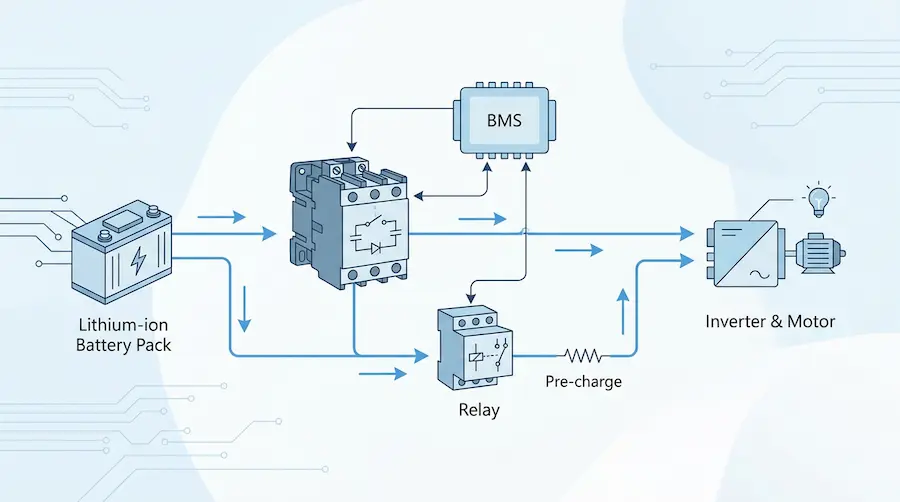
Designing a safe, efficient Power Distribution Unit (PDU) for modern EVs requires mastering the core switching components. If you’re struggling to understand the exact roles of high-voltage contactors and relays in your battery system, you’re in the right place.
In an EV’s PDU, high-voltage contactors are heavy-duty electromechanical switches that safely connect and disconnect the main lithium-ion battery pack power. Relays are smaller switches used for lower-current auxiliary circuits, like pre-charge functions, controlled directly by the BMS.
But knowing the basic definition is just scratching the surface. Let’s dive deep into how these critical components actually protect your EV architecture and why getting this right is non-negotiable.
What Is A High-Voltage Contactor In A PDU?
A high-voltage contactor is essentially the primary gatekeeper of your EV’s electrical system.
When you sit in an electric vehicle and press the “Start” button, you hear a distinct clunk from the back or bottom of the car. That sound is the high-voltage contactor snapping shut.
In a Power Distribution Unit (or HV Control Box), the contactor acts as a massive electromechanical switch. Its sole job is to safely handle the immense voltage (often 400V, 800V, or even up to 1000V) and the massive continuous current (sometimes exceeding 400 Amps) coming from the lithium-ion battery pack.
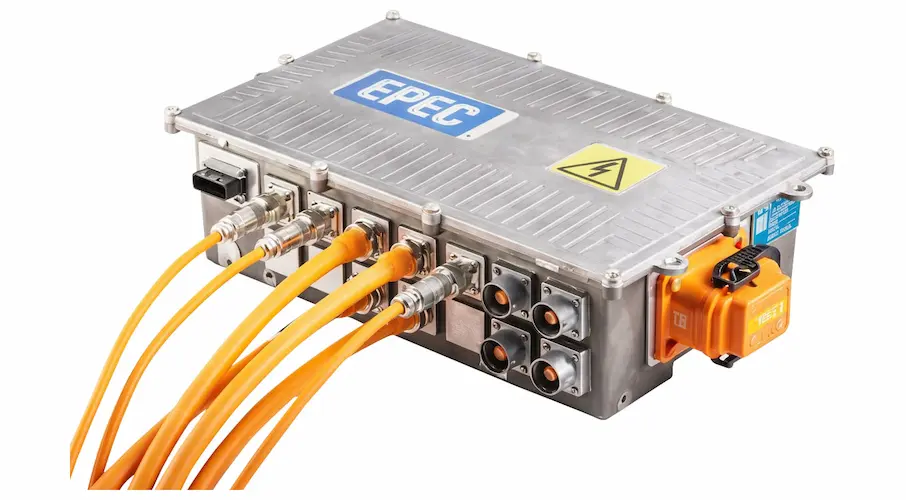
Because it handles the main power pathway, a contactor is built like a tank. It connects the battery to the main traction inverter, which drives the electric motor. If something goes catastrophically wrong, the contactor must physically break that high-voltage circuit to protect the vehicle and the passengers.
What Is A Relay In A PDU?
While the contactor is the heavy lifter, the relay is the precision instrument.
A relay in a PDU is also an electromechanical switch, but engineers design it to handle much lower power levels. You usually won’t see a relay managing the hundreds of amps required to spin the traction motor.
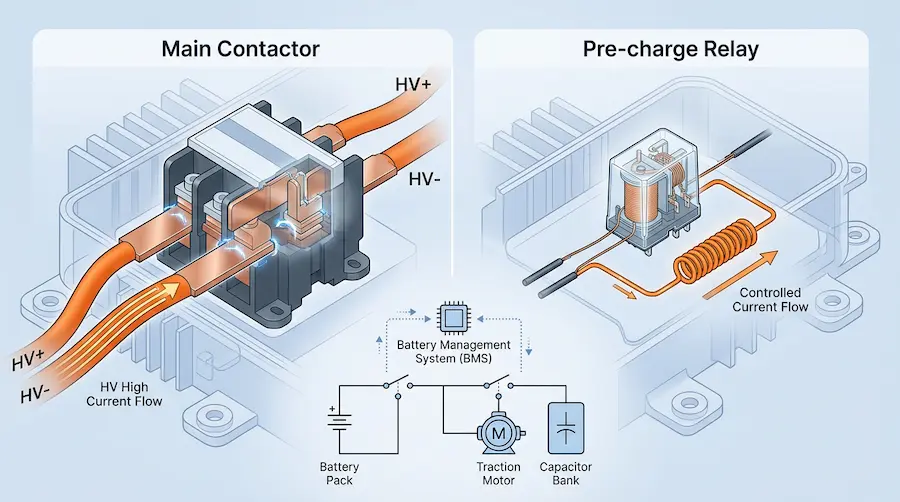
Instead, you use relays for auxiliary or control circuits. The most famous example in an EV architecture is the pre-charge relay.
If you just slammed the main contactors shut while the traction inverter’s massive capacitors were empty, the sudden rush of electricity (inrush current) would weld the main contactor’s metal contacts together. Game over for your PDU.
To prevent this, the Battery Management System (BMS) first closes a small pre-charge relay. This routes a controlled, low amount of current through a pre-charge resistor to slowly fill the capacitors. Once the voltage stabilizes, the big main contactor closes, and the pre-charge relay opens back up.
What Are Contactors And Relays Used For In A PDU?
Now that we know what they are, let’s look at exactly how we use them inside the HV Control Box.
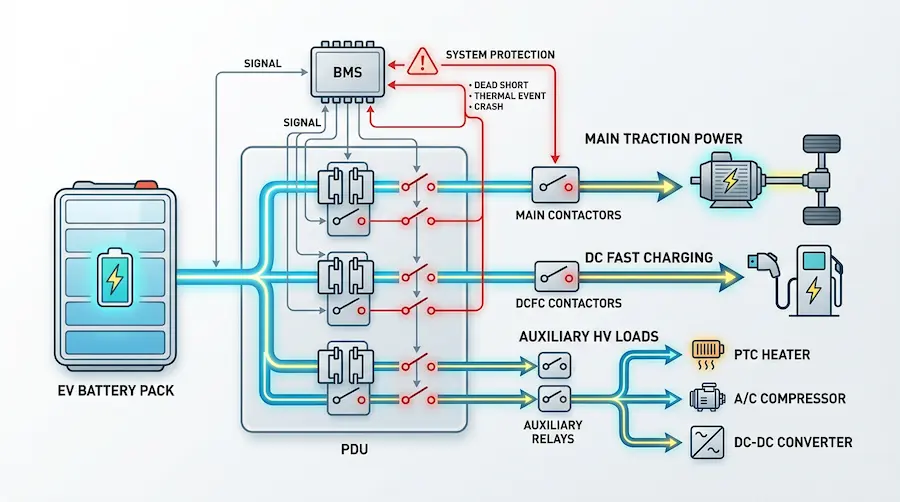
The PDU is the grand central station for high-voltage electricity in an EV. It takes the raw power from the lithium-ion battery pack and distributes it to everything that needs it. Contactors and relays are the traffic cops making this happen safely.
Here is what they manage:
Main Traction Power: The main positive and main negative contactors isolate the battery pack from the drivetrain when the car is off.
DC Fast Charging (DCFC): Dedicated fast-charge contactors route external power directly from a charging station into the battery, bypassing internal vehicle loads.
Auxiliary High-Voltage Loads: Smaller relays and contactors distribute power to the PTC heater, the air conditioning compressor, and the DC-DC converter.
System Protection: If the BMS detects a dead short, a thermal runaway event, or a crash, it immediately drops power to these components, physically severing the high-voltage lines.
Without these switching devices, your PDU would just be a dangerous box of live, unmanageable electricity.
How Does The High-Voltage Contactor And Relay Work In A PDU?
Let’s get into engineering mechanics. How do these devices actually operate under the hood?
Both contactors and relays rely on simple electromagnetism. Inside the device, there is a coil of wire wrapped around a metal core.
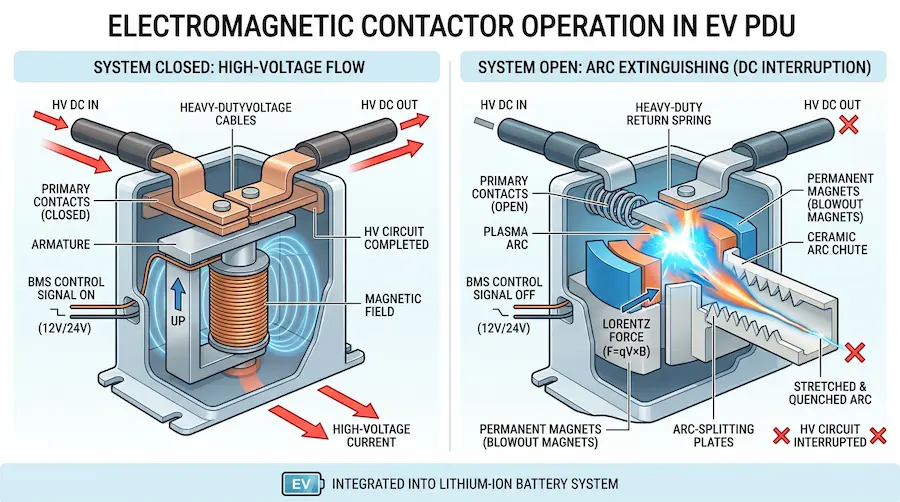
When the BMS decides it’s safe to power up the car, it sends a low-voltage signal (usually 12V or 24V) to this coil. As current flows through the coil, it generates a strong magnetic field.
This magnetic field acts like an invisible hand. It pulls down on a metal plate called an armature. The armature is physically attached to the electrical contacts. When the armature pulls down, it bridges the gap between the incoming battery cable and the outgoing PDU cable, allowing high-voltage electricity to flow.
When you turn the car off—or if the BMS detects a fault—the BMS cuts the 12V signal. A heavy-duty return spring violently snaps the contacts apart, stopping the flow of electricity.
The Arc Extinguishing Challenge
Opening a switch under 800V DC power is incredibly violent. Unlike AC power, which drops to zero volts 60 times a second, DC power is constant. When the contacts pull apart, the electricity tries to jump the gap, creating a plasma arc that burns hotter than the surface of the sun.
To solve this, high-voltage contactors use strong permanent magnets to physically “blow” the arc sideways into a ceramic chamber, stretching it until it snaps.
Need help optimizing your EV’s PDU architecture?
Dealing with high-voltage arcing, thermal management, and complex BMS integration can delay your product launch. At our engineering facility, we specialize in custom PDU/HV Control Box design, liquid cooling plates, and advanced BMS integration for leading OEMs and Tier 1 suppliers. [Click here to schedule a deep-dive technical consultation with our engineering team today.]
What Are The Benefits Of The High-Voltage Contactor And Relay?
Why do we rely on electromechanical contactors and relays instead of purely solid-state electronics?
While solid-state switches (like IGBTs or SiC MOSFETs) are amazing, physical contactors offer non-negotiable benefits for the PDU:
1. True Galvanic Isolation
When a contactor is open, there is a literal physical air gap (or gas gap) between the battery and the rest of the car. No electricity can leak through. Solid-state switches always have a tiny bit of leakage current, which is a massive safety hazard for technicians working on a vehicle.
2. Extreme Fault Tolerance
In the event of a catastrophic short circuit, contactors can carry thousands of amps for a few milliseconds without instantly vaporizing, giving the main pyrotechnic fuse time to blow.
3. Thermal Stability
Once a contactor is closed, the physical metal-to-metal connection generates very little heat compared to a solid-state switch carrying 400 amps.
What Does The High-Voltage Contactor And Relay Consist Of?
If you were to cut a high-voltage contactor open on your workbench, you would find several highly specialized components.
Here is a breakdown of what makes up these devices:
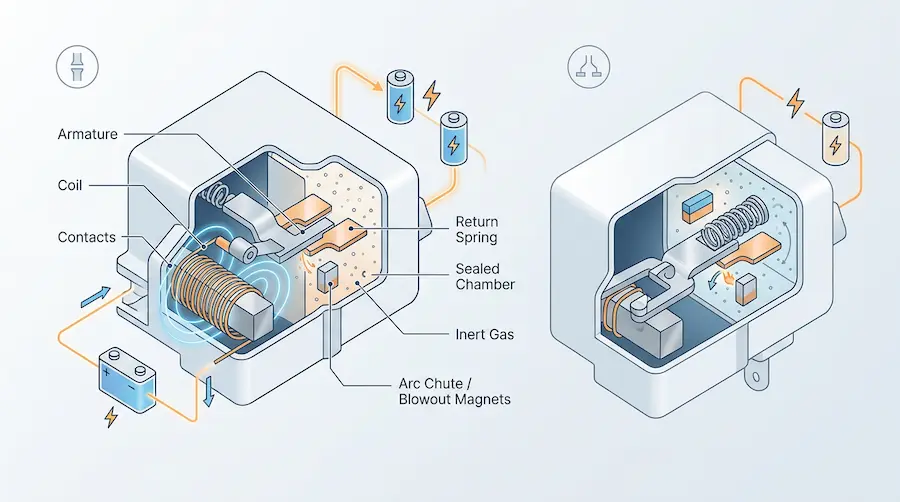
The Coil: The low-voltage wire winding that creates the magnetic field.
The Armature: The moving metal linkage that pushes the contacts together.
The Contacts: The actual conductive pads (usually made of proprietary copper alloys) that carry the high-voltage current.
The Return Spring: A heavy-duty spring that ensures the contacts fly apart the millisecond power is cut to the coil.
The Arc Chute / Blowout Magnets: Permanent magnets situated next to the contacts to force electrical arcs away from the metal.
The Sealed Chamber: In many modern EV contactors, the contact area is sealed inside a ceramic enclosure filled with inert gas (like hydrogen or nitrogen) to prevent oxidation and suppress arcs.
Relays share this exact same DNA, just scaled down significantly, usually omitting the heavy ceramic arc chambers since they deal with lower voltages and currents.
What’s The Difference Between High-Voltage Contactors And Relays?
This is a question I hear all the time from procurement managers and project leads trying to source parts for their HV Control Box.
While people often use the terms interchangeably in casual conversation, engineers treat them very differently. Here is a quick breakdown to make the distinction crystal clear.
| Feature | High-Voltage Contactor | High-Voltage Relay |
|---|---|---|
| Primary Role | Main power routing (Battery to Inverter/Drivetrain). | Auxiliary power routing (Pre-charge, HVAC, signaling). |
| Current Capacity | 100A to 500A (Continuous). | 10A to 40A (Continuous). |
| Arc Suppression | Heavy-duty magnetic blowouts and gas-filled ceramic chambers. | Minimal to moderate arc suppression (often air-filled). |
| Physical Size | Large, heavy, requires robust mounting inside the PDU. | Small, lightweight, often PCB-mountable. |
| Cost | High ($50 to $200+ per unit). | Low ($5 to $30 per unit). |
| Control Signal | Often requires PWM (Pulse Width Modulation) to reduce holding heat. | Simple 12V continuous DC signal. |
Think of the contactor as the main water valve for a city block, and the relay as the faucet in your kitchen sink. Both control flow, but the scale and engineering behind them are worlds apart.
Why Is It Necessary To Use The High-Voltage Contactor And Relay In A PDU?
You might be wondering, “Can we just hardwire the battery directly to the inverter and save weight, complexity, and cost?”
Absolutely not. Here is why using contactors and relays in your HV Control Box is strictly mandatory.
Crash Safety and Compliance
Global safety regulations (like UN ECE R100) mandate that an EV must isolate its high-voltage battery from the chassis and drivetrain in the event of a crash. If the airbags deploy, the vehicle sends an immediate kill signal to the BMS. The BMS drops the contactors in milliseconds, leaving the high-voltage trapped safely inside the battery pack.
Preventing Thermal Runaway
If a component in the vehicle shorts out, it will try to draw infinite current from the battery pack. This massive current draw creates extreme heat, which can trigger thermal runaway in the lithium-ion cells. The contactors act as the primary line of defense, breaking the circuit before the battery cooks itself.
Active Discharge and Maintenance
When a technician needs to service the vehicle, they need a way to ensure the high-voltage system is dead. The contactors allow the system to be turned “off.” Furthermore, once the contactors open, the relays help trigger active discharge circuits that safely bleed off any leftover voltage in the inverter’s capacitors.
Without contactors and relays, EVs simply would not be safe enough for public roads.
Conclusion
Understanding the distinct roles of high-voltage contactors and relays is crucial for anyone involved in EV supply chains, product development, or engineering.
They are the unsung heroes of the PDU. Contactors carry the immense load of the main drivetrain, safely isolating the massive power of the lithium-ion battery pack. Relays handle the delicate, smart operations—like pre-charging circuits—to keep the whole system running smoothly without self-destructing.
As EV architectures move from 400V to 800V and beyond, the demands on these electromechanical switches are only getting stricter. Picking the wrong component can lead to welded contacts, blown inverters, or worse.
Ready to bulletproof your next EV project?
Sourcing and integrating the right high-voltage components doesn’t have to be a guessing game. We provide end-to-end solutions for the NEV supply chain, from robust PDU enclosure and BMS integration to liquid cooling plates and high-voltage harnesses.
[Request a Custom Quote] to see how we can help you reduce costs, eliminate safety risks, and accelerate your time-to-market.
