

Getting a lithium-ion battery pack cleared for global shipping is no joke. If you are preparing for UN38.3 certification, you might be wondering exactly what your system will face. Today, I am going to break down the top 8 testing items you need to know.
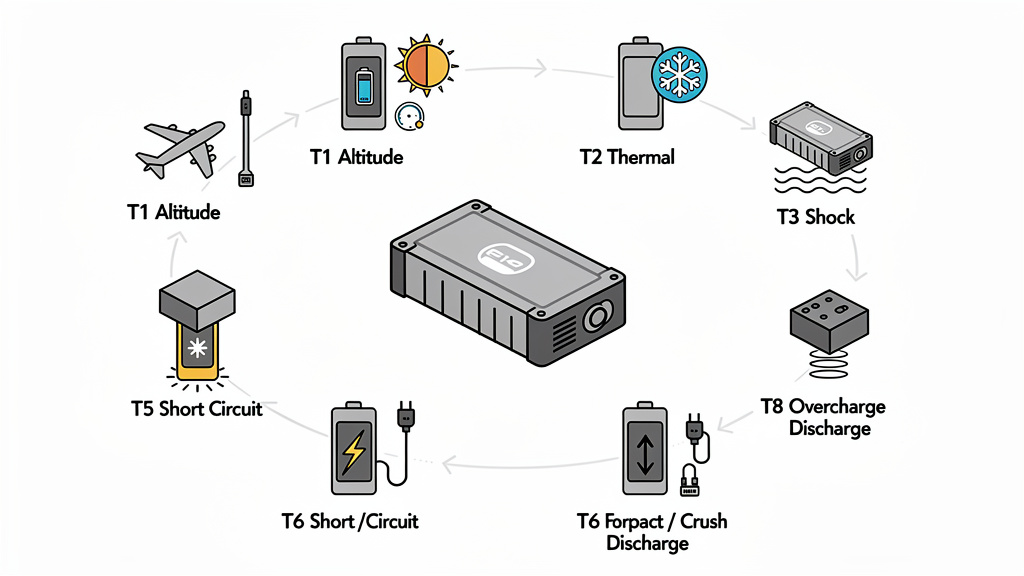
UN38.3 certification requires lithium-ion battery packs to pass 8 rigorous tests: Altitude Simulation, Thermal Test, Vibration, Shock, External Short Circuit, Impact/Crush, Overcharge, and Forced Discharge. Passing ensures your batteries are safe for global transportation.
Ready to dive into the specifics? Let’s look at exactly what each test entails and how your engineering team can prepare your battery system to pass with flying colors.
1 T1 – Altitude Simulation
When you ship a lithium-ion battery pack by air, the cargo hold isn’t always perfectly pressurized.
The T1 Altitude Simulation test ensures your battery can survive low-pressure environments without leaking, venting, or catching fire. In this test, the battery pack is stored at a pressure of 11.6 kPa (which simulates an altitude of about 50,000 feet) for at least six hours.
If your battery pack enclosure is not completely sealed, the pressure differential can cause the internal cells to expand or leak electrolyte. This is a massive safety hazard.
For engineering teams working on battery-powered mobility and industrial platforms, designing a robust enclosure is the first line of defense.
To pass this, we often rely on rugged IP67+ aluminum enclosures. A well-engineered CNC-machined enclosure ensures that the pressure differential does not compromise the internal structural integrity.

If you are a Battery Systems Engineer or Vehicle Integration Engineer, you might want to consider implementing pressure relief valves (PRVs) that can safely equalize pressure without allowing moisture in.
2 T2 – Thermal Test
Batteries hate extreme temperature changes.
The T2 Thermal Test evaluates the structural integrity of your lithium-ion battery pack under rapid and extreme temperature fluctuations. The test involves cycling the battery between -40°C and +72°C for a total of 10 cycles, with the battery held at each extreme for at least six hours.
Thermal expansion and contraction can wreak havoc on internal components. Seals can break, cell tabs can snap, and your liquid cold plate could develop microscopic leaks.
If you are building for heavy trucks, you already know they have high demands for battery pack durability and liquid cooling.
A highly precise liquid cold plate is crucial here. If the cooling system’s materials have mismatched coefficients of thermal expansion, the stress during this test will cause mechanical failure.

We master the deep engineering required to ensure that your thermal management system moves fluidly with the battery cells rather than fighting against them.
3 T3 – Vibration
Transporting a heavy-duty EV battery pack via truck, train, or ship involves a lot of shaking.
The T3 Vibration test mimics these conditions using a logarithmic sine sweep from 7 Hz to 200 Hz and back to 7 Hz in 15 minutes. This cycle is repeated 12 times in each of the three mutually perpendicular mounting positions.
Why does this matter? Continuous vibration can loosen high-voltage connectors, damage the intelligent BMS architecture, or cause chafing on communications cables.
For Marine vessel builders and integrators, vibration is a constant enemy. A failure here could lead to a loss of electrical continuity or, worse, an internal short circuit.
To mitigate this, your engineering team should utilize finite element analysis (FEA) to identify resonant frequencies within the battery pack enclosure. Using dampening materials and securing all internal wiring harnesses with high-grade automotive retaining clips could be a fantastic addition to your design strategy.

4 T4 – Shock
While vibration is continuous, shock is sudden.
The T4 Shock test simulates the sudden impacts a lithium-ion battery pack might experience during rough handling or dropping. The battery is subjected to a half-sine shock pulse. For larger battery packs (like those in an EV or heavy-duty EV), this usually means a 50G peak acceleration for 11 milliseconds.
If your system architecture is not locked down tight, a 50G shock will tear heavy components right off their mounting points.
This test specifically targets the mechanical fasteners securing the cells to the liquid cold plate and the battery pack enclosure.
If you are a CTO or Chief Engineer of an early-stage electrification company, you cannot afford to overlook mechanical integration. Battery projects often fail at the integration stage because mechanical, thermal, electrical, and control systems are not developed as one coordinated solution.
Using high-tensile strength bolts and structural adhesives between the cell modules and the cooling plate may help you achieve great results during this test.
5 T5 – External Short Circuit
This test is pure electrical stress.
The T5 test simulates an external short circuit condition at an elevated temperature. The battery is heated to 57°C, and then a short circuit is applied with a total external resistance of less than 0.1 ohms.
The battery must survive this without rupturing, catching fire, or exceeding 170°C.
This is where your intelligent BMS and high-voltage PDUs step into the spotlight.
When a short occurs, the current spikes massively. The BMS must detect this overcurrent instantly and command the high-voltage contactors in the PDU to open, breaking the circuit before thermal runaway begins.

For energy storage system (ESS) projects requiring large-scale battery packs and PDUs/BMS, passing this test proves your control logic works under fire.
If your team is struggling with this, utilizing a turnkey integration partner might be a good choice to ensure your controls are validated and commissioning is seamless.
6 T6 – Impact / Crush
The T6 test is brutal and evaluates the safety of individual cells against physical deformation.
Depending on the cell type, this involves either dropping a 9.1 kg mass from 61 cm onto a steel bar placed across the cell (Impact) or applying a 13 kN force directly to the cell (Crush).
The goal? To ensure that physical damage to the cell does not lead to a catastrophic fire or explosion.
While this test primarily focuses on the bare cell chemistry, the way you package these cells matters immensely. Tier-1 cell manufacturers sell you the raw modules, but they leave you with a massive engineering headache on how to package them safely.
Our defining strength is our transparent “Bring Your Own Cells/Modules” partnership model. You negotiate directly with top cell manufacturers for the chemistry, and we build the rugged enclosure around it to absorb impact forces before they ever reach the sensitive cells.

7 T7 – Overcharge
Overcharging a lithium-ion battery pack is one of the fastest ways to induce thermal runaway.
The T7 test pushes the battery past its limits to ensure the protection mechanisms work. For a standard EV battery pack, the test applies a charge voltage of twice the manufacturer’s maximum recommended voltage for 24 hours.
If your electrical and VCU communication systems fail here, the battery will catch fire.
The BMS must proactively intervene. It needs to detect the overvoltage condition and physically disconnect the charge path.
This requires flawless VCU communication and high-voltage integration. If you are an Electrical or HV Engineer, ensuring your voltage measurement accuracy is within a few millivolts could be the difference between a pass and a catastrophic failure.

8 T8 – Forced Discharge
The final hurdle is T8, the Forced Discharge test.
This test evaluates the safety of a completely discharged cell when it is forced into a deep discharge state by an external power supply.
Why test this? In a series-connected heavy-duty EV battery pack, if one cell has a lower capacity than the others, it can be driven into a negative voltage state (reverse polarity) by the surrounding cells during a heavy acceleration event.
This reverse voltage causes copper to dissolve into the electrolyte, which then precipitates as dendrites, causing an internal short circuit.
A well-calibrated BMS will monitor individual cell voltages and enforce an undervoltage lockout, cutting power to the vehicle before any single cell drops below its safe threshold.

We work with customers as an engineering-driven integration partner to define the system architecture and integrate these control elements, supporting validation right through to final deployment.
Conclusion
Passing the UN38.3 certification is not just a regulatory checkmark; it is proof that your lithium-ion battery pack is engineered to survive the real world.
From surviving 50G shocks to managing extreme thermal expansion on a liquid cold plate, these top 8 testing items demand flawless integration across mechanical, thermal, electrical, and control domains.
At Astraion Dynamics, our mission is to make battery system integration more practical, more reliable, and more deployment-ready for demanding real-world applications. We bridge the gap between raw cell chemistry and your customized vehicle, handling everything from 3D design to global homologation.
If you want to shorten development cycles and bring battery-powered platforms into operation with greater confidence, we can help.
Struggling with the engineering headache of UN38.3 certification?
If it’s important to you to eliminate integration risk and accelerate your time-to-market, requesting a custom integration consultation with our engineering team might be a great place to start.
Click here to book a technical review of your battery pack architecture.
