

Struggling to get your procured battery modules to talk to your vehicle controller? You are not alone.
Choosing the right communication protocol for EVs is the absolute backbone of any successful electrification project. Today, I am breaking down the top 8 protocols you need to know to make your BMS, VCU, and charging integration flawless.
What are the top communication protocols for EVs?
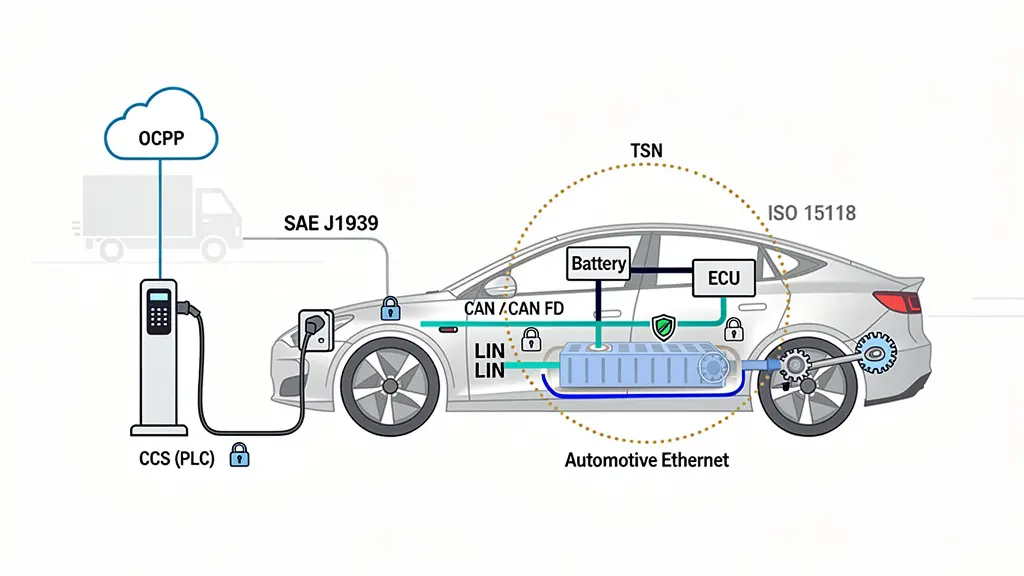
The primary in-vehicle and charging communication protocols include CAN/CAN FD for reliable component control, Automotive Ethernet for high-bandwidth data, LIN for low-cost sensors, TSN for deterministic real-time sync, SAE J1939 for heavy-duty vehicle networking, ISO 15118 for secure Plug & Charge, OCPP for charging station back-office management, and CCS (PLC) for vehicle-to-charger handshakes.
Want to know which architecture fits your specific platform? Let’s dive right in.
1 CAN / CAN FD (Controller Area Network / Flexible Data-rate)
If you are an Electrical Engineer or VCU Controls Engineer, you already know CAN. It is the undisputed workhorse of In-Vehicle Networks.
Traditional CAN 2.0 has been around for decades, operating at up to 1 Mbps with an 8-byte payload. But as EVs become more complex, traditional CAN bottlenecks.
Enter CAN FD (Flexible Data-rate).
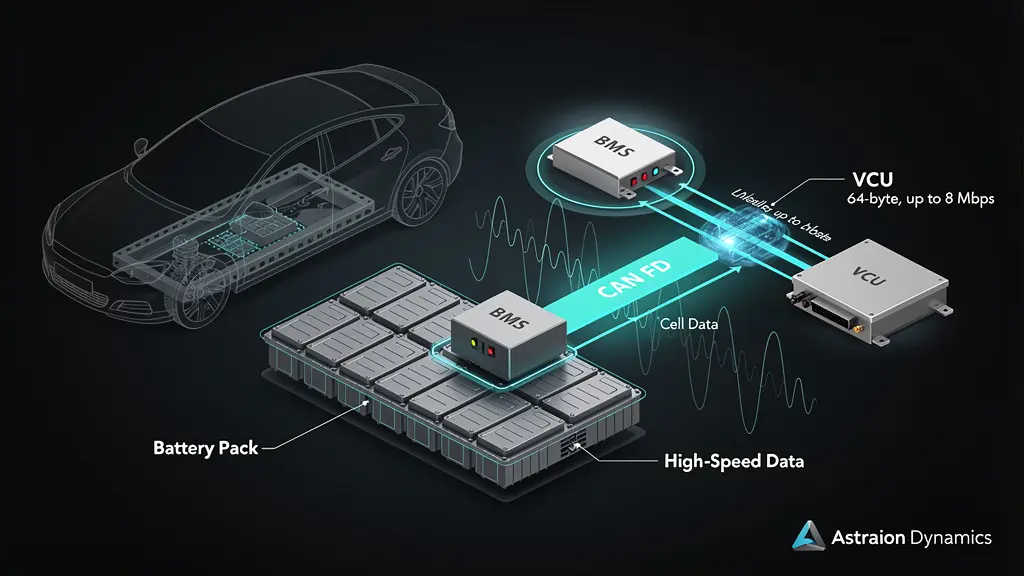
CAN FD cranks the payload up to 64 bytes and pushes data rates up to 8 Mbps. This is critical for modern BMS (Battery Management Systems) that need to blast high-frequency cell voltage, temperature, and State of Charge (SoC) data to the VCU without bus congestion.
Why it matters: It provides high reliability and robust fault tolerance in high-EMI (Electromagnetic Interference) environments.
The Catch: Tier-1 cell manufacturers are built for massive standard volume and will happily sell you raw modules, but they leave you with a massive engineering headache when it comes to making those modules talk to your vehicle.
If you are a Chief Engineer leading a project, this might be where you stall. As an engineering-first integrator, Astraion Dynamics transforms procured raw modules into a fully certified energy system, including custom VCU communication and intelligent BMS architectures.
2 Automotive Ethernet
Cars are essentially becoming data centers on wheels.
While CAN FD is great for control messages, it simply cannot handle the sheer volume of data required by ADAS (Advanced Driver Assistance Systems), LiDAR, and over-the-air (OTA) BMS firmware updates.
This is where Automotive Ethernet steps in. Utilizing standards like 100BASE-T1 and 1000BASE-T1, it delivers 100 Mbps to 1 Gbps over a single unshielded twisted pair (UTP) cable.
Weight Reduction: By using a single twisted pair, Automotive Ethernet significantly reduces the weight and cost of the wiring harness compared to traditional shielded cables.
IP-Based: It allows your vehicle network to use the same TCP/IP protocols as the internet, making cloud diagnostics much easier.

3 LIN (Local Interconnect Network)
Not every component in an EV needs lightning-fast, highly secure data transmission.
Using CAN FD for a simple seat motor or an ambient light controller is overkill and unnecessarily expensive.
LIN is a single-wire, low-cost serial network protocol. In an EV context, you will often see LIN used as a sub-network for non-critical thermal management actuators, coolant valves, and low-level sensors.
Cost-Effective: It drastically cuts down on hardware costs (no quartz crystal required in the slave nodes).
Hierarchy: It operates strictly on a master-slave architecture. The master node is usually connected to the main CAN bus, acting as a gateway.

4 TSN (Time-Sensitive Networking)
Standard Ethernet is great for bandwidth, but it has a fatal flaw for EV powertrains: it is not deterministic.
If your VCU sends a critical torque-vectoring command to the inverters, or a rapid shutdown command to the high-voltage PDU (Power Distribution Unit) during a thermal event, you cannot afford random network delays.
TSN is a set of IEEE standards (like 802.1AS for precise time synchronization and 802.1Qbv for traffic scheduling) layered on top of Ethernet.
Guaranteed Latency: TSN ensures that critical control data arrives exactly when it is supposed to.
The Future of EVs: As we move toward domain-centralized and zonal vehicle architectures, TSN may become the gold standard for syncing the VCU, BMS, and motor controllers.

5 SAE J1939 (The Heavy-Duty Standard)
Note: Since this guide targets heavy-duty and commercial EVs, I’ve included J1939 as it is the absolute standard for this sector.
If you are building an electric truck, marine vessel, or off-highway construction equipment, you aren’t just using standard CAN—you are using SAE J1939.
J1939 operates on a physical CAN bus but defines a standardized set of messages (PGNs and SPNs) for heavy-duty components.
Standardization: It allows a motor controller from Brand A to easily understand the throttle position sent by a VCU from Brand B.
Application Focus: Heavy trucks and mining vehicles demand highly reliable and heavy-duty battery systems.
If your engineering team is working on battery-powered mobility for demanding applications, integration can get incredibly complex. Our mission at Astraion Dynamics is to make battery system integration more practical and deployment-ready for these exact demanding real-world applications.

6 ISO 15118 (Plug & Charge)
Let’s shift from In-Vehicle Networks to Vehicle-to-Charger (V2I) communication.
ISO 15118 is the international standard defining the communication between the EV and the charging station (EVSE). Its crown jewel is the “Plug & Charge” feature.
How it works: When a user plugs in the charger, the EV and the EVSE automatically authenticate each other using TLS (Transport Layer Security) encryption and exchange digital certificates.
The Benefit: No more swiping RFID cards or opening clunky smartphone apps. The billing is handled seamlessly in the background.
Smart Charging: ISO 15118 also enables bidirectional charging (V2G – Vehicle to Grid), allowing the BMS to tell the charger exactly how much power it needs based on real-time cell temperatures and SoC.

7 OCPP (Open Charge Point Protocol)
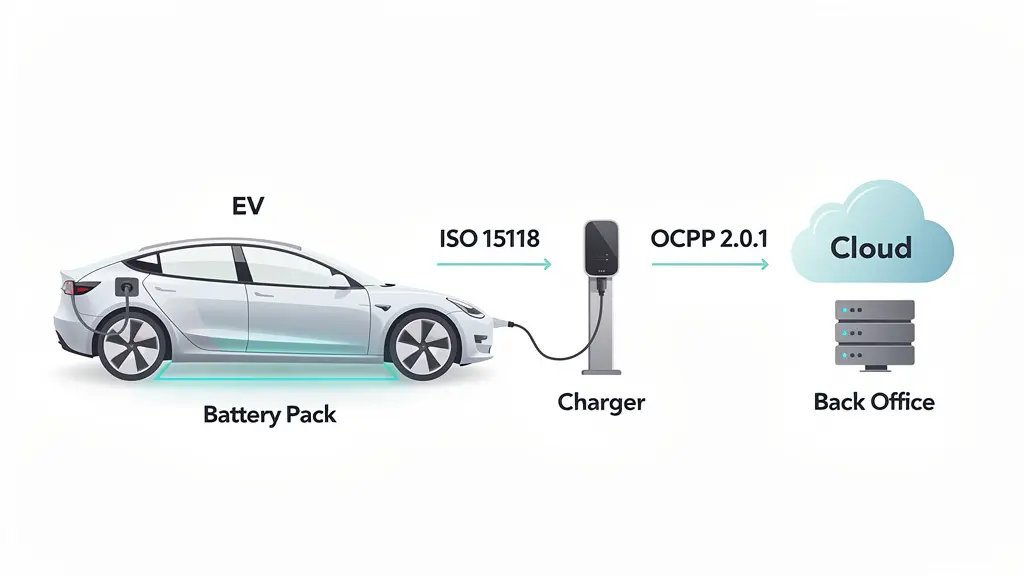
While ISO 15118 handles the link between the Car and the Charger, OCPP handles the link between the Charger and the Central Cloud Back-Office.
OCPP is essentially the universal language for charging station management.
Cloud Management: It allows charging operators to monitor charger health, push firmware updates, manage billing, and load-balance power across multiple chargers.
OCPP 2.0.1: The latest version includes native support for ISO 15118 Plug & Charge, enhanced security, and better smart charging profiles.
For Wholesalers, Importers, and ESS Integrators handling large-scale energy deployments, ensuring your hardware supports the latest OCPP versions is non-negotiable.
8 CCS Communication (Combined Charging System)
When you pull up to a DC Fast Charger, your vehicle’s high-voltage system needs to negotiate the massive influx of power safely.
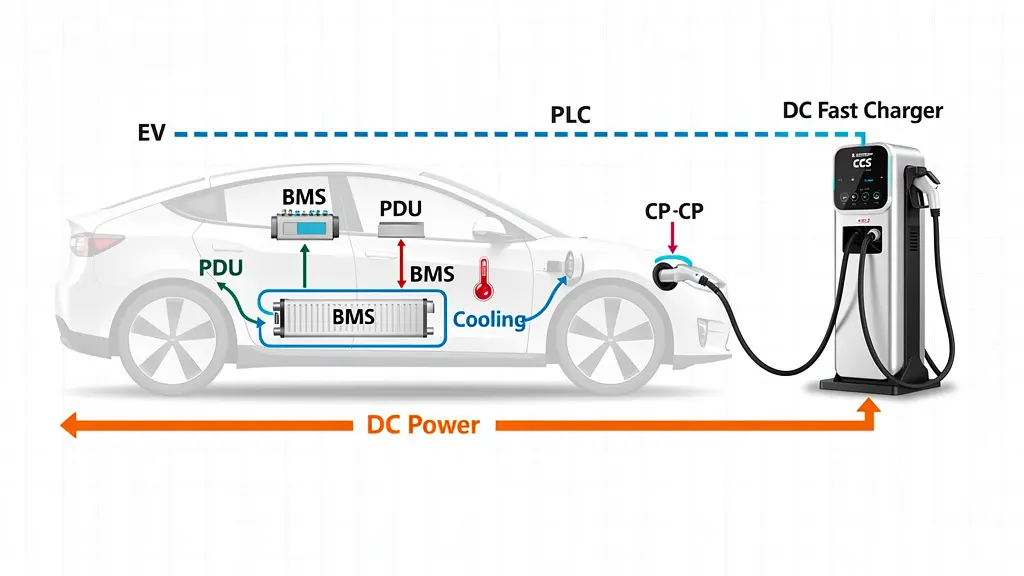
CCS communication relies on PLC (Power Line Communication). Specifically, it injects a high-frequency signal over the Control Pilot (CP) pin of the charging cable.
Safety First: Standards like DIN 70121 and IEC 61851 dictate the preliminary handshake. If the BMS detects a thermal anomaly, the CCS communication line instantly tells the charger to cut the power.
Integration Challenge: Integrating CCS protocols with onboard PDUs and liquid cooling systems is notoriously difficult. Battery projects often fail at the integration stage because mechanical, thermal, electrical, and control systems are not developed as one coordinated solution.
This is exactly why Astraion Dynamics exists. We combine custom CNC-machined enclosures, precision liquid cold plates, high-voltage PDUs, and intelligent controls in one coordinated workflow.
Conclusion
Navigating the web of EV communication protocols—from CAN FD in your battery pack to ISO 15118 at the charging station—is complex. Applying these protocols correctly ensures your powertrain is safe, responsive, and future-proof.
But having the right protocols is only half the battle; integrating them into rugged, real-world hardware is where the real challenge begins.
Are you ready to eliminate integration risks and accelerate your time-to-market?
At Astraion Dynamics, our corporate positioning is simple: The Ultimate “Bring Your Own Cells / Modules” Integration Hub for Heavy-Duty, Marine, and Off-Highway Applications. You control the chemistry, we master the engineering.
If you are a Program Manager or R&D Director looking to turn raw modules into a fully integrated, plug-and-play power system, let’s talk.
