
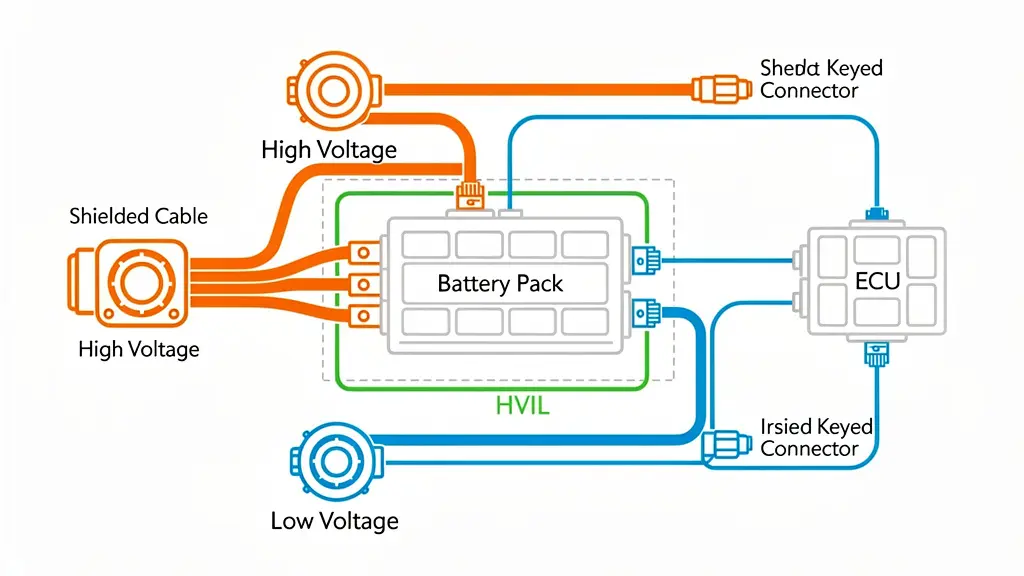
Are you struggling to standardize your heavy-duty EV battery system installation requirements? I get it. Integrating a lithium-ion battery pack is incredibly complex. One missed high-voltage interlock, and your whole system shuts down. Here is your ultimate guide to ensuring safe, compliant, and rock-solid electrical interfaces.
What are the core battery system installation requirements? Proper EV battery installation demands strict physical isolation of high-voltage and low-voltage harnesses, anti-mismatch keying on all HV connectors, shielded cables for main power, and a closed High-Voltage Interlock Loop (HVIL).
Want to know exactly how to execute this for your next vehicle architecture? Let’s dive right in.
1 High-Voltage Interface Installation Requirements
The heart of your EV is the main power connection. And getting this wrong isn’t just a compliance failure—it’s a massive safety hazard.
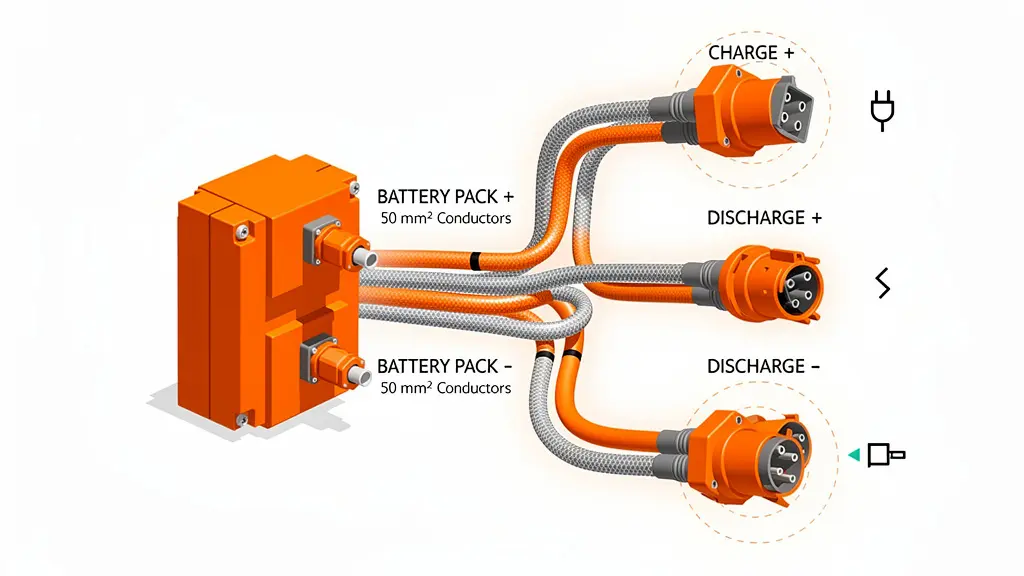
For your charging and discharging circuits (CHARGE +/- and DISCHARGE +/-), you absolutely must use shielded high-voltage cables. We typically specify 95 mm² conductors paired with reliable REQ7 series connectors for heavy-duty EV applications. For the main battery pack terminals (BATTERY PACK +/-), a 50 mm² conductor usually does the trick.
But here is the most critical part: anti-mismatch keying.
Your assembly technicians are moving fast on the line. You need to physically prevent them from plugging the wrong cable into the wrong slot. Plus, you must ensure all HV wiring meets strict EMC (Electromagnetic Compatibility) and insulation requirements. Without good shielding, high-frequency noise from your inverter will completely scramble your vehicle’s electronics.
2 High-Voltage Distribution Box (HV Box) Interface Requirements
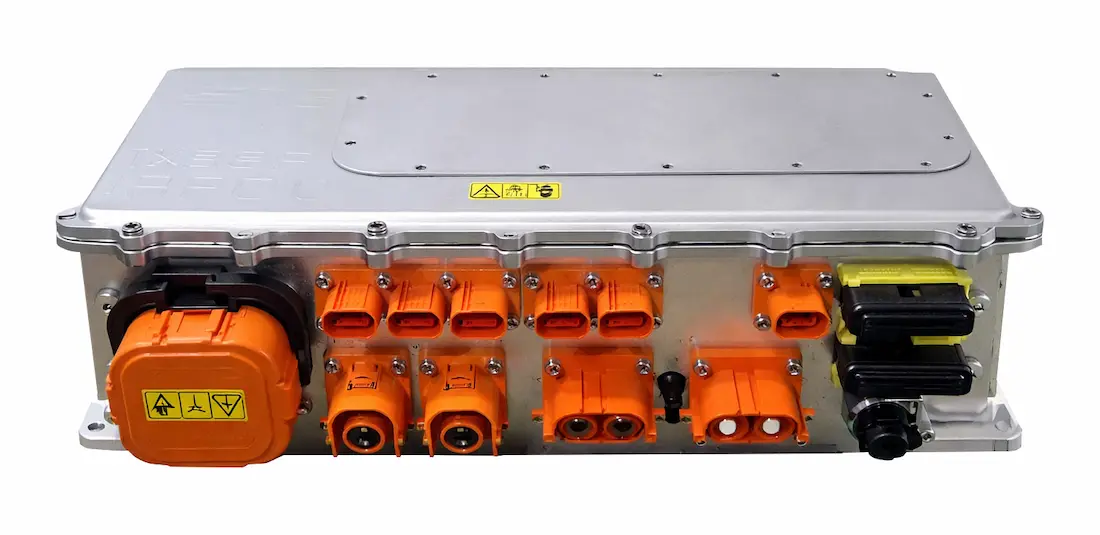
Think of the High-Voltage Distribution Box (PDU) as the traffic cop for your heavy-duty EV.
It distributes power to everything: the DC+/DC- traction system, the HTR+/HTR- heating system, the AC compressor, and the PTC heating circuit.
My number one rule here? Complete physical isolation.
You must use dedicated, keyed connectors for every single high-voltage branch. Ensure each circuit is independently keyed. We strictly prohibit cross-mating between different functions. If an operator accidentally plugs the AC compressor line into the traction output, you’re looking at instant catastrophic component failure and blown fuses.
3 Communication Interface Installation Requirements
Your battery system is essentially a massive computer. It needs to talk flawlessly with the rest of the vehicle.
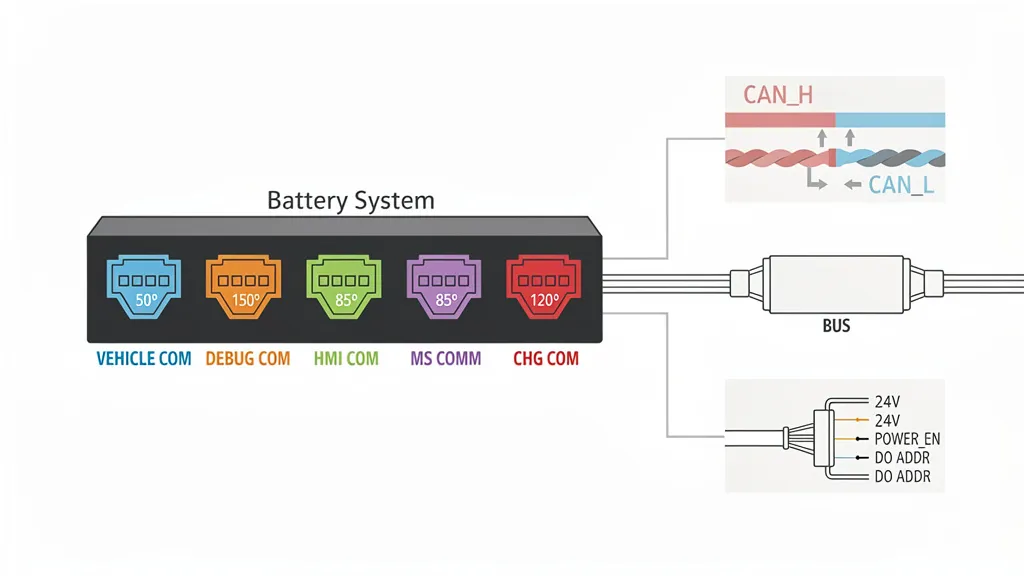
This means you’re dealing with multiple distinct interfaces: VEHICLE COM, DEBUG COM, HMI COM, MS COMM, and CHG COM.
To keep things organized and bulletproof, you should use industrial-grade connectors (like Recode or RECCADA types) for all communication ports.
How do you keep them straight? Use a smart mix of color-coding, keying design, and connector angles. We love using 50°, 85°, and 120° physical variants to make incorrect assembly literally impossible.
For your CAN wiring, you must strictly align your CAN_H and CAN_L polarities. These interfaces often carry your 24V power supply, enable signals (POWER_EN), and address configuration signals (DO_ADDR). Get the polarity wrong, and your Battery Management System (BMS) goes completely blind.
4 Charging Interface Installation Requirements
Charging heavy-duty EVs pushes massive amounts of current. Safety here is 100% non-negotiable.
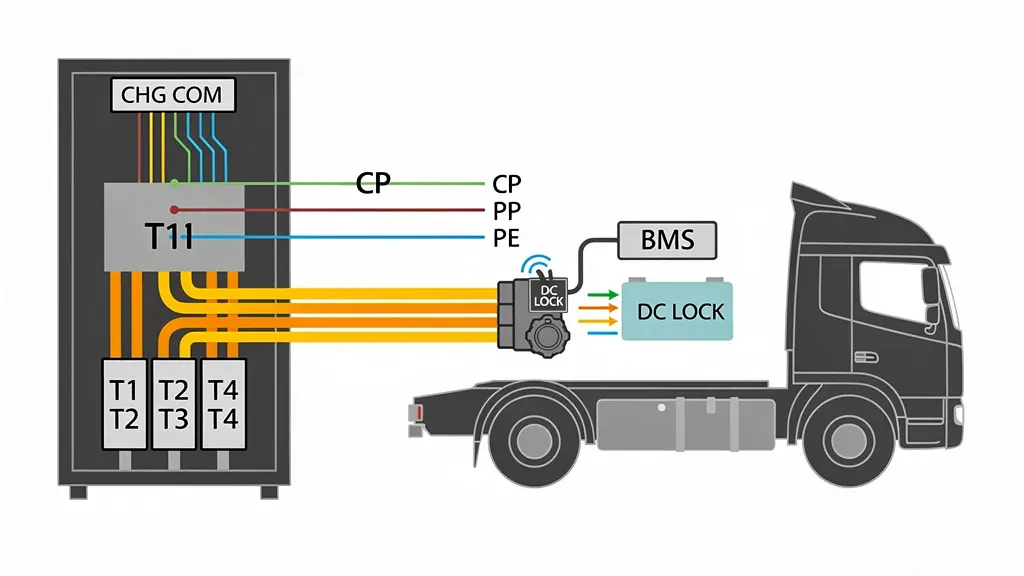
Your CHG COM interface handles the T1–T4 charging current channels, plus the crucial PP (Proximity Pilot), PE (Protective Earth), and CP (Control Pilot) signaling lines.
Installation requirement number one: you must include a robust electronic locking mechanism (DC lock) on your charging connector. And it’s not enough just to have the hardware lock—you must route the fully functional lock status feedback signal back to the BMS.
Also, physically separate your charging communication lines and power lines. Your CP/PP signaling must comply perfectly with regional charging protocol standards so the handshakes happen instantly.
5 Wiring Harness Installation Requirements
I see this exact mistake all the time in start-up EV designs: sloppy harness routing.
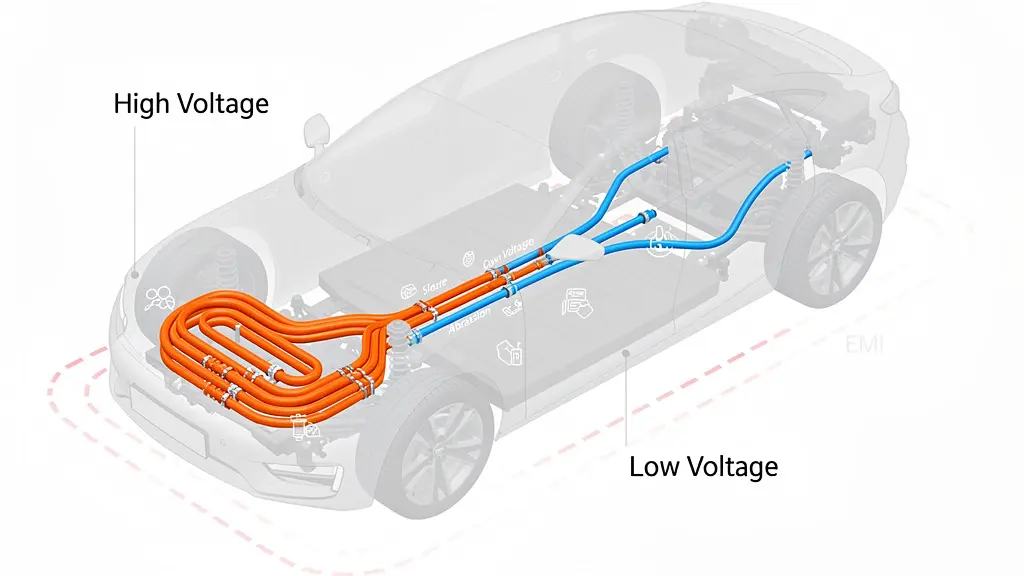
The golden rule of wiring harness installation? You must route high-voltage and low-voltage harnesses separately. They need generous physical separation.
Choose shielded, vibration-resistant, and abrasion-protected high-voltage cables. Heavy-duty EVs endure brutal operational environments. A rubbed-through HV cable is a thermal event waiting to happen.
For your low-voltage signal wiring, strictly avoid long parallel runs alongside HV cables. This cuts down on electromagnetic interference (EMI) that can corrupt your CAN bus data packets.
6 Structural & Identification Requirements
Never underestimate the physical packaging hardware.
Your lithium-ion battery pack needs a clear, durable nameplate. We specify industrial-grade aluminum (L4), sized exactly at 100 mm × 70 mm. Install it right on a highly visible external surface of the pack enclosure.
Then there is mechanical protection. You must thoroughly protect all exposed metal surfaces against corrosion. For heavy-duty applications, we recommend an e-coat primer of 35–45 μm and a durable top coat of 30–40 μm.
Demand a rigorous salt spray test requirement of at least 480 hours without severe corrosion. If your enclosures and liquid cooling plates can’t survive that, they simply won’t survive the winter roads.
7 Safety Logic Requirements
Finally, the brains behind the brawn. You haven’t finished installation until you validate the software behaviors.
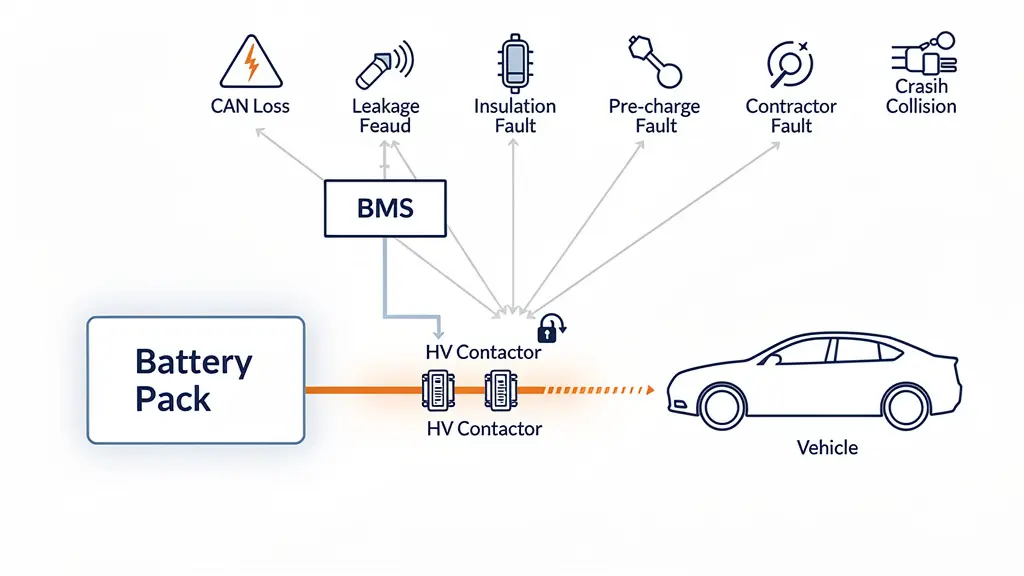
After installation, your system must execute mandatory safety logic. Before you even permit high-voltage power-up, ensure you fully close and verify the High-Voltage Interlock Loop (HVIL).
Program your BMS to disable high voltage instantly under any of these critical conditions:
- Communication failure (CAN bus loss)
- Insulation fault (leakage current detected)
- Pre-charge failure (capacitor charging timeout)
- Contactor welding or open circuit faults
Most importantly, if the vehicle receives a collision signal, it must trigger an immediate high-voltage shutdown sequence. This physical disconnect protects first responders and saves lives in a crash.
If you are struggling to integrate a fail-safe high-voltage architecture, we can help. Our engineering team specializes in lithium-ion battery packs, PDUs, and BMS debugging. Click here to request an engineering consultation and accelerate your EV development.
Conclusion
Standardizing your battery system installation requirements is the only way to build safe, scalable heavy-duty EVs. By enforcing strict harness isolation, anti-mismatch keying, and robust HVIL safety logic, you eliminate costly failures. Apply these rules to your next architecture, and watch your system reliability skyrocket.