

Let’s be honest. Tier-1 cell manufacturers are built for massive standard volume, often rejecting deep customization for specialized commercial fleets. They sell you the raw modules, but they leave you with a massive engineering headache. How do you cool them? Today, I’m breaking down the exact liquid cooling plates you need to keep your battery packs safe and efficient.
The top 6 liquid cooling plates for lithium-ion battery packs include stamped/hydroformed plates, extruded cooling plates, friction stir welding (FSW) plates, vacuum brazed plates, CNC machined plates, and embedded tube plates. Each offers unique advantages in thermal resistance, pressure drop, structural integrity, and manufacturing scalability.
Choosing the right thermal management strategy can make or break your vehicle’s homologation and field reliability. Read on to discover which liquid cooling plate architecture is the perfect fit for your specific application.
#1 Stamped / Hydroformed Cooling Plates
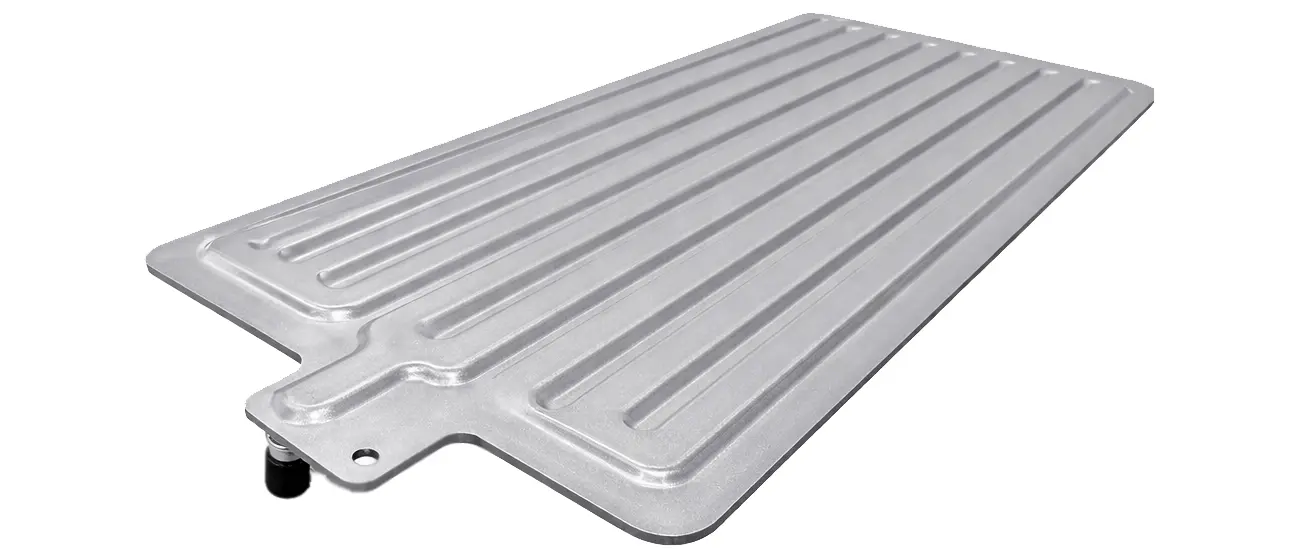
If you are designing a high-volume passenger EV, you have probably looked at stamped or hydroformed cooling plates.
Here is how they work. Two thin sheets of aluminum (usually 5xxx series) are stamped or hydroformed to create intricate flow channels. These two halves are then brazed together to form a single, low-profile cooling plate.
The Engineering Advantage
The beauty of stamped plates lies in their design flexibility. You can engineer highly optimized serpentine or parallel flow channels that force the water-glycol coolant exactly where the heat flux is highest. This allows you to maintain a tight temperature delta (usually within 2°C to 3°C) across the entire battery module.
When to Use Them
Stamped plates are fantastic for high-volume production because the piece price is incredibly low once the tooling is paid for. However, the initial tooling costs are astronomical.
If you are a Battery Engineer working on lower-volume specialty vehicles, the upfront capital expenditure for stamping dies might not make sense. Furthermore, these plates are extremely thin and offer almost zero structural support to the battery pack box.
#2 Extruded Cooling Plates
Heavy trucks have high demands for battery pack durability, liquid cooling, and high-voltage integration. When you need your cooling system to also act as a structural, load-bearing component, extruded cooling plates are your best friend.
The Engineering Advantage
Aluminum extrusion pushes heated aluminum billets through a steel die, creating long, continuous profiles with internal micro-channels.
Because the walls of extruded plates are thicker, they provide immense structural rigidity. You can literally mount heavy lithium iron phosphate (LFP) or nickel manganese cobalt (NMC) modules directly onto them. The straight, parallel micro-channels also offer an incredibly low pressure drop, meaning your coolant pumps don’t have to work as hard, saving parasitic energy losses from the vehicle.
When to Use Them
I highly recommend extruded plates for rectangular battery packs in commercial applications. If you are building platforms for heavy-duty vehicle manufacturers, marine vessel builders, or off-highway and construction equipment OEMs, this is usually the go-to choice. They are highly scalable, require very low tooling costs, and can be easily cut to length depending on your pack size.

#3 FSW – Friction Stir Welding Cooling Plates
If you want zero leaks, period, you need to look at Friction Stir Welding (FSW).
Electric boats and ferries have stringent requirements for waterproofing, liquid cooling, and system integration. In these environments, a coolant leak doesn’t just ruin a battery; it can cause a catastrophic thermal runaway event.
The Engineering Advantage
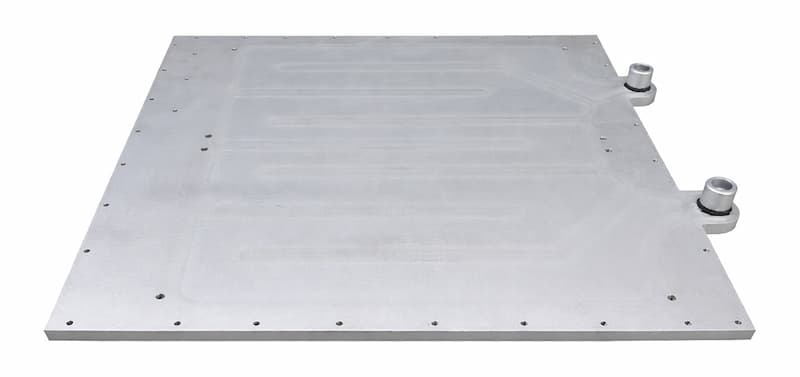
FSW is a solid-state joining process. Instead of melting the aluminum (like traditional TIG or MIG welding), a rotating tool generates friction, plasticizing the metal and forging two pieces together.
Because the metal never reaches its melting point, you avoid porosity, shrinkage, and thermal distortion. The result? A perfectly flat, IP67+ rated seal that is stronger than the parent material itself.
When to Use Them
We frequently use FSW when sealing the ends of extruded cooling plates or capping off complex CNC-machined flow channels. Mining vehicles demand highly reliable, explosion-proof, and heavy-duty battery systems. FSW plates deliver the extreme mechanical robustness and vibration resistance required for these brutal operating profiles.
#4 Brazed / Vacuum Brazed Cooling Plates
When you are dealing with ultra-high charge/discharge rates, your heat flux skyrockets. This is where vacuum brazed cooling plates step in.
The Engineering Advantage
Vacuum brazing allows engineers to place complex internal geometries—like offset strip fins or louvered fins—inside the cooling plate before it is sealed in a high-temperature vacuum furnace.
These internal turbulators disrupt the laminar flow of the coolant, forcing it into a turbulent state. In fluid dynamics, turbulent flow drastically increases the heat transfer coefficient. This means you can pull a massive amount of heat out of the cells in a very short amount of time, which is critical during ultra-fast DC charging.
When to Use Them
Vacuum brazed plates are expensive. The process is energy-intensive and time-consuming. However, if you are developing high-performance electric sports cars, advanced aerospace battery packs, or high-C-rate hybrid systems, the thermal performance of a vacuum brazed plate is totally unmatched.
#5 CNC Machining Cooling Plates
Sometimes, standard extrusions and stampings just don’t fit the packaging constraints of your customized vehicle.
Our in-house engineering team designs rugged IP67+ aluminum enclosures and precision liquid cold plates. Often, the best way to achieve absolute precision is through CNC machining.
The Engineering Advantage
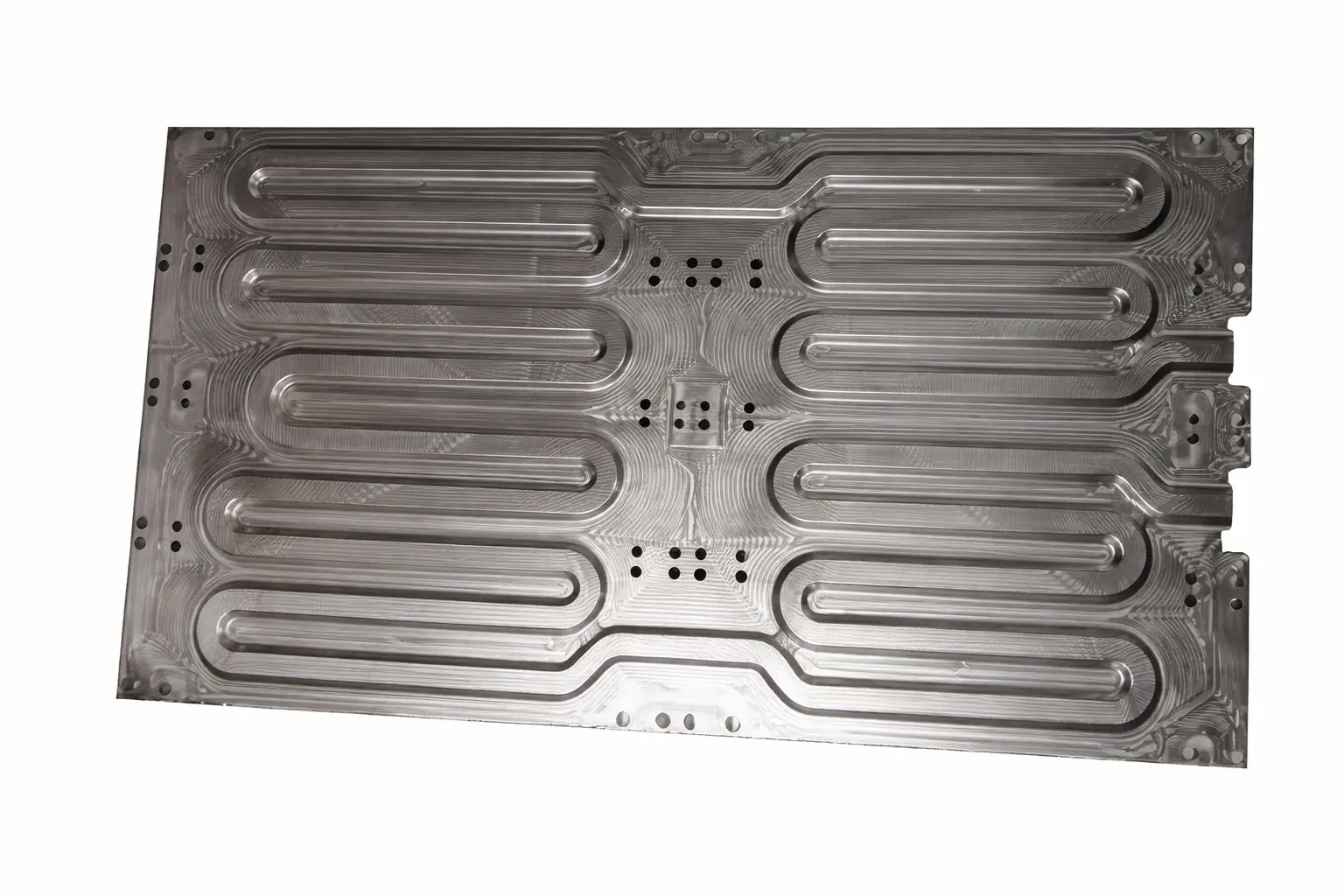
With CNC machining, we take a solid block of aluminum and mill out the exact flow channels required by the thermal simulation.
This method gives you 100% control over the channel routing, wall thickness, and mounting points. More importantly, CNC machining guarantees a perfectly flat surface finish. A flat surface is critical because it allows for a microscopic layer of Thermal Interface Material (TIM) between the cell and the plate, drastically reducing thermal resistance.
When to Use Them
CNC machined plates are perfect for prototyping, low-volume production, or highly complex bespoke geometries where tooling up for casting or stamping is out of the question. If you are an engineering team working on battery-powered mobility and industrial platforms, CNC gives you the agility to iterate designs quickly.
#6 Embedded Tube Cooling Plates
Let’s say you are an Energy Storage System (ESS) integrator. ESS projects require large-scale battery packs, PDUs/BMS, and thorough testing. You need a cooling solution that is effective, highly reliable, and above all, cost-efficient at scale.
The Engineering Advantage
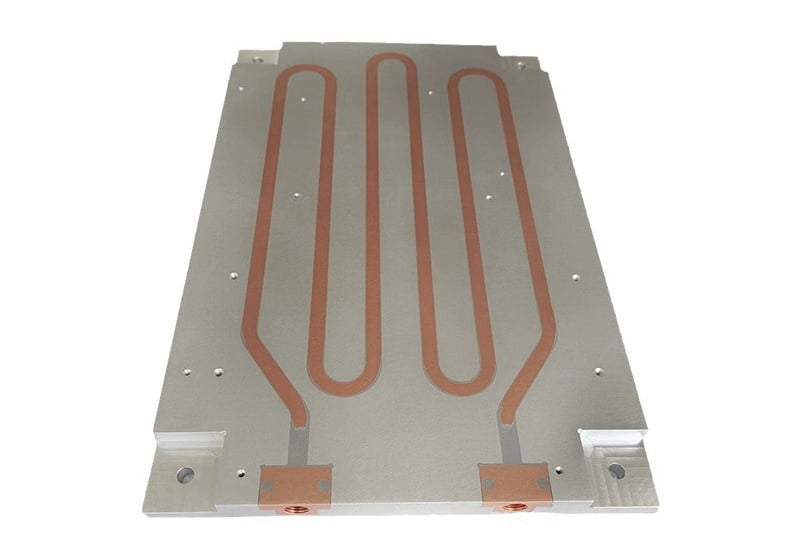
Embedded tube cooling plates are beautifully simple. You take a flat aluminum plate, machine a groove into it, and press a continuous copper or aluminum coolant tube into that groove.
Because the tube is one continuous piece, the risk of internal coolant leaks is virtually zero. To ensure good thermal transfer, we typically backfill any micro-gaps between the tube and the plate with a high-conductivity thermal epoxy.
When to Use Them
This is a fantastic, budget-friendly option for stationary energy storage or electric agricultural machinery manufacturers. While it doesn’t offer the extreme cooling capacity of a vacuum brazed plate, it provides incredibly reliable, leak-free thermal management for large format prismatic cells operating at standard C-rates.
Summary
Battery projects often fail at the integration stage — not because components are unavailable, but because mechanical, thermal, electrical, and control systems are not developed as one coordinated solution.
Choosing between an extruded plate for a heavy-duty truck or a vacuum brazed plate for a high-performance EV is just the first step. You still have to integrate that thermal management system with your high-voltage architecture, intelligent BMS, and rugged enclosure.
Take Control of Your Supply Chain
If you are a Chief Engineer, or Purchasing Manager, you know that buying off-the-shelf battery packs limits your design and eats into your margins.
At Astraion Dynamics, our defining strength is our transparent “Bring Your Own Cells/Modules” partnership model. You negotiate directly with top cell manufacturers to secure raw modules at zero middleman markup, while we master the deep engineering and complex supply chain ecosystem.
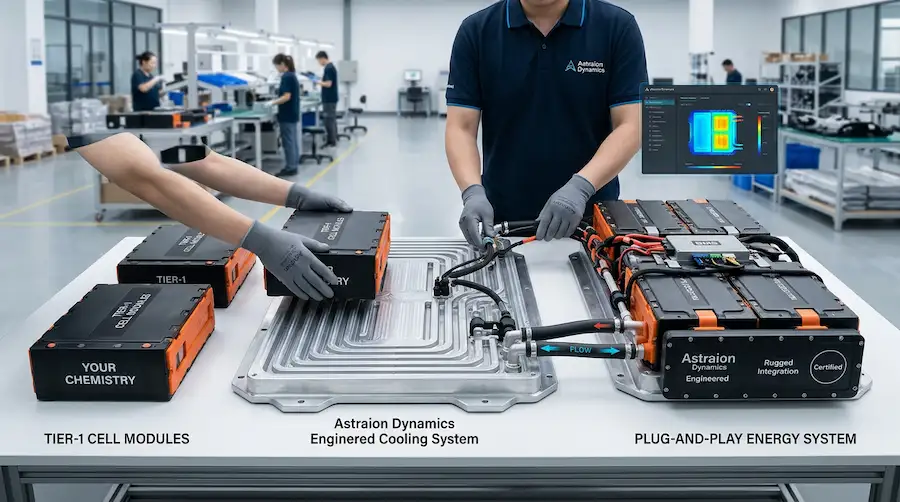
We transform your procured raw modules into a rugged, fully certified, plug-and-play energy system, leveraging China’s vast specialized supply chain. From initial 3D design and thermal simulation to flawless UN38.3 / ECE R100.3 homologation and global logistics, we bridge the gap between raw cell chemistry and your customized vehicle.
Ready to eliminate your integration risks?
If you are developing a heavy-duty, marine, or off-highway platform, let’s talk. Contact our engineering team today to schedule a technical review of your operating profile, packaging constraints, and liquid cooling requirements.
