

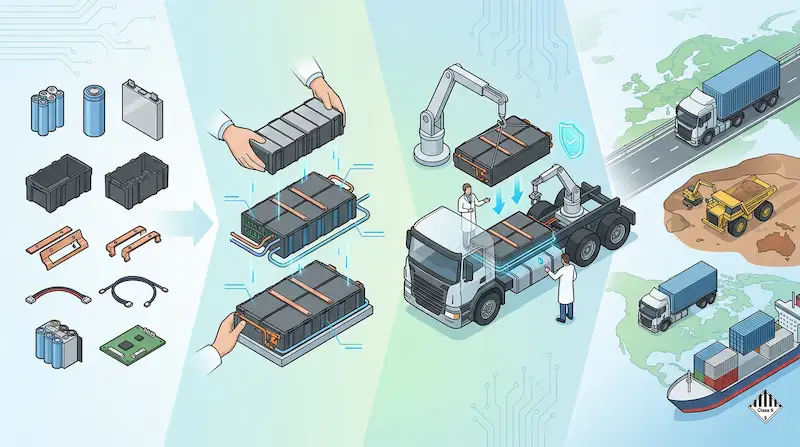
In the heavy-duty, marine, and off-highway sectors, ambiguity kills projects. You might have secured the perfect cell chemistry, but battery programs rarely fail due to lack of component availability; they fail at the integration stage. Navigating the labyrinth of structural engineering, multiphysics thermal management, high-voltage interlocks, and trans-oceanic Class-9 homologation is exactly where most uncoordinated system integrations collapse.
This is not a marketing brochure. This is an uncensored, engineering-first interrogation of what it takes to build zero-compromise power systems. Welcome to Astraion Dynamics—the Ultimate Tier-1 Integration Hub.
Part 1: The “BYOC” Business Model & Cell Sourcing
Q: What exactly is the “Bring Your Own Cells” (BYOC) model?
A: We consider the traditional battery pack middleman obsolete. With BYOC, you negotiate directly with top cell manufacturers to secure raw modules at zero markup, and we engineer everything around it. We transform your raw chemistry into a rugged, IP67+ globally homologated plug-and-play energy system. You control the chemistry; we master the engineering.
Q: What if we don’t have a reliable cell partner? Can you source them in China?
A: Absolutely. China operates the most advanced battery supply chain in the world. We offer direct-to-factory channels with Tier-1 Chinese cell titans—such as CATL, EVE Energy, CALB, BYD, and REPT—tailoring heavy-duty prismatic or LFP/NMC blades specifically to your C-rate and cycle life demands.
Q: How do you calculate and manage cell expansion over a 10-year lifespan?
A: We refuse to guess. We utilize the cell manufacturer’s precise BOL (Beginning of Life) and EOL (End of Life) swelling curves. By implementing specialized aerogel compression pads and highly rigid extruded aluminum ribs inside our CNC-machined enclosures, we maintain module structural integrity at a constant kgF over a decade of cycling.
Part 2: Structural Engineering & Extreme Enclosures
Q: Why do you mandate Friction Stir Welding (FSW) over standard MIG/TIG for battery enclosures?
A: Heavy-duty applications cannot afford weld fatigue. FSW is a solid-state joining process that creates zero porosity and eliminates heat-affected zone (HAZ) distortion. This guarantees flawless IP67/IP68 sealing over decades of intense vibration in mining, agriculture, or marine environments.
Q: How do you prevent catastrophic failure under off-highway vibration modes?
A: We conduct hyper-spectrum FEA (Finite Element Analysis) via ANSYS. We optimize the enclosure’s natural resonance frequency (Hz) so the battery pack never aligns with the vehicle chassis’ natural destruction frequency under load.
Q: Marine platforms demand zero-corrosion. How is this achieved?
A: Electric boats and ferries have extremely stringent waterproofing and anti-corrosion requirements. We deploy marine-grade 6000-series (6061/6063-T6) aluminum, treated with hard-anodizing and extreme weather powder coating. Coupled with specialized cathodic protection designs, our packs confidently meet strict DNV (Norway/Germany) and CCS (China) maritime standards.
Part 3: Thermal Management & Liquid Cold Plates
Q: Extruded cold plates vs. Brazed. Which is better for heavy-duty?
A: Brazed plates are prone to micro-cracking under the severe cyclic loading of off-highway vehicles. We engineer robust extruded multi-channel liquid cold plates sealed via FSW to ensure zero coolant leakage even under maximum chassis torsion.
Q: How do you prevent flow dead-zones and guarantee a strict temperature delta (ΔT)?
A: Flow dead-zones cause localized degradation. Through extensive CFD (Computational Fluid Dynamics) simulations, we balance the pressure drop (ΔP), ensuring equalized volumetric flow across all cell rows. Under 1C to 2C continuous discharge, we strictly maintain cell-to-cell ΔT within ≤3°C.
Note: While we engineer the thermal architecture in-house, we leverage Tier-1 Chinese thermal manufacturing champions like Sanhua and Yinlun for mass-production execution.
Part 4: Advanced BMS & High-Voltage Architecture
Q: Can you integrate advanced Chinese BMS supply chains for our overarching domain controllers?
A: Yes. China currently leads the globe in practical BMS algorithm deployment. We deeply integrate Tier-1 BMS chains—like Ligoo or pacing players in the commercial sector—bridging their robust active/passive balancing matrix with your internal VCU via CAN 2.0A/B or J1939 protocols.
Q: VCU timeout drops often happen during handshakes. How do you solve this?
A: It is a classic integration failure. We rewrite the negotiation latency and cycle limits in the gateway node, bridging the packet delay between western power electronics and the internal BMS matrix, ensuring uninterrupted UDS (Unified Diagnostic Services) handshakes.
Q: How do you mitigate inrush current from welding the main contactors?
A: Our 100% in-house engineered PDUs utilize precise pre-charge circuits with calibrated power resistors. We mathematically align this against your VCU’s inverter capacitor size. Logic checks run stringently before we allow heavy-duty magnetic arc-blowout contactors (e.g., TE Connectivity, Hongfa) to engage.
Part 5: Global Validation, Testing & Logistics (UN38.3 & ECE R100.3)
Q: Do you guarantee an ECE R100.3 pass for the brutal 5-Minute Thermal Propagation Rule?
A: R100.3 mandates 5 minutes for passenger escape after thermal runaway. Because we simulate thermal physics heavily via CFD and deploy multi-layered defenses (aerogel, mica sheets, active BMS throttling), passing physical nail-penetration is often a single-pass formality for our LFP solutions. For NMC chemistries, we execute highly coordinated mitigation designs with your specific cell supplier.
Q: Which testing agencies act as your trusted partners in China?
A: To guarantee E-Mark and UN approvals that are globally trusted, we partner strictly with accredited authorities. For R100.3, we utilize CATARC and SMVIC. For UN38.3 (mandatory altitude, thermal, vibration, and crush testing for Class-9 dangerous goods ocean freight), we utilize top-tier labs like CQC, SMQ, and TÜV SÜD China.
Q: How do you handle Trans-Oceanic shipping for an active 800V Mega-Watt pack?
A: Safety and compliance are integrated into our logistics ecosystem. Packs are discharged to exactly 30% SOC, isolated, and packaged in localized UN-certified dangerous goods steel or ISPM-15 timber crates. We coordinate with hazmat Dedicated Freight (DF) forwarders to seamlessly clear China Customs, allowing you to focus purely on site deployment.
Conclusion
Your project begins with a review of your application constraints, operating profile, and electrical targets. Let Astraion Dynamics take responsibility for the full integration path—from step-by-step master schematics to flying our engineering SWAT team to your facility for final commissioning.
