

Designing a heavy-duty EV? Then you know the headache of high-voltage integration.
Let’s clear up a massive industry confusion: the exact difference between a PDU and an HV Control Box. Getting this wrong could easily derail your electric truck project.
As an engineer with 15 years in the NEV supply chain, I see this misunderstanding constantly. Let’s dive in.
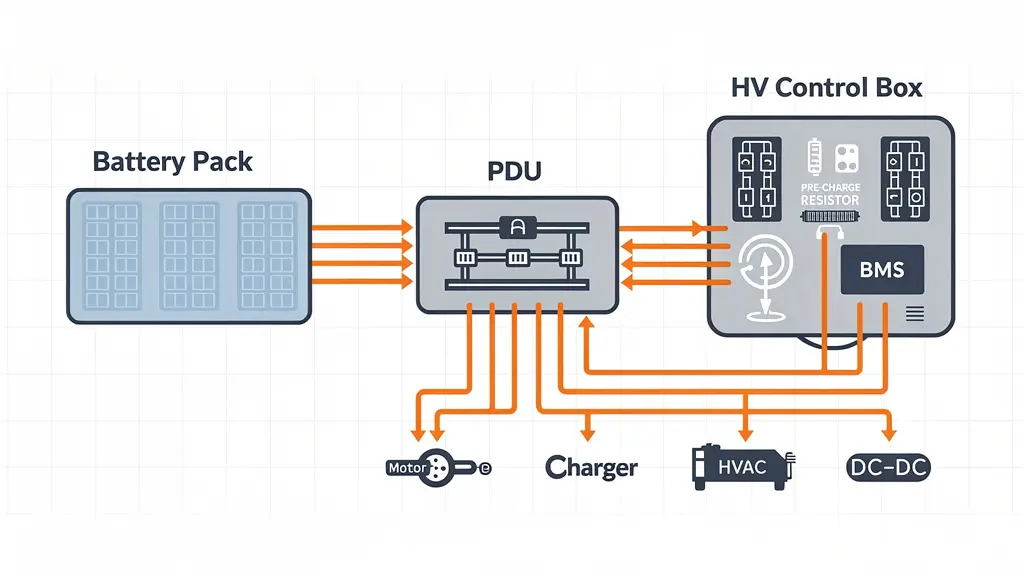
A Power Distribution Unit (PDU) primarily acts as a passive router, distributing high-voltage DC power to various vehicle subsystems using busbars and fuses. In contrast, an HV Control Box is an active, intelligent hub. It typically houses the PDU components alongside main contactors, pre-charge circuits, high-voltage interlock (HVIL) logic, and BMS controllers to actively manage, monitor, and protect the high-voltage architecture.
Sounds similar? They are closely related.
But treating them as the exact same component will cost you months in testing and homologation. Here are crucial differences you need to know when designing your next battery platform.
1 The Core Function: Routing vs. Commanding
The easiest way to understand the difference is to look at their primary jobs.
A traditional Power Distribution Unit (PDU) is essentially a highly robust breaker box. It takes the massive DC current from your lithium-ion battery pack and splits it into different channels for your traction inverter, DC-DC converter, electric air conditioning compressor, and PTC heaters.
It relies mostly on passive components like copper busbars and high-voltage fuses.
An HV Control Box, on the other hand, is the brains and the brawn.
It usually contains the PDU routing, but it adds intelligent switching and monitoring. Inside an HV Control Box, you will find the main positive and negative contactors, the pre-charge relay, and often the Battery Management Unit (BMU) or BMS master controller.
If the PDU is the highway, the HV Control Box is the traffic control center shutting down the highway during an emergency.

2 Managing Inrush Currents with Pre-Charge Logic
This is a critical engineering hurdle for heavy-duty vehicle manufacturers.
When you start an electric truck, you can’t just slam the main battery contactors closed. The capacitive load inside the heavy-duty motor inverter is enormous. If you connect raw battery power instantly, the massive inrush current will weld your contactors shut.
A simple PDU does not solve this.
An HV Control Box handles this through a dedicated pre-charge circuit. It first closes a smaller pre-charge relay, pushing current through a pre-charge resistor to slowly fill the inverter’s capacitors. Once the voltage equalizes, the main contactors close safely.

If your team is working on battery-powered mobility or industrial platforms, mastering this sequence is absolutely vital.
3 Thermal Management Under Heavy Loads
Electric trucks and heavy-duty EVs have intense demands for battery pack durability and liquid cooling.
Running 600 amps of continuous current through a confined space generates a tremendous amount of heat. High-voltage fuses and contactors act as localized heat sources.
If you just shove these components into a standard PDU enclosure, they will overheat. This degrades efficiency and triggers thermal protection faults.

An advanced HV Control Box takes thermal management seriously. At Astraion Dynamics, our in-house engineering team designs rugged IP67+ aluminum enclosures and precision liquid cold plates to extract heat directly from the high-voltage architecture.
Tier-1 cell manufacturers might sell you the raw battery modules, but they leave you with the massive engineering headache of how to cool them and package them safely. A custom-engineered HV Control Box solves this.
4 Communication with the Vehicle Control Unit (VCU)
Your vehicle needs to know exactly what the battery is doing at all times.
A standalone PDU is generally “dumb.” It doesn’t talk.
An HV Control Box is highly communicative. It acts as the primary translator between your lithium-ion battery pack and the Vehicle Control Unit (VCU). Through the CAN bus network, it transmits real-time data on pack voltage, current draw, isolation resistance levels, and contactor status.
With deep expertise in VCU communication and intelligent controls, an integration partner can help you bridge the gap between raw cell chemistry and your customized vehicle.

5 IP Ratings and Environmental Durability
The operating environments for specialized EVs are brutal.
Electric boats require stringent waterproofing, while mining vehicles demand highly reliable, explosion-proof, and heavy-duty battery systems.
You cannot afford a high-voltage short circuit in an underground mine or a marine vessel.
While a standard PDU might be rated for light passenger car use, heavy-duty applications require extreme environmental sealing. Your HV Control Box needs to be housed in CNC-machined enclosures with an IP67 or IP69K rating to keep out dust, high-pressure water, and corrosive salt spray.
Application-driven engineering must be built around real platform constraints, not just theoretical lab conditions.

6 Compliance, EMC, and Safety Homologation
Global homologation is the ultimate test of your electrical engineering.
To sell your electric truck or energy storage system (ESS), you must pass rigorous certifications. ESS projects, for example, require large-scale battery packs, PDUs/BMS, and thorough testing.
An HV Control Box contains high-speed switching components and microprocessors. This makes Electromagnetic Compatibility (EMC) incredibly tricky. You have to design the internal layout to prevent electromagnetic interference (EMI) from disrupting your BMS signals.
Furthermore, the HV Control Box houses the High-Voltage Interlock Loop (HVIL). If a technician unplugs a high-voltage cable, the HVIL instantly breaks the circuit, commanding the HV Control Box to open the main contactors and isolate the battery.

Flawless UN38.3 and ECE R100.3 homologation isn’t an accident; it requires designing these safety features perfectly from day one.
7 The Supply Chain and Integration Strategy
Here is the hard truth about building battery systems.
Battery projects often fail at the integration stage—not because components are unavailable, but because mechanical, thermal, electrical, and control systems are not developed as one coordinated solution.
Chief Engineers, and Purchasing Managers usually reach out to us when they hit this exact wall.
You might be tempted to buy an off-the-shelf PDU and try to wire up a BMS and contactors yourself. But this extends your development cycle by months.
Instead, you may want to consider a transparent “Bring Your Own Cells/Modules” partnership model.
In this model, you negotiate directly with top cell manufacturers to secure raw modules at zero middleman markup, securing Tier-1 chemistry pricing. Then, an engineering-first integrator takes over.
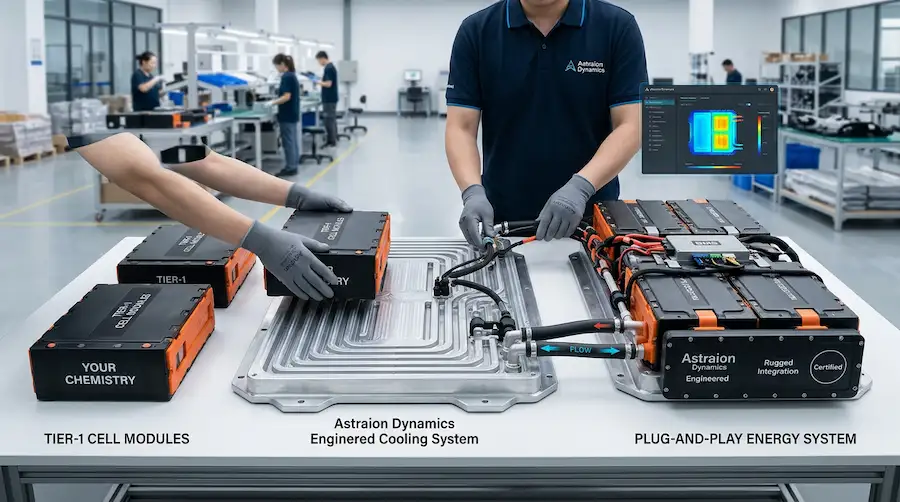
We transform your procured raw modules into a rugged, fully certified, plug-and-play energy system. We integrate the precision liquid cooling, the intelligent BMS architecture, and the high-voltage PDUs/Control Boxes in one coordinated workflow.
As our business model states: You Control the Chemistry, We Master the Engineering.
Conclusion
Understanding the difference between a simple PDU and a comprehensive HV Control Box is the first step toward a safer, more reliable electric vehicle. By focusing on smart pre-charge logic, liquid cooling, and robust IP67+ enclosures, you can significantly shorten your development cycle and bring your battery-powered platforms into operation with greater confidence.
Need Help Integrating Your High-Voltage Architecture?
If your engineering team is tired of dealing with the massive headache of integrating raw modules, thermal management, and high-voltage controls, we can help.
Astraion Dynamics is the ultimate “Bring Your Own Cells/Modules” integration hub for heavy-duty, marine, and off-highway applications. Our resident QA engineers and IATF-16949 certified partners ensure your system passes 100% End-of-Line testing.
Ready to reduce your integration risk? Contact our technical team today to schedule a comprehensive review of your battery system architecture and discover how we can turn your modules into a deployment-ready power system.
