
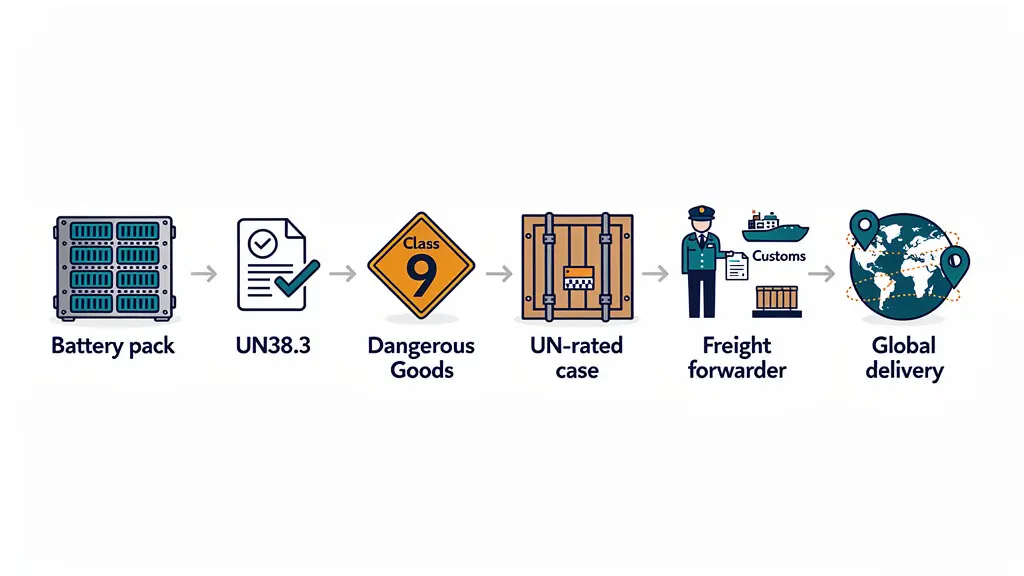
You’ve secured the best lithium-ion cells for your new heavy-duty platform. You’ve spent countless hours perfecting thermal management and high-voltage architecture. But now you’re facing a massive logistical headache: how do you safely package, clear customs, and ship these massive powerhouses globally?
Shipping heavy-duty EV battery packs gives many engineers and project managers a major headache. I get it. The stakes are incredibly high. In this comprehensive guide, I’ll show you exactly how to ship lithium-ion battery packs without getting your cargo seized at customs.
To ship a lithium-ion battery pack, you must classify it as Class-9 Dangerous Goods, pass the strict UN38.3 safety certification, secure it in specialized UN-rated wooden cases, and partner with certified freight forwarders. These experts will manage the complex maritime documentation needed for air or sea transit under Incoterms like DDU.
Read on. I am going to break down the exact steps, costs, packaging rules, and carrier requirements you need to know so you can get your EV packs delivered securely and on time.
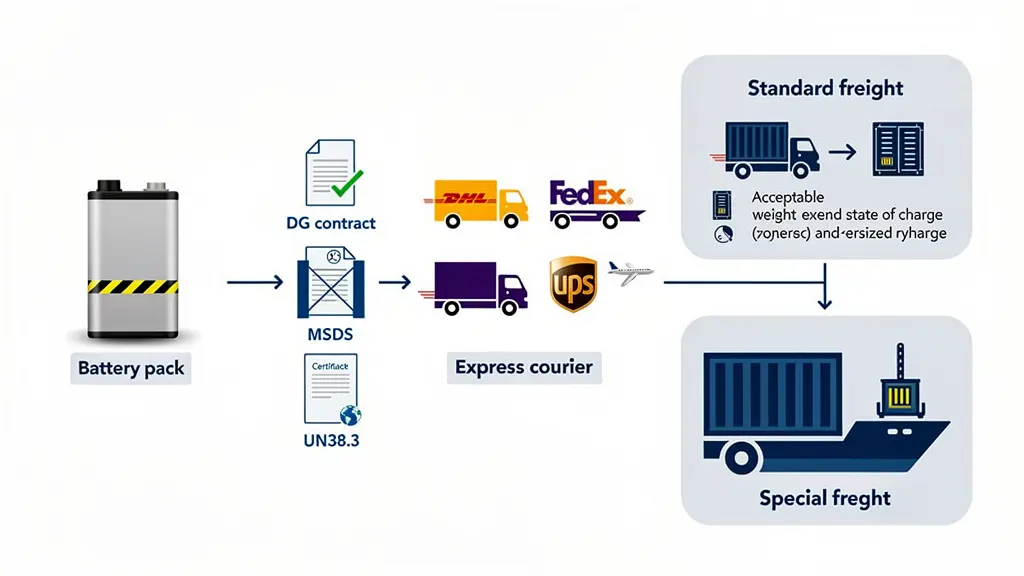
Can I ship a lithium battery pack by DHL/FedEx/UPS?
The short answer is yes. You can ship a lithium-ion battery pack via major couriers like DHL, FedEx, or UPS.
However, it is not as simple as dropping a box off at your local post office. Because lithium-ion batteries hold massive amounts of energy, these couriers treat them with extreme caution.
If you want to use express couriers, you must have a pre-approved dangerous goods contract with them. They will require you to provide specific documentation, including Material Safety Data Sheets (MSDS) and proof of UN38.3 testing. Additionally, strict weight and state-of-charge (SOC) limitations apply. For massive battery systems designed for commercial vehicles or marine vessels, you might exceed their standard weight limits, pushing you toward specialized freight services.
What are Class-9 Dangerous Goods?
If you are moving batteries, you need to understand this classification. High-voltage battery pack systems are not standard cargo.
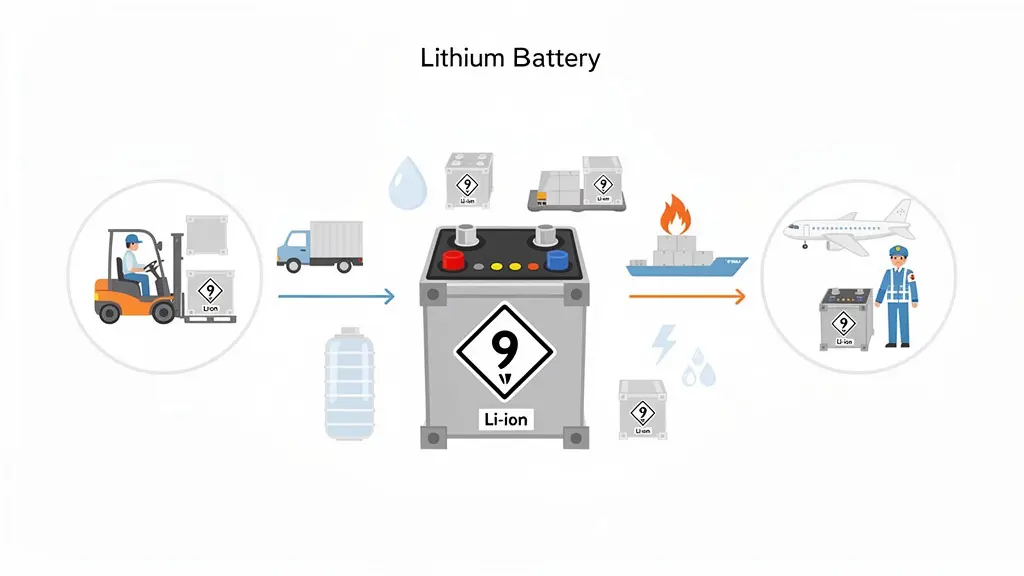
Under international shipping regulations, lithium batteries are classified as Class-9 Dangerous Goods. This classification exists because these batteries pose significant thermal, electrical, and chemical hazards during transit. If a battery cell is damaged, it can trigger localized thermal runaway.
Shipping Class-9 dangerous goods requires specialized handling. Everyone involved in the logistics chain—from the forklift driver at the warehouse to the pilot flying the cargo plane—needs to know exactly what is inside that box and how to handle it in an emergency.
How much is it to ship a lithium battery pack?
Cost is always a primary concern for procurement leads and project managers. Unfortunately, there is no one-size-fits-all price tag.
Because you are dealing with Class-9 goods, you will instantly face dangerous goods surcharges. The total cost depends heavily on the volume, weight, and chosen transport mode. Heavy-duty EV battery systems are highly ruggedized, large-scale energy storage units. Because of their massive physical footprint and heavy metal enclosures, freight costs can skyrocket.
You should also factor in the cost of UN-certified packaging, specialized labeling, and handling fees from your freight forwarder.
What’s the lead-time to ship a lithium battery pack?
Lead times can make or break a vehicle integration schedule.
If you opt for air shipment, the physical transit time might just be 3 to 7 days. However, booking space for Class-9 cargo on an aircraft can take an additional 1 to 2 weeks because airlines strictly limit how many dangerous goods they carry per flight.
If you choose sea shipment, expect a transit time of 15 to 60 days, depending on the routing. On top of the physical transit, you must budget extra days for customs clearance and hazardous materials inspections at the port of entry.
What is the packaging requirement for a lithium battery pack?
You cannot just wrap a high-voltage system in bubble wrap and call it a day.
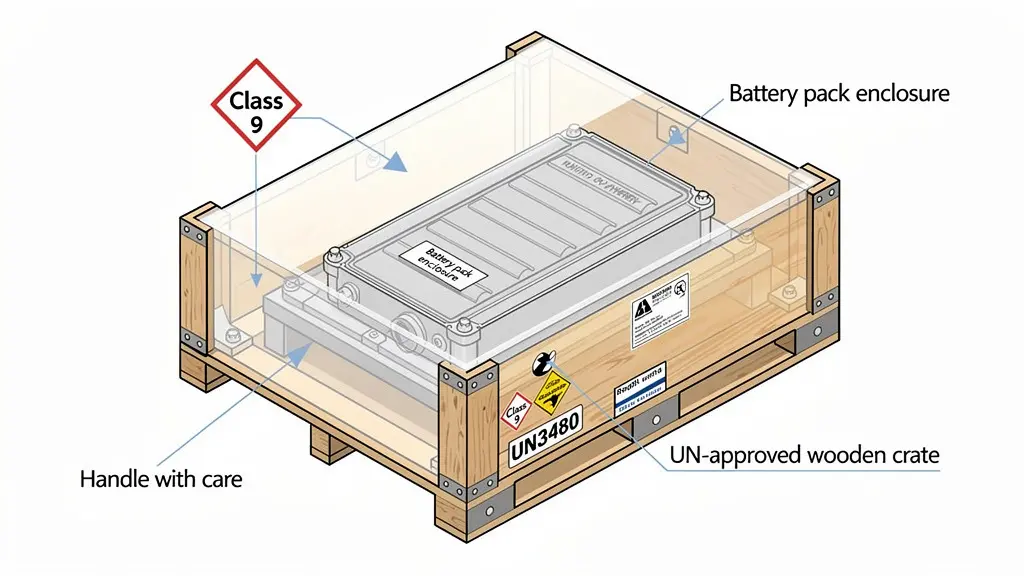
The first layer of defense is the custom battery pack enclosure. This structural housing is highly engineered to protect lithium-ion battery modules from physical impact, environmental ingress, and thermal events . For marine applications, the best enclosure is typically a heavily sealed, CNC-machined aluminum box with absolute IP67+ waterproofing. For mining vehicles and heavy trucks, the enclosure favors thick-walled, reinforced extruded aluminum that can survive continuous high-vibration environments.
Beyond the enclosure itself, the external shipping packaging is heavily regulated. You must use UN-approved packaging. For heavy-duty systems, this usually means a custom-built, fumigated wooden case. The battery pack must be secured inside the wooden case using non-conductive, fire-retardant materials to prevent any shifting during transit. Finally, the outer wooden case must display all mandated Class-9 labels, handling instructions, and UN identification numbers prominently.
Which carriers will ship the lithium battery packs?
Not all carriers are willing to touch high-voltage battery systems.
You will need to work with specialized commercial airlines that have dedicated cargo-only fleets. Passenger airlines generally ban large-format lithium-ion batteries entirely.
For sea freight, major maritime lines like Maersk, MSC, and COSCO will ship lithium battery packs, provided you submit all the correct paperwork in advance. They have specialized protocols for stowing Class-9 containers, usually placing them in easily accessible areas of the ship in case of a fire.
Shall I need to find a forwarder to ship lithium battery packs?
Yes, absolutely. I highly recommend finding an experienced dangerous goods freight forwarder.
Managing the full Class-9 dangerous goods chain—from UN38.3 maritime documentation to final delivery—is a complex, highly specialized task. A single mistake on your commercial invoice or dangerous goods declaration can result in your shipment being held at customs for weeks, racking up massive storage fees.
A specialized forwarder takes this burden off your shoulders. They know the carrier schedules, the specific port regulations, and exactly how to prepare a compliant wooden case.
What’s the best way to ship a lithium battery pack?
The “best” way entirely depends on where you are in your product development cycle.
If you are a CTO or R&D Director waiting on a critical prototype for vehicle validation, air freight is the best way. The cost will be high, but the time saved is invaluable.
If you are a Purchasing Manager coordinating the delivery of 500 battery packs for a heavy-duty EV production run, sea freight is the only financially viable option.
Air shipment vs. Sea shipment
Let’s break down the classic debate.
Air shipment is incredibly fast but exceptionally expensive. It is best suited for low-volume orders, lightweight modules, or urgent prototype testing. However, airlines have very strict payload limits and state-of-charge regulations (usually mandating the battery be kept below 30% SOC).
Sea shipment is much slower but far more cost-effective for bulk logistics. Ships can carry massive, heavy-duty enclosures made of 304 or 316L Stainless Steel, which are incredibly heavy but provide fantastic puncture resistance. If you are shipping marine-grade battery packs or high-volume orders, the ocean is your highway.
Air shipment vs. DDU
When project managers plan logistics, there is often confusion between the mode of transport and the terms of trade.
Air shipment simply dictates the vehicle (an airplane). DDU (Delivered Duty Unpaid) is an Incoterm—a standard contract term used in international trade.
Under DDU terms, the seller is responsible for paying all transportation costs and assuming all risks to bring the lithium-ion battery pack to the buyer’s specified destination. However, the buyer is responsible for paying the import duties and taxes once the shipment arrives.
If you agree to an Air DDU shipment, your supplier will fly the battery pack directly to your local airport or facility, but your accounting team must be ready to clear the import duties immediately upon touchdown.
DDU vs. Sea shipment
Similar to the above, DDU is a contractual term, while Sea shipment is a transport method.
A Sea DDU agreement means your supplier will load your custom battery packs onto an ocean freighter, manage the Class-9 maritime documentation, and deliver the containers to your local port or warehouse.
This could be a great choice for OEMs. You get the cost benefits of sea freight, and the supplier handles the grueling trans-oceanic logistics. You only need to handle your local customs duties.
Is the UN38.3 certification necessary to ship the lithium battery packs?
This is the most critical question in battery logistics. The answer is a non-negotiable yes.
UN38.3 is an internationally recognized safety standard created by the United Nations for the safe transportation of lithium-ion and lithium-metal batteries. Passing ensures your batteries are safe for global transportation.
To get this certification, the battery pack must pass eight rigorous testing procedures (T1 through T8). These tests simulate extreme environmental, mechanical, and electrical conditions. The testing items for UN38.3 certification require the lithium-ion battery pack to pass Altitude Simulation, Thermal Test, Vibration, Shock, External Short Circuit, Impact/Crush, Overcharge, and Forced Discharge.
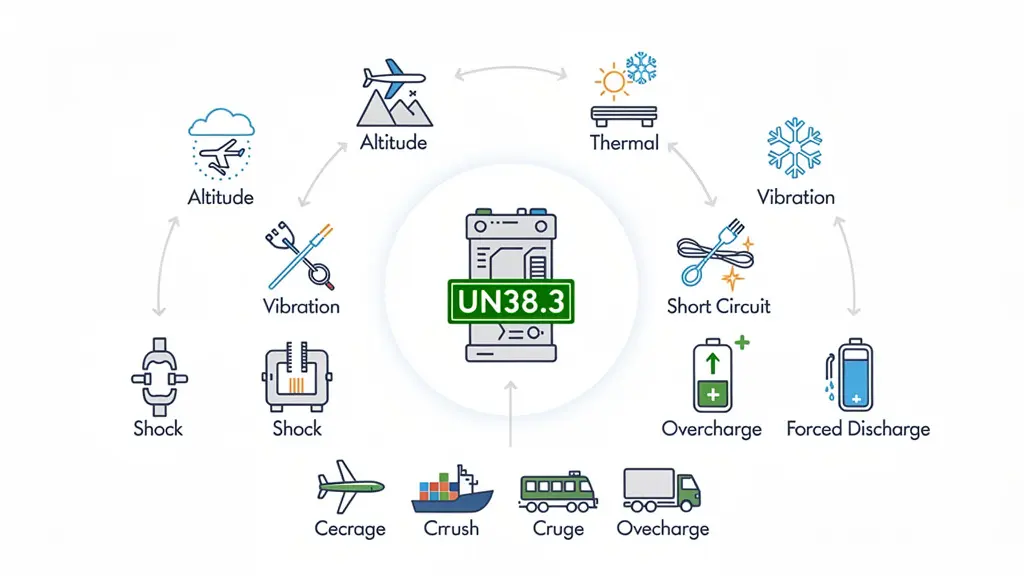
These tests ensure that the battery pack can withstand high altitude, thermal shocks, vibration, and short circuits without posing a fire or explosion risk during air, sea, rail, or road transit. We design systems with certification pathways in mind and can support projects targeting international transport and vehicle-related compliance requirements. By partnering with tier-1 lab alliances like TÜV SÜD, SGS, and CATARC, the certification process can be streamlined for faster approval.
However, in some cases, the UN38.3 certification is not necessary in some regions and countries. You need to double check with us.
Conclusion
Shipping heavy-duty lithium-ion battery packs doesn’t have to be a nightmare if you follow the rules. By understanding Class-9 regulations, securing proper UN38.3 certification, using approved wooden case packaging, and working with specialized freight forwarders, you can keep your EV projects running smoothly and on schedule.
Ready to eliminate the risk of global battery integration?
At Astraion Dynamics, shipping Class-9 dangerous goods is just the beginning. We provide a turnkey process—from bespoke battery enclosure engineering and UN38.3 validation to managing the trans-oceanic logistics. We don’t leave you stranded with a high-voltage “black box”. Our engineers travel directly to your facility to provide on-site commissioning support and ensure seamless integration.
Contact our Engineering Team today for a project consultation. Let’s get your vehicles powered and on the road.