

If you are developing a new platform, choosing between aluminum vs stainless steel battery pack enclosures is one of the most critical engineering decisions you will make. Pick the wrong material, and your project could suffer from thermal issues, severe weight penalties, or certification failures.
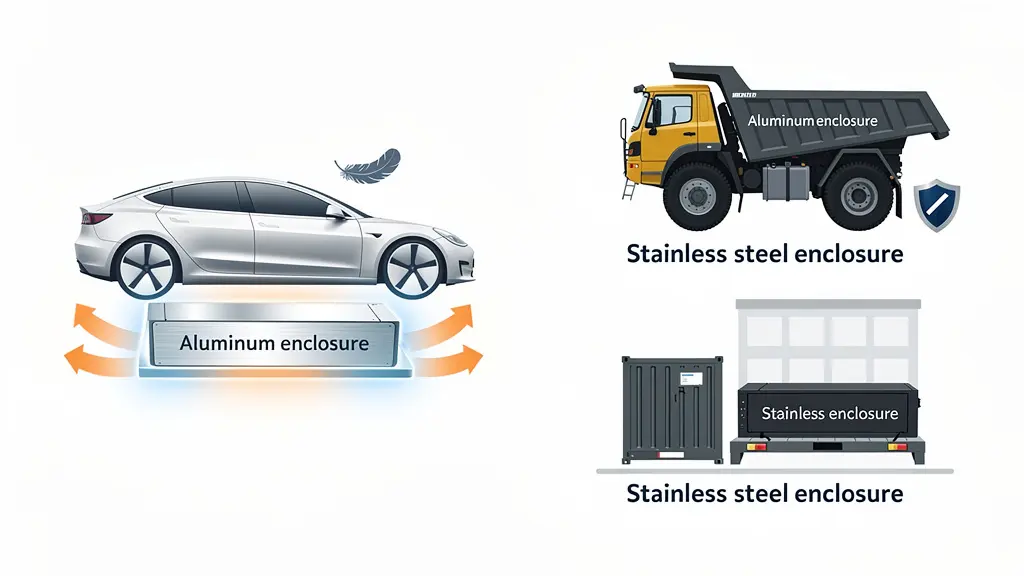
Aluminum battery pack enclosures offer superior thermal conductivity and lightweight properties, making them ideal for passenger EVs. Stainless steel enclosures provide unmatched durability and impact resistance, perfect for heavy-duty mining vehicles and stationary energy storage systems. Your choice depends entirely on your platform’s weight limits and operating environment.
Want to know which material aligns perfectly with your engineering targets? Let’s break down the technical pros, cons, and best use cases for both metals.
What is an aluminum battery pack enclosure?
An aluminum battery pack enclosure is a highly engineered structural housing designed to protect raw lithium-ion battery cells or modules from mechanical impacts, moisture, and debris.
But it’s much more than just a metal box.
In modern electrification, the enclosure acts as the backbone of your thermal management and electrical safety systems. It houses the high-voltage distribution units (PDUs), battery management systems (BMS), and precision liquid cold plates that keep your cells operating within their optimal temperature window.
Because lithium-ion batteries are highly sensitive to external environments, we specifically design rugged IP67+ aluminum enclosures to ensure absolute water and dust resistance. This is critical to preventing high-voltage shorts and ensuring the safety of the entire vehicle.

[Insert image of a 3D CAD design of an aluminum battery pack enclosure with liquid cooling channels]
What is a stainless steel battery pack enclosure?
A stainless steel battery pack enclosure is a robust, ultra-durable protective casing built from steel alloys containing high levels of chromium.
Unlike passenger vehicles where every ounce matters, some off-highway and industrial applications prioritize pure, unadulterated toughness over weight savings. A stainless steel enclosure is designed to take a beating. It protects sensitive battery modules in environments where flying rocks, extreme vibrations, and highly corrosive elements are just another day at the office.
If you are building battery electric mining vehicles or trucks, your battery systems demand highly reliable, explosion-proof, and heavy-duty characteristics. In these extreme edge cases, stainless steel steps up to the plate.

What are the benefits of the aluminum battery pack enclosure?
There is a reason aluminum is the undisputed king of the passenger EV market.
1. Incredible Weight-to-Strength Ratio
Aluminum is roughly one-third the weight of steel. By keeping the enclosure light, you dramatically improve the vehicle’s energy efficiency and overall range.
2. Superior Thermal Conductivity
Thermal management is the heartbeat of battery engineering. Aluminum has excellent thermal conductivity (around 205 W/m·K), which allows it to naturally dissipate heat generated by lithium-ion cells during high C-rate charging and discharging. This makes it significantly easier to integrate precision liquid cooling systems directly into the enclosure floor.
3. Exceptional Manufacturability
Aluminum is highly formable. It can be easily extruded, cast, or machined into complex geometries, allowing engineers to create custom enclosures that perfectly fit tight packaging constraints.
4. Natural Corrosion Resistance
When exposed to air, aluminum instantly forms a microscopic oxide layer that protects it from rusting, ensuring long-term structural integrity without the need for heavy protective coatings.
What are the disadvantages of the aluminum battery pack enclosure?
As great as aluminum is, it’s not perfect.
1. Lower Tensile Strength
Compared to stainless steel, aluminum requires thicker walls to achieve the same level of impact resistance. If an electric tractor hits a massive boulder, a thin aluminum wall might puncture, whereas stainless steel would merely dent.
2. Welding Complexities
Welding aluminum can be a nightmare if your supply chain isn’t dialed in. It requires specialized techniques like Friction Stir Welding (FSW) or advanced MIG/TIG processes to prevent porosity and ensure a critical IP67+ waterproof rating.
3. Higher Material Costs
Raw aluminum is generally more expensive than mild steel, though the price gap with specialized stainless steel is much closer.
Material Selection for the aluminum battery pack enclosure
Not all aluminum is created equal. When our engineering team designs an enclosure, we look closely at specific alloy series.
5000 Series (e.g., 5052): Excellent for sheet metal bending and forming. It offers fantastic corrosion resistance, especially against saltwater, making it a viable candidate for certain marine applications.
6000 Series (e.g., 6061, 6063): This is the workhorse of the EV industry. 6061 provides immense structural strength and is easily machined. 6063 is highly extrudable, making it perfect for creating the intricate side rails and crash structures of the battery pack.
Choosing the right alloy is the first step in bridging the gap between raw cell chemistry and your customized vehicle.

CNC Machining vs. Aluminum Extrusions
When manufacturing aluminum enclosures, you have a few process choices. Let’s compare CNC machining and extrusions.
CNC Machining:
This process involves taking a solid block of aluminum and carving out the enclosure using high-precision, computer-controlled routers.
Pros: It offers unparalleled precision and zero tooling costs. It is perfect for low-to-medium volume production, prototyping, and complex, thick-walled designs.
Cons: High per-part cost and longer cycle times.

Our Take: We lean heavily on our expertise in CNC-machined enclosures to help specialized vehicle manufacturers get to market faster without waiting months for expensive tooling.
Aluminum Extrusions:
Extrusion involves pushing heated aluminum through a die to create long structural shapes (like playdough through a mold).
Pros: Highly scalable and cost-effective for creating long, consistent cross-sections (like the outer crash-rails of a battery pack).
Cons: Limited to 2D continuous profiles. You still need to weld or bolt these pieces together to form a complete box.

Aluminum Extrusions vs. Die-Casting
If you are scaling up to massive volumes, die-casting enters the chat.
Die-Casting:
This involves injecting molten aluminum into a highly engineered steel mold under extreme pressure.
Pros: Incredible for mass production. You can create a complex, single-piece, leak-proof tub in seconds. EV passenger car manufacturers love this for high-volume, low-cost assembly.
Cons: The tooling costs are astronomical (often hundreds of thousands of dollars). If you need to change a dimension by 1mm, you have to buy a new mold.

The Verdict:
If you are an off-highway or marine vessel builder, your production volumes likely don’t justify die-casting. Extrusions combined with CNC machining offer the flexibility to adapt to real platform constraints without crippling upfront costs.
What are the benefits of the stainless steel battery pack enclosure?
If you are operating in the most brutal environments on earth, stainless steel is your best friend.
1. Unmatched Impact and Tensile Strength
Stainless steel can withstand massive mechanical abuse. For applications like electric agricultural machinery or construction equipment, where the battery pack might double as a structural chassis component or be exposed to ground strikes, steel won’t easily yield.
2. Superior Fire Resistance
Stainless steel has a melting point of around 1,400°C to 1,500°C, compared to aluminum’s ~660°C. In the worst-case scenario of a thermal runaway event inside a lithium-ion battery pack, a steel enclosure contains the fire much longer, giving operators critical time to evacuate.
3. Extreme Corrosion Resistance
While aluminum forms a protective oxide layer, high-grade stainless steel actively resists deep chemical corrosion, making it perfect for heavily salted roads or deep subterranean mining operations.
What are the disadvantages of the stainless steel battery pack enclosure?
1. It is Heavy
This is the dealbreaker for most mobility applications. A stainless steel enclosure will drastically reduce an electric vehicle’s payload capacity and range.
2. Poor Thermal Conductivity
Stainless steel is a terrible conductor of heat (around 15 W/m·K). If you rely on the enclosure walls to passively dissipate heat from your battery modules, you are going to run into serious thermal bottlenecking. You must rely entirely on internal active liquid cooling systems.
3. Harder to Machine
Steel wears out CNC tools quickly and is more difficult to form and extrude than aluminum, leading to higher manufacturing friction if complex geometries are required.
Material Selection for the stainless steel battery pack enclosure
If you’ve decided the durability of steel is necessary, you need to pick the right grade. The “stainless” property comes from the addition of chromium, which forms a passive layer that prevents rust.
The two heavyweights in this category are 304 and 316L.
304 Stainless Steel vs 316L Stainless Steel

304 Stainless Steel:
This is the most common grade. It contains 18% chromium and 8% nickel. It is relatively easy to form and weld.
Best for: Energy Storage System (ESS) integrators and operators. ESS projects require large-scale battery packs housed in massive stationary cabinets. Weight isn’t an issue, and 304 steel provides the perfect blend of structural rigidity and standard weather resistance for outdoor utility-scale installations.
316L Stainless Steel:
The “L” stands for Low Carbon, making it easier to weld without compromising corrosion resistance. More importantly, 316L adds Molybdenum to the alloy mix.
Best for: Electric boat and marine vessel manufacturers. The marine sector has stringent requirements because saltwater will aggressively pit and destroy standard 304 steel. The molybdenum in 316L provides exceptional resistance to chloride and saltwater, making it the absolute gold standard for maritime battery enclosures.
What are the applications for the aluminum and stainless steel battery pack enclosures?
To summarize, material selection always comes down to your specific application and operating profile.
When to choose Aluminum:
EV Passenger Cars: Weight is everything. To hit range targets, aluminum is mandatory.
Electric Trucks / Heavy Duty Vehicles: Heavy trucks demand immense power. While they can handle more weight than cars, the massive size of their battery packs means steel would just be too heavy. Ruggedized aluminum with high-voltage integration is the sweet spot.
Performance Electric Boats: If the marine vessel prioritizes speed over pure utility, coated marine-grade aluminum provides the necessary weight savings.

When to choose Stainless Steel:
Stationary Energy Storage Systems (ESS): Weight doesn’t matter when the battery sits on a concrete pad for 20 years. Stainless steel provides unmatched security and weatherproofing for large-scale ESS projects.
Mining and Construction Vehicles: Explosion-proof requirements and massive impact risks make heavy-duty steel enclosures the safest bet for subterranean or rough-terrain environments.

Look, we know that Tier-1 cell manufacturers are built for massive standard volume and often reject deep customization for off-highway or marine fleets. They sell you the raw modules, but they leave you with a massive engineering headache. How do you cool them? How do you package them safely in the right enclosure?
That is exactly where we step in. As an engineering-first integrator, Astraion Dynamics transforms your procured raw modules into a rugged, fully certified, plug-and-play energy system.
Conclusion
Whether your project demands the lightweight thermal efficiency of a CNC-machined aluminum enclosure, or the bomb-proof resilience of 316L stainless steel, the integration phase is where projects succeed or fail. Battery systems must be developed as one coordinated solution, encompassing mechanical, thermal, electrical, and control elements.
Need help turning raw chemistry into a deployment-ready system?
Astraion Dynamics is the ultimate “Bring Your Own Cells/Modules” integration hub. You negotiate directly with top cell manufacturers for zero middleman markup, and our in-house engineering team designs the rugged IP67+ enclosures, liquid cold plates, and intelligent BMS architectures required to get your platform moving.
Stop wrestling with integration risks. Contact our engineering team today to discuss your platform constraints, and let us build a battery system engineered for the real world.
