


You’ve procured top-tier lithium-ion cells for your new heavy-duty electric platform. But during testing, the pack degrades unevenly, and the battery management system (BMS) keeps throttling power. The likely culprit? A poor temperature delta (ΔT). Let’s dive into exactly how mastering ΔT can save your battery system from premature failure and costly warranty claims.
In battery thermal management, Temperature Delta (ΔT) is the maximum temperature difference between the hottest and coldest cells within a battery pack at any given time. Keeping this variance strictly controlled (typically under 3°C to 5°C) ensures uniform cell aging, prevents thermal runaway, and maximizes the overall lifespan, safety, and performance of the energy storage system.
Sounds straightforward, right?
But achieving a tight ΔT across hundreds of densely packed energy modules is a massive engineering headache. Let me show you exactly how to calculate, control, and optimize it for your next specialized mobility or industrial project.
What is meant by delta temperature (ΔT)?
Simply put, delta temperature (ΔT) represents the temperature spread across your battery pack.
Imagine a large lithium-ion battery pack operating in an electric mining truck or marine vessel. The cells clustered near the center of the pack naturally retain more heat because they are surrounded by other heat-generating cells. Meanwhile, the cells on the outer edges dissipate heat more easily into the ambient environment.
This creates a temperature gradient. ΔT is the quantifiable difference between the single hottest point and the single coldest point inside that battery system.
What is delta T temperature used for?
In the engineering world, ΔT is the ultimate scorecard for your battery thermal management system (BTMS).
We use it to evaluate whether a cooling system is actually doing its job. When designing a liquid cold plate or mapping out coolant channels, engineers monitor the ΔT to validate the efficiency of the design.
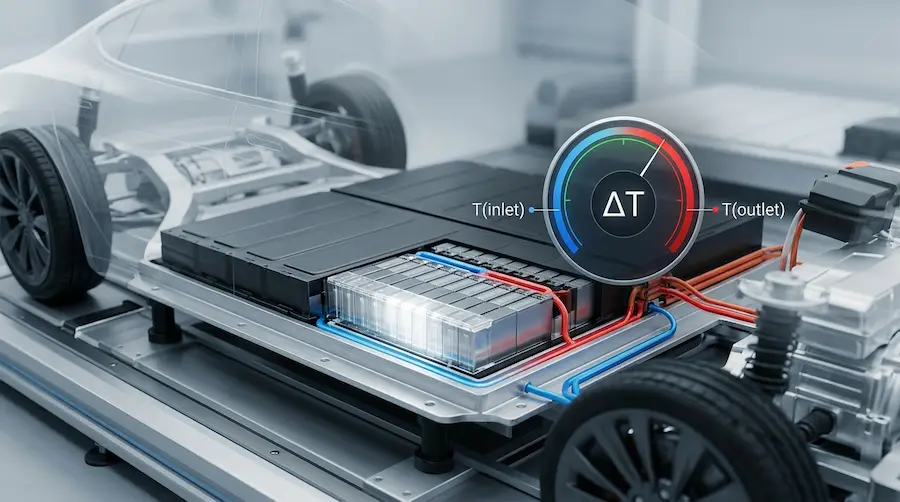
If you are a Vehicle Integration Engineer, looking at the ΔT data from your prototype testing tells you instantly if your packaging constraints, flow rate, and thermal interface materials are harmonized—or if you are heading toward an integration disaster.
What is a good delta T temperature?
For most standard electric passenger vehicles, keeping the ΔT under 5°C is generally acceptable.
However, we are usually dealing with heavy-duty vehicle manufacturers, marine vessel builders, and off-highway OEMs. In these demanding environments, the discharge rates are brutal.
For high-performance or heavy-duty commercial applications, a “good” ΔT is typically ≤ 3°C. Achieving this tight window ensures that every single cell operates in lockstep, delivering predictable power without triggering safety derating from the BMS.
What happens if delta T is too low?
Wait, isn’t a lower ΔT always better?
Thermally speaking, yes. A ΔT of 0°C would be absolute perfection. But practically speaking, engineering is about trade-offs.
If your ΔT is exceptionally low (e.g., < 0.5°C), it often means your system is heavily over-engineered. To achieve such a minuscule gradient, you might be pushing a massive coolant flow rate that drains your parasitic power. Or, you might be using overly thick, heavy thermal materials that kill your gravimetric energy density.
A ΔT that is “too low” usually just means you are wasting energy, weight, and money to cool a pack beyond what the cell chemistry actually requires.
What happens if delta T is too high?
This is where the nightmare begins. If your ΔT climbs above 5°C to 10°C, a few destructive things happen.
First, your battery ages unevenly. Hotter cells degrade much faster than colder cells. Because a battery pack is only as strong as its weakest cell, those prematurely aged hot cells will drag down the total capacity of the entire pack.
Second, internal resistance shifts. Hotter cells have lower internal resistance, meaning they naturally draw more current during high-load operations. This makes them work harder, which generates even more heat. It is a vicious cycle that throws your State of Charge (SOC) estimations completely out of whack.
Worst case scenario? The localized heat exceeds the safe operating limit, triggering a catastrophic thermal runaway.
How to calculate delta temperature?
Calculating ΔT at a basic level is simple arithmetic:
ΔT = T_max – T_min
T_max: The temperature of the hottest cell or module in the pack.
T_min: The temperature of the coldest cell or module in the pack.
However, capturing these numbers accurately in a real-world environment requires a highly intelligent BMS architecture. You cannot just place a single thermistor in the pack and call it a day.
You need a strategically mapped sensor network communicating via high-speed CAN bus to the Vehicle Control Unit (VCU). The BMS must constantly poll these sensors, calculate the real-time ΔT, and adjust the cooling pump output dynamically.
Why is the Temperature Delta (ΔT) important in Battery Thermal Management?
Battery projects often fail at the integration stage—not because components are unavailable, but because mechanical, thermal, electrical, and control systems are not developed as one coordinated solution.

Ignoring ΔT is the fastest way to fail that integration. Here is why it matters so much:
Warranty Mitigation: High ΔT leads to early capacity fade. If you want your heavy-duty pack to survive a 10-year commercial warranty, you must keep temperatures uniform.
Fast Charging Performance: When you pump high current into a battery, it generates massive heat. If your ΔT is poorly managed, the BMS will throttle the charge rate to protect the hot spots, ruining your fast-charging times.
Safety & Compliance: Homologation standards like UN38.3 and ECE R100.3 require strict thermal management validation. You won’t pass global certification if your pack has dangerous thermal gradients.
How to control the Temperature Delta (ΔT) in Battery Thermal Management?
Tier-1 cell manufacturers are built for massive standard volume, often rejecting deep customization for off-highway, marine, or specialized commercial fleets. They sell you the raw modules, but they leave you with a massive engineering headache: How do you cool them? How do you package them safely?
As an engineering-first integrator, Astraion Dynamics transforms procured raw modules into rugged, fully certified energy systems. Here is exactly how we master the engineering to keep ΔT under strict control.
1. Initial 3D Design and Simulations
Before we ever cut metal, we run extensive Computational Fluid Dynamics (CFD) simulations. From initial 3D design and thermal simulation, we model the exact heat generation profiles of your specific operating duty cycle. This allows us to map out the cold plate micro-channels, predicting where the hot spots will occur and redirecting coolant flow to those exact locations before the first prototype is built.
2. Optimizing Coolant Flow Rate
You cannot just blast coolant through a plate and hope for the best. If the flow rate is too high, you create excessive pressure drop, forcing the pump to work too hard. If it’s too low, the fluid absorbs too much heat early in the channel, leaving the cells at the end of the line to cook. We engineer custom flow paths that balance velocity and thermal absorption, ensuring the fluid maintains a consistent temperature removal capacity from the first module to the last.

3. Smart Material Selections & CNC Machining
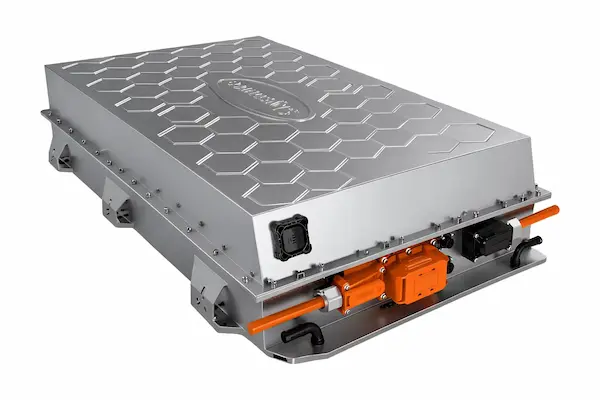
Thermal transfer relies entirely on perfect surface contact. Material selections matter immensely. We design rugged IP67+ aluminum enclosures paired with precision liquid cold plates. By utilizing highly accurate CNC machining, we ensure the flatness of the cooling plates matches the module bases perfectly. This eliminates micro-gaps, allowing the thermal interface materials (TIM) to spread evenly and transfer heat flawlessly.
4. Advanced Friction Welding
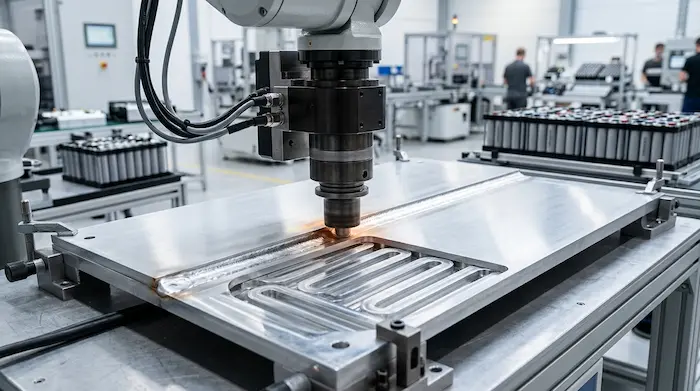
To move liquid coolant safely around high-voltage components, zero leakage is non-negotiable. Traditional welding can leave porous joints or warp the cold plate, ruining the surface contact we just machined. We utilize advanced friction welding (Friction Stir Welding) to join the cold plate assemblies. This solid-state welding process creates forged-quality, leak-proof cooling channels without melting the aluminum, maintaining perfect dimensional stability.
5. Rigorous Testing Protocols
You don’t truly know your ΔT until you torture-test the pack. Manufacturing is executed by our strategic network of over 20 IATF-16949 certified partners, governed by 100% End-of-Line testing protocols. This includes:
The Bottom Line: Your Chemistry, Our Engineering
Mastering Temperature Delta (ΔT) is not a single step; it requires a coordinated workflow combining enclosure engineering, thermal management, HV architecture, and intelligent controls.
Our defining strength is our transparent “Bring Your Own Cells/Modules” partnership model. You negotiate directly with top cell manufacturers to secure raw modules at zero middleman markup, while we master the deep engineering and complex supply chain ecosystem.
If you are an OEM, system builder, or electrification team tired of battling uneven cell degradation and thermal headaches, we are here to help. We stay involved until the system is tested, integrated, and ready to work in the field.
Ready to eliminate thermal integration risks from your next heavy-duty or marine battery project? Let’s talk about your application constraints and build a system that works.
